




Manuals & documents
Documents Diving & ROV Specialists
The handbooks "Diving & ROV Specialists" and Diving Studies CCO Ltd.
are based on scientific and technical documents stored in the various
sections mentioned on this homepage. The topics covered include
diving systems, the implementation of diving procedures, drug abuse
policy implementation, lifting procedures, and more. These studies
exist solely and explicitly to present guidelines that we consider
relevant to commercial diving. The method used to write them is to
analyze all available references for a given topic and select the most
appropriate one. Thus, they can be used as components of company
manuals or as references.
Click the button below to access the folder where they are stored to
read and download them.
Videos and animations
The videos and animations in this section are published by companies
that produce or install equipment, national bodies, and professional
organizations. They can be used to illustrate courses, studies, and
reports. They are grouped into three sub-sections that can be opened
through the button below:
1 - Lifting systems and winches,
2 - Renewable energies systems.
3 - Marine and ROV systems, and diving equipment.














Click on the
octopus to return to
the top of the page
Diving & ROV procedures and standards
This section, which can be accessed by clicking on the button below,
contains current diving standards and guidelines adopted by national
authorities or published by professional organizations. It also includes
procedures published by highly qualified independent authors that can
be used as references. In addition, links are provided to organizations
that publish paid-for documents often used or imposed on
contractors, although we believe that any standard or norm imposed
on contractors should be free.
The documents listed chronologically in this
section are also categorized in the index file
under the following subheadings:
•
Guidelines
•
Regulations and laws
•
Decompression tables
This PDF file can be downloaded by clicking
on the cover image aside.

Historical diving
This section groups diving standards and guidelines that national
bodies adopted or professional organizations published but are no
longer in force because new versions have replaced them. They have
been separated from the documents currently in use to avoid
confusion and can be accessed by clicking the button below.
Maintaining obsolete documents in a database is essential because
they can serve as references for analyzing the evolution of standards
or guidelines. Additionally, they constitute our collective memory and
should not be ignored.
The documents listed chronologically in this
section are also categorized in the index file
under the following subheadings:
•
Guidelines
•
Rules and acts
•
Reports
•
Decompression tables
This PDF file can be downloaded by clicking
on the cover image aside.
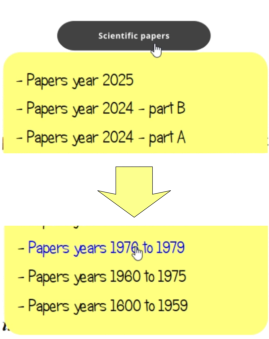
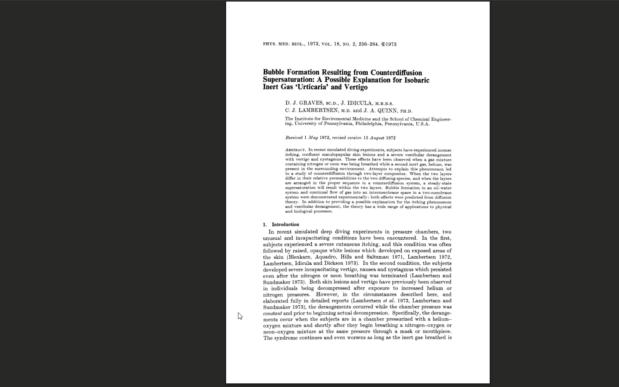
Scientific papers
This section provides scientific documents published from the
beginning of the diving industry to the present day. The studies are
classified by year of publication, enabling a researcher to follow the
evolution of research on a topic from the earliest to the latest study.
Scientific documents are essential, as they form the basis on which
diving manuals should be written and referred to. This is the approach
we use when writing documents. You can access the scientific paper
database by clicking the button provided below.
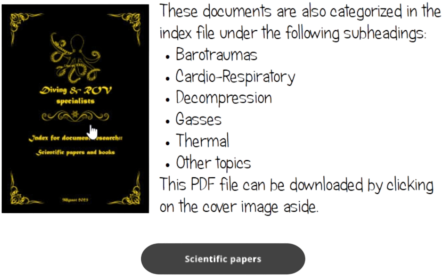
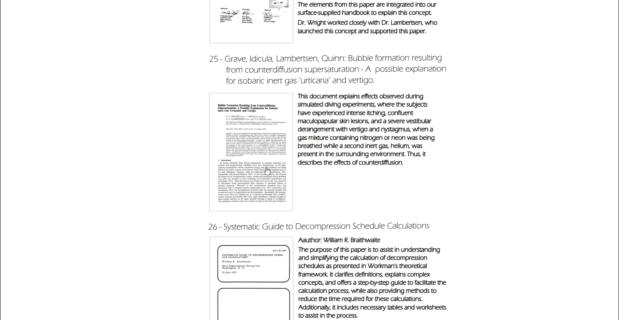
These documents are also categorized in the
index file under the following subheadings:
•
Barotraumas
•
Cardio-Respiratory
•
Decompression
•
Gasses
•
Thermal
•
Other topics
This PDF file can be downloaded by clicking
on the cover image aside.
First aid
This section provides articles and books related to first aid procedures
during underwater operations and in any work facility. These
documents include manuals from official bodies and reports and
studies from doctors and emergency teams. Some are directly linked
to products presented in the "Medical Equipment" subsection of
"Logistics" (see the navigation bar).
You can consult and download these documents by clicking the button
below.
These documents are also categorized in the
index file under the following subheadings:
•
General guidelines and rules (standard
procedures)
•
General studies (universally applicable
documents)
•
Diving guidelines and studies (documents
specific to diving operations)
This PDF file can be downloaded by clicking
on the cover image aside.
Studies of ROV and AUV concepts
This section gives access to engineering studies regarding new ROV
(Remotely Operated Vehicles) and AUV (Autonomous Underwater
Vehicles) concepts.
These documents come from scientists, universities, and ROV
manufacturers. Therefore, they can be considered scientific studies.
Some proposed solutions have been adopted by the industry, and
others will be adopted later or forgotten. Whatever has happened and
will happen, it is interesting to read them. These articles, which can be
accessed by clicking the button below, are classified according to the
years of publication.
These documents are also categorized in the
index file under the following subheadings:
•
Propulsion
•
Manipulation and grabbing systems
•
Sensing and visualization
•
Navigation and localization
•
Communication and controlling
•
New general design studies
This PDF file can be downloaded by clicking
on the cover image aside.
United Nations conventions & national laws
This section, accessible by clicking the button below, links to
publications from specialized agencies of the United Nations, such as
the International Maritime Organization (IMO) or the International
Labour Organization (ILO), as well as maritime and labour laws
published by countries.
Awareness of and understanding of publications from the United
Nations and states is essential for people organizing underwater
operations. Please note that we provide tools to access some United
Nations databases easily.
Click on the button below to open this section.
These documents are also categorized in the
index file under the following subheadings:
•
International Maritime Organization (IMO)
conventions and guidelines.
•
International Labour Organization (ILO)
conventions and guidelines.
•
National and supranational organizations'
laws and guidelines
This PDF file can be downloaded by clicking
on the cover image aside.
Technical documents - Vessels
This section provides publications that discuss vessel design,
maintenance, and management rules. These include guidelines from
the US Navy, classification societies, states, and professional
organizations, as well as documents from vessel designers and
various engineering studies. You can view and download them by
clicking the button below.
These documents are also categorized in the
index file under the following subheadings:
•
Guidelines.
•
Rules and acts
•
Studies
This PDF file can be downloaded by clicking
on the cover image aside.
Technical documents - Diving systems
This section links to publications that discuss rules for conceiving,
constructing, and maintaining diving systems. Documents published by
the US Navy, manufacturers, and classification societies are
chronologically stored in our database, which can be opened by
clicking the button below.
These documents are also categorized in the
index file under the following subheadings:
•
Guidelines.
•
Rules and acts
•
Studies
This PDF file can be downloaded by clicking
on the cover image aside.
Underwater construction
This section provides descriptions of offshore, harbour, port, and river
facilities, such as platforms, floating structures, seabed oil and gas
structures, wind turbines, tide turbines, and many others, in addition to
methods for installing and maintaining them. These documents are
sourced from manufacturers, engineering offices, national and
international bodies, etc. They are classified by year of publication.
The database can be accessed by clicking the button below.
These documents are also categorized in the
index file under the following subheadings:
•
Procedures and studies for the oil and gas
industry.
•
Procedures and studies for the renewable
energy industry
•
Procedures and studies for the tunneling
industry
•
Procedures and studies for all subsea
work
This PDF file can be downloaded by clicking on the cover image.
Non Destructive Testing (NDT)
This section links to publications discussing non-destructive testing
(NDT) techniques applicable underwater and at the surface, as we
must remember that such procedures are also used during
mobilizations. Documents from various organizations, including the UK
HSE and the International Atomic Energy Agency (IAEA), are provided
to help readers understand the methods employed based on their
technical level. They are classified by year of publication, and the
database in which they are stored can be accessed by clicking the
button below.
These documents are also categorized in the
index file under the following subheadings:
•
Presentations of principles used by NDT
techniques
•
Guidelines for NDT operations at the
surface
•
Guidelines for NDT operations performed
underwater
•
Various studies
Click on the cover image to open this PDF file.
Underwater mapping
This section provides publications that discuss methods and tools
for designing 2D and 3D maps and positioning job sites, vessels,
underwater vehicles, and divers on these maps.
Note that the progress of the industry results in autonomous
underwater vehicles (AUVs) often being used to establish maps and
locate targets. Therefore, some documents in this section could be
considered AUV procedures.
Click on the button below to access these papers.
These documents are also categorized in the
index file under the following subheadings:
•
Overview presentations of various
systems.
•
Acoustic imaging.
•
Image treatment.
•
Positioning & localization.
•
Autonomous systems.
This PDF file can be downloaded by clicking
on the cover image aside.
Environmental studies
Environmental studies is a complex and interdisciplinary academic
field that delves into the intricate interactions between humans and
their environment. This field integrates principles from diverse areas
such as physical sciences, philosophy, sociology, law, and economics,
among others. This section focuses on studies that analyze the impact
of industrial and underwater activities on rivers, lakes, and the marine
ecosystem.
These documents are also categorized in the
index file under the following subheadings:
•
Descriptions of specific elements of fauna
and flora.
•
Underwater noise pollution.
•
Other types of pollution.
•
Positioning & localization.
•
Various studies related or unrelated to the
above.
Click on the cover image to open this PDF file.

Editors' Databases directory
Although our database is extensive and regularly updated, it may not
fulfill the needs of all research. In such cases, we recommend
exploring the editors' databases available through the link below:

Courtesy of Fabrice Pipault
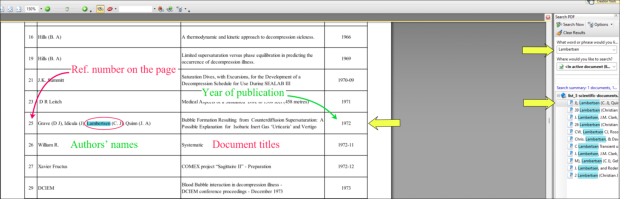
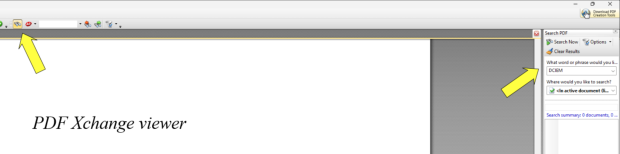
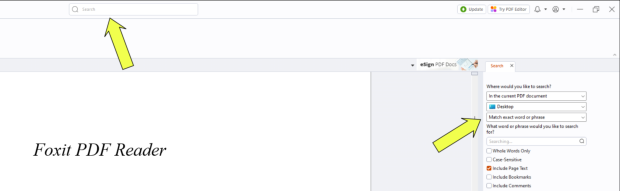
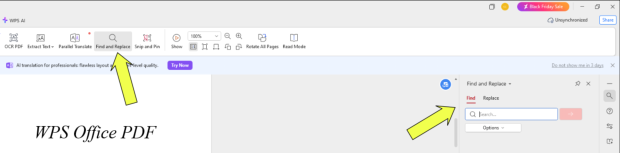
As mentioned, the PDF “Indexes for document research” can also
be used. Click the button below to see how to proceed using the
embedded search features of modern PDF software.
This database compiles freely accessible documents on underwater
activities, saving readers, authors, and researchers the effort of
searching multiple sources. While these papers are available for use,
they remain protected by copyright. You may read and reproduce
them, in whole or in part, for manuals, studies, or reports, as long as
you appropriately credit the copyright holders.
For easy navigation, documents are organized chronologically by main
topic. To refine your search further, use the search engine below or
browse the PDF directories, which categorize papers by subtopic. Also,
note that the recently added documents are highlighted in the relevant
sections on the homepage.
“Freefind” is a search engine used by various organizations, including
administrations, universities, and many commercial companies.
It offers an “Advanced Search” option, accessible via the button at
the top of the search box, that enables users to refine their searches
by selecting or deselecting specific words, entering complete
phrases, and adjusting other parameters, such as the number of
results and the search engine sensitivity.
For guidance on refining searches, users can click the “Search Tips”
button, which is also located at the top of the search box.