










Studies of ROV concepts 2025 - Part C










Click on the
octopus to return to
the top of the page


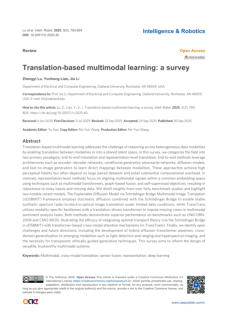
02 - Translation-based multimodal learning: a survey
Authors: Zhengyi Lu, Yunhong Liao, & Jia Li
The article provides a comprehensive survey of translation-
based multimodal learning, focusing on two main
paradigms: end-to-end translation and representation-
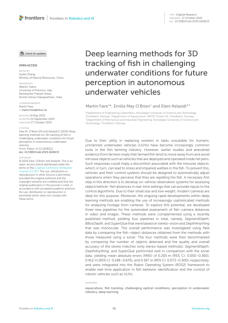
level translation. End-to-end methods facilitate direct
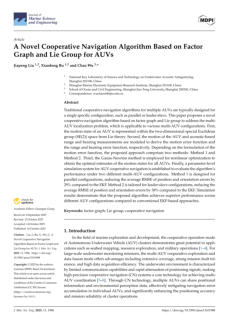
mappings between modalities using various advanced
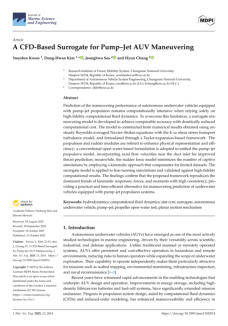
architectures, while representation-level methods align
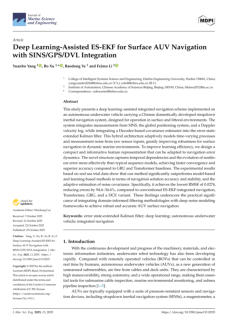
multimodal signals within a common embedding space,
enhancing robustness against data noise. Highlighting
insights from over forty benchmark studies, the article
discusses two notable models—the xDSBMIT and
TransTrans—demonstrating their effectiveness in
multimodal translation tasks. Lastly, it identifies ongoing
challenges and future directions for developing versatile
and ethically sound multimodal systems.

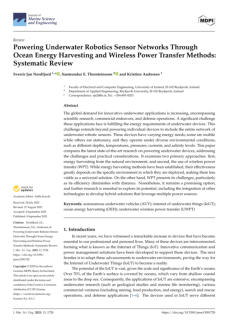
03 - Powering Underwater Robotics Sensor Networks Through
Ocean Energy Harvesting and Wireless Power Transfer Methods:
Systematic Review
Authors: Sverrir Jan Nordfjord, Saemundur E.
Thorsteinsson, and Kristinn Andersen
The article discusses the rising global demand for
innovative underwater applications, highlighting the
energy challenges faced by underwater devices used in
scientific research, commercial ventures, and defense
operations. It focuses on two primary methods for
powering these devices: energy harvesting from natural
environmental sources and wireless power transfer (WPT).
While energy harvesting is dependent on specific
environmental conditions, WPT faces efficiency issues over
distance. The paper concludes that further research is
necessary to develop hybrid solutions that can effectively
utilize multiple power sources.

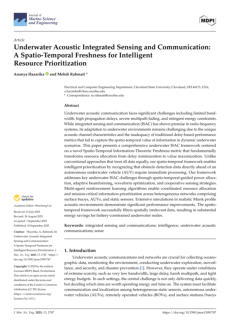
04 - Underwater Acoustic Integrated Sensing and Communication:
A Spatio-Temporal Freshness for Intelligent Resource Prioritization
Authors: Ananya Hazarika, & Mehdi Rahmati
This article introduces an integrated sensing and
communication (ISAC) framework specifically designed for
underwater environments, which uses a new Spatio-
Temporal Information-Theoretic Freshness metric. This
approach shifts the focus from merely minimizing delays
to maximizing the value of transmitted information. The
framework includes intelligent strategies for power
allocation, beamforming, and cooperative sensing,
supported by multi-agent reinforcement learning for
enhanced resource use. The proposed methods
demonstrate significant performance improvements in
energy efficiency and data relevance in realistic
underwater scenarios.
05 - Influence of Marine Environmental Factors on Characteristics of
Composite Magnetic Field of Underwater Vehicles
Authors: Honglei Wang, Xinyu Dong, and Yixin Yang
This research study explores the spatiotemporal
characteristics, attenuation laws, and influencing
mechanisms of these fields. The study integrates three
distinct types of magnetic fields: the magnetic anomaly
field created by the ferromagnetic vehicle, the wake
magnetic field from its motion, and the ocean wave
magnetic field influenced by wind-driven waves. Findings
reveal that vehicle motion parameters affect the magnetic
anomaly and wake fields, while wind conditions
significantly impact the ocean wave magnetic field.
Overall, this work improves the understanding of how
marine environmental factors and vehicle dynamics
contribute to the magnetic fields during underwater
navigation.
06 - Inductive Wireless Power Transfer for Autonomous Underwater
Vehicles: A Comprehensive Review of Technological Advances
and Challenges
Authors: Han Xu, Rong Zheng, & Bo Yang, and Wei Ning
The article discusses the advancements in underwater
inductive wireless power transfer (UIWPT) as a solution to
enhance the endurance and efficiency of autonomous
underwater vehicles (AUVs) by providing efficient energy
replenishment. It systematically reviews the architecture of
UIWPT systems, evaluates power loss mechanisms and
optimization strategies, and summarizes recent research
developments in relevant technologies. The discussion
extends to environmental factors affecting UIWPT
integration with AUV platforms and concludes with future
trends and challenges in deploying reliable underwater
power systems.
07 - Visual Signal Recognition with ResNet50V2 for Autonomous
ROV Navigation in Underwater Environments
Authors: Cristian H. Sánchez-Saquín, Alejandro Gómez-
Hernández, Tomás Salgado-Jiménez, Juan M.
Barrera Fernández, Leonardo Barriga-Rodríguez,
and Alfonso Gómez-Espinosa
This article details the development and assessment of
AquaSignalNet, a deep learning system designed for
recognizing underwater visual commands, thus facilitating
autonomous navigation for Remotely Operated Vehicles
(ROVs). Utilizing a ResNet50 V2 architecture and a custom
dataset, UVSRD, the system was trained on 33,800 labeled
images representing various gesture classes. Deployed on
a Raspberry Pi 4, AquaSignalNet demonstrated high
success rates in navigating predefined paths, showing
promise as a markerless solution for underwater tasks.

08 - An Underwater Salvage Robot for Retrieving Foreign Objects in
Nuclear Reactor Pools
Authors: Ming Zhong, Zihan Gao, Zhengxiong Mao, Ruifei
Lyu, and Yaxin Liu
The article presents the development of an underwater
salvage robot designed to locate and retrieve foreign
objects in nuclear reactor pools. The robot features an
ROV platform combined with a three-degree-of-freedom
Delta robotic arm and utilizes advanced technologies for
localization and object detection. Experimental results
demonstrate the robot’s high effectiveness, achieving
notable identification and retrieval rates of foreign objects.

09 - Deep learning methods for 3D tracking of fish in challenging
underwater conditions for future perception in autonomous
underwater vehicles
Authors: Martin Føre, Emilia May O’Brien, and Eleni
Kelasidi
Unmanned underwater vehicles (UUVs) are increasingly
employed in fish farming to perform tasks unsuitable for
human workers. However, there is concern that these
vehicles could stress farmed fish by causing them to flee
from intrusive objects. To address this issue, researchers
have developed automated systems that can assess the
distance between fish and the UUVs in real-time using
modern camera technology and deep learning methods.
This involves four innovative pipelines that facilitate the
measurement of distances, which were validated against
sonar data. The best-performing methods were integrated
into the Robot Operating System (ROS2) to improve fish
welfare and enhance control over UUVs.
10 - A Novel Cooperative Navigation Algorithm Based on Factor
Graph and Lie Group for AUVs
Authors: Jiapeng Liu, Xiaodong Bu, & Chao Wu
The article introduces a new cooperative navigation
algorithm for multiple Autonomous Underwater Vehicles
(AUVs) that is versatile and applicable to various
configurations. Unlike traditional algorithms designed for
specific forms (like parallel or leader-slave), this method
utilizes factor graphs and Lie group theory to enhance
AUV localization capabilities. By representing AUV motion
states in the two-dimensional special Euclidean group and
employing nonlinear optimization techniques, the new
algorithm demonstrates substantial improvements in
localization accuracy across different operational setups,
significantly outperforming conventional Extended
Kalman Filter (EKF) methods.
11 - A CFD-Based Surrogate for Pump–Jet AUV Maneuvering
Authors: Younhee Kwon, Dong-Hwan Kim, Jeonghwa
Seo, and Hyun Chung
This article presents a surrogate maneuvering model
developed to predict the performance of autonomous
underwater vehicles (AUVs) equipped with pump-jet
propulsion. Traditional methods relying on high-fidelity
computational fluid dynamics (CFD) are computationally
expensive. The surrogate model provides comparable
accuracy while significantly reducing costs, utilizing results
from unsteady Reynolds-averaged Navier-Stokes equations
and employing a Taylor-expansion-based framework. It
improves the representation of propulsion and rudder
forces and has been validated against high-fidelity
simulations, demonstrating its ability to accurately forecast
kinematic responses, forces, and moments.
12 - Deep Learning-Assisted ES-EKF for Surface AUV Navigation
with SINS/GPS/DVL Integration
Authors: Yuanbo Yang, Bo Xu, Baodong Ye, & Feimo Li
The article introduces a new cooperative navigation
algorithm for multiple Autonomous Underwater Vehicles
(AUVs) that is versatile and applicable to various
configurations. Unlike traditional algorithms designed for
specific forms (like parallel or leader-slave), this method
utilizes factor graphs and Lie group theory to enhance
AUV localization capabilities. By representing AUV motion
states in the two-dimensional special Euclidean group and
employing nonlinear optimization techniques, the new
algorithm demonstrates substantial improvements in
localization accuracy across different operational setups,
significantly outperforming conventional Extended
Kalman Filter (EKF) methods.
13 - Multi-AUV Cooperative Search for Moving Targets Based on
Multi-Agent Reinforcement Learning
Authors: Le Li, Ruiqi An, Zhaozhi Guo, & Jian Gao
The paper presents a novel convolutional multi-agent
deep deterministic policy gradient method, termed PER-
CMADDPG, designed for multi-autonomous underwater
vehicle (AUV) cooperative search of moving targets. It
establishes a mathematical model comprising
environment, AUV, and information update systems. The
PER-CMADDPG method innovates on the MADDPG
framework by integrating convolutional neural networks
(CNNs) for improved spatial awareness and employing a
prioritized experience replay (PER) to enhance learning
efficiency. Simulation results illustrate that this method
accelerates convergence and achieves greater rewards,
while also analyzing the effects of various operational
parameters
14 - Robust Underwater Docking Visual Guidance and Positioning
Method Based on a Cage-Type Dual-Layer Guiding Light Array
Authors: Ziyue Wang, Xingqun Zhou, Yi Yang, Zhiqiang
Hu, Qingbo Wei, Chuanzhi Fan, Quan Zheng,
Zhichao Wang, and Zhiyu Liao
This paper introduces a cage-type dual-layer guiding light
array that enhances visual localization as the Autonomous
Underwater Vehicle (AUV) approaches the docking
station. It outlines a dynamic localization algorithm
designed to differentiate beacon appearance at various
docking stages, applying advanced techniques like particle
swarm optimization and a robust filtering strategy. The
proposed method demonstrates high success rates in
beacon matching, even under extreme conditions,
facilitating reliable and continuous docking guidance for
AUVs.
15 - Marine-Inspired Multimodal Sensor Fusion and Neuromorphic
Processing for Autonomous Navigation in Unstructured
Subaquatic Environments
Authors: Chandan Sheikder, Weimin Zhang, Xiaopeng
Chen, Fangxing Li, Yichang Liu, Zhengqing Zuo,
Xiaohai He, and Xinyan Tan
This article proposes a novel neuromorphic framework
inspired by marine species’ navigation strategies,
emphasizing the co-design of advanced sensors and
event-based neuromorphic processors. This framework
aims to improve navigational robustness and energy
efficiency by mimicking the multisensory fusion and
processing capabilities found in marine life, suggesting
significant advancements for applications like deep-sea
exploration and underwater infrastructure inspection.
22 - Physics-Informed Dynamics Modeling: Accurate Long-Term
Prediction of Underwater Vehicles with Hamiltonian Neural
ODEs
Authors: Xiang Jin, Zeyu Lyu, Jiayi Liu, and Yu Lu
This document introduces a physics-informed framework
that models the dynamics of an Autonomous Underwater
Vehicle (AUV) through the discovery of its energy
landscape, integrating Port-Hamiltonian mechanics into a
neural ordinary differential equation (NODE) structure.
This approach allows for rigorous identification of the
AUV’s Hamiltonian and associated physical matrices from
observational data, achieving superior accuracy and
consistency compared to traditional black-box deep
learning models, especially during complex maneuvers.
23 - Distributed Adaptive Fault-Tolerant Formation Control for
Heterogeneous USV-AUV Swarms Based on Dynamic Event
Triggering
Authors: Haitao Wang, Hanyi Wang, & Xuan Guo
This article discusses a novel approach to cooperative
formation control for heterogeneous unmanned systems,
specifically Unmanned Surface Vehicles (USVs) and
Autonomous Underwater Vehicles (AUVs), addressing
challenges such as actuator faults, varying communication
topologies, and communication delays. A unified dynamic
model utilizing the Euler–Lagrange framework is
developed, along with a Distributed Adaptive Fault-
Tolerant Control (DAFTC) that incorporates a Dynamic
Event-Triggered Mechanism (DETM) to optimize
communication efficiency while maintaining robustness
through online fault compensation.

01 - Deformable USV and Lightweight ROV Collaboration for
Underwater Object Detection in Complex Harbor Environments:
From Acoustic Survey to Optical Verification
Authors: Yonghang Li, Mingming Wen, Peng Wan, Zelin
Mu, Dongqiang Wu, Jiale Chen, Haoyi Zhou, Shi
Zhang, and Huiqiang Yao
This paper presents a USV-ROV collaborative system for
efficient underwater inspection and object disposal in
complex harbor environments. The deformable USV,
equipped with side-scan sonar (SSS) and multibeam echo
sounder (MBES), enables rapid large-area surveying and
high-resolution 3D seabed mapping; it accurately
localized and preliminarily identified simulated objects
with ≤2.2 m positioning deviation. The lightweight ROV,
fitted with an optical camera, forward-looking sonar, and
a manipulator, performed close-range verification and
disposal, confirming object identity and location with ≤3.2
m deviation from SSS estimates.
26 - Research and Development of a Autonomous Underwater
Vehicle
Authors: Mustafa Cenik, Mehmet Talha Yilmaz, Umut Can
Senuzar, Ömer Eroglu, and Orçin Uygun
This study outlines the design of a fully autonomous
unmanned underwater vehicle (UUV) aimed at
enhancing automation in aquaculture, aquatic scientific
research, and national defense. The prototype uses a
Raspberry Pi 5 for AI-driven image processing (via
Raspberry Pi Camera V2) and real-time sensor data
handling—including motor control, orientation, depth,
and temperature. Autonomous navigation and decision-
making are implemented through embedded Python and
AI algorithms. Three-axis movement is enabled by a
Pixhawk PX4 flight controller and six motors.
27 - Digital twin-driven swarm of autonomous underwater vehicles
for marine exploration
Authors: Jing Yan, Tianyi Zhang, Xinping Guan, Xian Yang
& Cailian Chen
This article proposes a digital twin (DT)-driven swarm
control framework for autonomous underwater vehicles
(AUVs) to address two key challenges in marine
exploration: high communication energy consumption
and limited environmental perception. It constructs DT
models for each AUV by fusing dynamics and
environmental data; employs a parameter estimator to
predict underwater flow fields; designs an energy-efficient
swarm networking protocol; introduces an integral
reinforcement learning (IRL)-based controller for
coordinated virtual and physical AUV operation; and
applies a virtual-real error optimization algorithm to
enhance model fidelity.
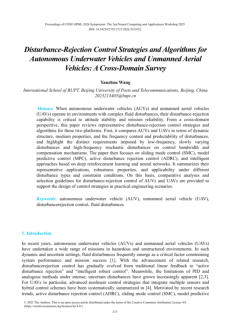
28 - Disturbance-Rejection Control Strategies and Algorithms for
Autonomous Underwater Vehicles and Unmanned Aerial
Vehicles: A Cross-Domain Survey
Author: Yanzhou Wang
This paper reviews disturbance-rejection control strategies
for autonomous underwater vehicles (AUVs) and
unmanned aerial vehicles (UAVs) operating in fluid-
disturbed environments. It contrasts the two platforms'
dynamic structures, medium properties, and disturbance
types—highlighting differing requirements for low-
frequency and high-frequency disturbances. The study
examines key control methods, including sliding mode
control (SMC), model predictive control (MPC), active
disturbance rejection control (ADRC), and intelligent
approaches like deep reinforcement learning and neural
networks, assessing their robustness and applicability.
Comparative analyses and guidelines are provided to aid
practical control strategy design.
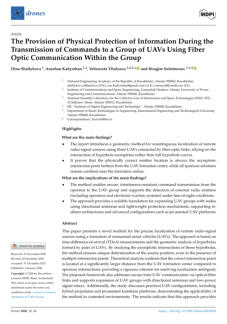
29 - The Provision of Physical Protection of information During the
Transmission of Commands to a Group of UAVs Using Fiber
Optic Communication Within the Group
Author: Dina Shaltykova, Aruzhan Kadyrzhan, Yelizaveta
Vitulyova, and Ibragim Suleimenov
This paper presents a novel method for the precise
localization of remote radio-signal sources using a
formation of unmanned aerial vehicles (UAVs).
By studying the asymptotic intersections of these
hyperbolas, the method ensures unique determination of
the source position, even in the presence of multiple
intersection points.
Theoretical analysis confirms that the correct intersection
point is located at a significantly larger distance from the
UAV formation center compared to spurious intersections,
providing a rigorous criterion for resolving localization
ambiguity.
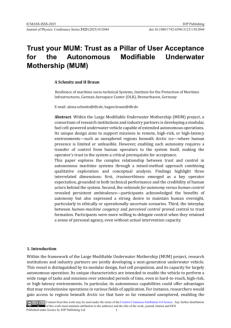
16 - Trust your MUM: Trust as a Pillar of User Acceptance for the
Autonomous Modifiable Underwater Mothership (MUM)
Authors: A Schmitz and H Braun
The MUM project develops a modular, fuel cell-powered
autonomous underwater vehicle for extended missions in
remote, high-risk areas like under Arctic ice, where
operator trust is essential for accepting control transfer.
Using mixed qualitative and conceptual methods, the
paper identifies three trust-control dimensions:
trustworthiness based on technical performance and
human credibility; ambivalence toward autonomy,
acknowledging benefits yet preferring human oversight in
uncertain scenarios; and human-machine coagency,
where perceived personal agency enables delegation
even without intervention capability.
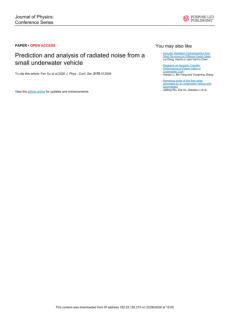
17 - Prediction and analysis of radiated noise from a small
underwater vehicle
Authors: Fan Xu, Yun Zhao, Yu Yao, Xiangyu You, Hefeng
Zhou
Small underwater vehicles, valued for their stealth,
compact size, and maneuverability in missions like
reconnaissance, face a critical challenge: vibrations from
internal components (e.g., motors, propulsion) transmit
through the structure, radiating noise into water. This
compromises acoustic stealth and heightens passive sonar
detection risk. Using a frogman carrier as a case study, this
research employs a coupled acoustic-structure interaction
finite element model to simulate its vibroacoustic behavior.
By analyzing structural vibrations and sound fields, the
study identifies noise frequency spectra, directivity
patterns, and dominant sources.
18 - Numerical simulation of hydrodynamic performance of AUV
approaching an Underwater Charging Platform
Authors: Baowen Zhang, Yazhou Zhu, Yongquan Wang,
Xiang Hu
This study uses Computational Fluid Dynamics (CFD) to
analyze hydrodynamic effects on Autonomous
Underwater Vehicles (AUVs) during their approach and
docking with underwater charging platforms. Numerical
simulations characterize the flow field near the platform
and assess hydrodynamic responses influenced by factors
such as AUV speed, distance to the platform, and angle of
attack. The findings provide theoretical guidance for
ensuring the stability, safety, and attitude control of AUV
motion during docking, offering valuable insights for the
reliable design of related systems.
19 - Analysis of crack formation mechanism in the wedge ring area
of underwater high-speed vessels' shell
Authors: Tao Kong, Wenfeng He, Lei Wang, Jian Ma
Wedge ring connections are widely used in high-speed
underwater vehicles but suffer from stress issues under
extreme conditions like high-altitude transportation and
vibration fatigue, leading to potential cracking and safety
hazards. This paper employs non-linear finite element
simulation to analyze the relationship between assembly
and operational conditions of wedge rings and localized
shell cracking. The findings align with real-world crack
conditions. The study proposes improved design methods
and assembly requirements for wedge ring connections,
significantly reducing stress concentration and preventing
crack generation and propagation under extreme
conditions.
20 - WaveCodNet: A Frequency-Aware Framework for Underwater
Camouflaged Object Detection
Authors: Jiajun Lin, Yuanbo Chen, Yi Le, Shangjing Sun,
Hongyang Bai, Shuai Guo, Tianyu Deng
Detecting camouflaged objects in Unmanned Surface
Vehicles (USVs) is challenging. WaveCODNet, a novel
camouflaged object detection framework, addresses this
by combining frequency-domain analysis with multi-scale
feature learning. The system uses an enhanced Pyramid
Vision Transformer backbone and introduces three key
components: a Frequency-enhanced Dense Interaction
Decoder that mimics human visual perception by fusing
high and low-frequency information, a Spatial-Frequency
Attention Block (SFAB) that models spatial and frequency
dependencies, and a Frequency-Aware Multi-Scale Fusion
module that integrates multi-level features across different
object scales.

21 - A Differential Time-of-Arrival Localization Method for Underwater
Moving Platforms Based on Time Reference Synchronization and
Motion Compensation
Authors: Xiaoyue Shao, Chuanqi Zhu, Liang An
Accurate underwater localization is hindered by clock
offsets and platform motion, degrading traditional TOA
methods. High-cost atomic clocks mitigate
synchronization errors but fail to address motion-induced
propagation delays. This paper introduces a lightweight
differential TOA (dTOA) framework using time-reference
synchronization and motion compensation. Fixed
beacons sequentially broadcast signals, creating a unified
time reference without external clocks. A motion-
compensation model corrects displacement-induced
timing bias for moving receivers, while a novel dTOA
estimator cancels residual clock biases.
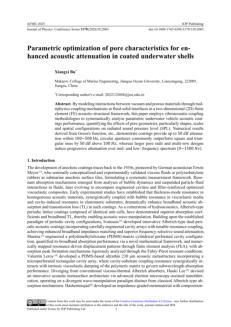
24 - Parametric optimization of pore characteristics for enhanced
acoustic attenuation in coated underwater shells
Author: Xiangxi Bu
This study analyzes underwater vehicle acoustic coatings
using a 2D vibroacoustic finite element framework with
multiphysics coupling at fluid-solid interfaces. It quantifies
how pore geometries (shape, scale, and spatial
configuration) affect radiated sound pressure levels (SPL).
Results show coatings achieve up to 50 dB attenuation
between 100–500 Hz, with circular pores outperforming
square and triangular pores by 50 dB above 100 Hz.
Larger pore radii and multi-row designs further enhance
attenuation across 0–1500 Hz.
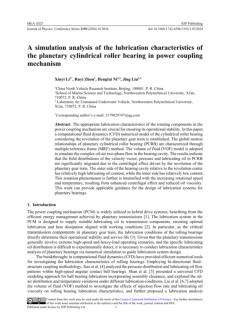
25 - A simulation analysis of the lubrication characteristics of the
planetary cylindrical roller bearing in power coupling mechanism
Authors: Xinyi Li, Ruyi Zhou, Hengtai Ni, Jing Liu
This study establishes a CFD model of a cylindrical roller
bearing under planetary gear train conditions, using MRF
and VOF methods to analyze oil-air two-phase flow.
Results show that centrifugal forces from gear revolution
significantly redistribute velocity, pressure, and lubricating
oil, with higher oil concentration on the outer side of the
cavity and lower on the inner side. This effect intensifies
with higher rotational speeds and temperatures due to
increased centrifugal force and reduced oil viscosity,
offering insights for optimizing lubrication system design
in planetary bearings.