










Underwater mapping 1980 - 2019







Authors:
John O. Klepsvik, Hans Olav Torsen
This paper, published in 1989, reviews the underwater
mapping techniques available during this period and their
expected evolution.


Author: Mark Rognstad
Date of publication: 1992
The HIG Acoustic Wide Angle Imaging Instrument,
Mapping Researcher 1 (HAWAII MR1) was an ocean
floor mapping sonar designed and built at the Hawaii
Institute of Geophysics of the University of Hawaii. Towed
behind a ship at a depth of 100 meters, it could measure
acoustic backscatter reflectivity and bathymetry over a
swath up to 25 km wide in all ocean depths.


Authors:
M Vacchi, A Rovere, V Parravicini, M Firpo, M. Burlando, N.
Zouros
Date of publication: 2008
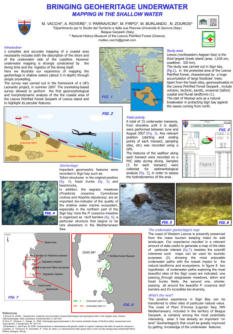
A complete and accurate mapping of a coastal area
necessarily includes the description of the shore and the
underwater side of the coastline. However, underwater
mapping is strongly constrained by diving time and
logistics. This presentation illustrates an experience of
mapping the geoheritage in shallow waters of the Lesvos
Petrified Forest Geopark of Lesvos island using snorkeling.


Authors:
JSilvia Silva da Costa Botelho, Paulo Drews Jr, & Gabriel
Leivas.
Date of publication: 2009
This paper proposes an approach to visual odometry and
mapping with underwater vehicles. Autonomous
Underwater Vehicles (AUVs) can carry visual inspection
cameras. Besides serving the activities of inspection and
mapping, the captured images can also be used to aid
navigation and localization of the robots. Visual odometry
is the process of determining the position and orientation
of a robot by analyzing the associated camera images.


Authors:
Armagan Elibol, Nuno Gracias, Rafael Garcia, Art Gleason,
Brooke Gintert, Diego Lirman and R. Pam Reid.
Date of publication: 2012
This paper proposes a generic framework for image
mosaicing to obtain the topology and estimate the best
possible trajectory. Innovative aspects include using a fast
image similarity criterion combined with a minimum
spanning tree (MST) solution to obtain a tentative
topology. This topology is improved by attempting image
matching over the more substantial overlap evidence
pairs.


Authors:
B. Douillard, N. Nourani-Vatani, M. Johnson-Roberson, S.
Williams, C. Roman, O. Pizarro, I. Vaughn, G. Inglis.
Date of publication: 2012
This paper presents a method for segmenting three-
dimensional scans of unstructured underwater terrains.


Authors:
Gerd Niedzwiedz, Dirk Schories
Date of publication: 2013
The quality of scientific sampling, monitoring, or
underwater mapping depends more and more on the
exact allocation of place and time to the object of interest.
That might be the sample itself or the visual
documentation of the object of interest by high-resolution
images, video sequences, or underwater mapping. Ideally,
these data are accompanied by other geo-referenced
physical and chemical datasets. In this document, written
in 2012 - 2013, the authors focus on cable towed
solutions and also discuss other promising alternatives that
might be on the market.


Authors:
Alistair Dobke, Joshua Vasquez, Lauren Lieu, Ben
Chasnov, Christopher Clark, Ian Dunn, Zoe, & J. Wood.
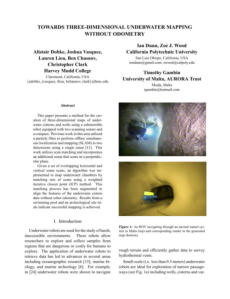
This paper presents a method for creating three-
dimensional maps of underwater cisterns and wells using
a submersible robot equipped with two scanning sonars
and a compass. Previous work in this area utilized a
particle filter to perform offline simultaneous localization
and mapping (SLAM) in two dimensions using a single
sonar. This work utilizes scan matching and incorporates
an additional sonar that scans in a perpendicular plane.


Authors:
A. Ch. Kapoutsis, G. Salavasidis, S. A. Chatzichristos, J.
Braga, J. Pinto, J. B. Sousa, Elias B. Kosmatopoulos.
Date of publication: 2015
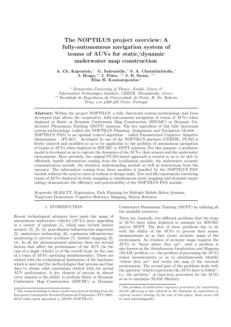
The project NOPTILUS, was a system/methodology
developed to allow the fully-autonomous navigation of
teams of AUVs deployed in Static or Dynamic Underwater
Map Construction (SDUMC) or Dynamic Underwater
Phenomena Tracking (DUPT) missions.


Authors:
Alista
Date of publication: 2016
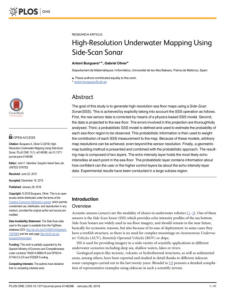
The goal of this study is to generate high-resolution
seafloor maps using a Side-Scan Sonar(SSS).


Authors:
Athanasios Ch. Kapoutsis, Savvas A. Chatzichristofs, Lefteris
Doitsidis, João Borges de Sousa, Jose Pinto, Jose
Braga, Elias B. Kosmatopoulos.
Date of publication: 2016
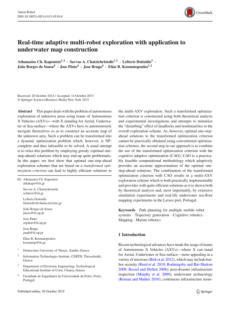
This paper discusses the problem of autonomous
exploration of unknown areas using Autonomous
Vehicles that have to navigate to construct an accurate
map of the unknown area.


Author: Mingxi Zhou
Date of publication: 2017
A technology of AUV-based underwater iceberg-profiling
is evaluated in this paper.
An iceberg-profiling simulator is constructed to analyze
underwater iceberg-profiling missions. The operation
accuracy is compared with conventional methods of
deploying sonar profilers around icebergs. Beyond the
simulation, a guidance, navigation, and control (GNC)
system is designed to guide the vehicle traveling around
the iceberg at a standoff distance.

Authors: Ricard Campos, Rafael Garcia
Date of publication: 2017
Owing to the many possible errors that may occur during
real-world mapping, point set maps often present a
considerable amount of outliers and significant levels of
noise. This paper gives two robust surface reconstruction
techniques dealing with corrupted point sets without
resorting to any prefiltering step. They are based on
building an unsigned distance function, discretely
evaluated on an adaptive tetrahedral grid, and defined
from an outlier-robust splat representation.


Authors:
Tomasz Łuczynski,, Tobias Fromm, Shashank Govindaraj,
Christian A. Mueller, and Andreas Birk.
Date of publication: 2017
ROV operations are expensive, and there is an urge to
improve their efficiency and speed. The EU project
”Effective Dexterous ROV Operations in the presence of
Communications Latencies (DexROV)” proposes a solution
to those needs by developing a set of hardware and
software tools to support the teleoperation of ROVs over a
satellite link, i.e., from remote locations, including offshore
sites.


Authors: Hendra Kurnia Febriawan
Date of publication: 2018
While piers can be mapped using various methods,
capturing the seabed directly beneath them remains a
challenge. Traditional single-beam and standard
multibeam echosounders cannot produce the necessary
detail for this task. However, newly developed high-
resolution multibeam echosounders generate the dense,
detailed imagery required for successful underwater pier
mapping.


Authors: Emily J. Chua, William Savidge, Timothy Short,
Andres M. Cardenas-Valencia, and Robinson
W. Fulweiler.
Underwater mass spectrometry (UMS) has drastically
improved our capability to monitor a broad suite of
gaseous compounds in the aquatic environment.
This study provides an overview of the progress made
from the nineties to the present day, particularly on the
approaches undertaken by various research groups in
developing mass spectrometers. It also provides examples
of how underwater mass spectrometers have been used
and the future trends.


Click on the
octopus to return to
the top of the page

Authors:
Thomas Scholz, Martin Laurenzis, and Frank Christnacher
This document overviews advancements and applications
in underwater laser-based imaging systems and data-
processing techniques. It provides information about
integrating these systems into platforms like remote-
operated vehicles (ROVs) and autonomous underwater
vehicles (AUVs) and highlights the importance of
environmental conditions on imaging performance. It also
seeks to present advanced 3D laser oblique scanning
techniques and contrast enhancements for gated viewing
based on experimental findings.

Authors: Maurice A.Tivey, Woods Hole, Albert Bradley,
Dana Yoerger, Rodney Catanach, Alan
Duester, Steve Liberatore, and Hanu Singh
This text provides a presentation of the various types of
underwater vehicles in service during the 90s that, like
many documents published during this period, should be
considered a historical reference.

03 - Autonomous Underwater Vehicle Maps Seafloor

04 - Mapping coastal optical and biogeochemical variability using
an autonomous underwater vehicle and a new bio-optical
inversion Algorithm
Authors: Catherine A. Brown, Yannick Huot, Michael J.
Purcell, John J. Cullen, and Marlon R. Lewis
Autonomous underwater vehicles (AUVs) can map water
conditions at high spatial and temporal resolution,
including under cloudy conditions. However, harnessing
their full potential for oceanographic research requires
innovative sampling and data processing techniques,
especially in shallow littoral environments. This study
describes a passive radiometer, which uses one optical
sensor at depth to characterize variability in underwater
clarity and coastal seawater constituents.

17 - Generation of High-resolution Three-dimensional
Reconstructions of the Seafloor in Color using a Single Camera
and Structured Light
Authors: Adrian Bodenmann, Tamaki Ura, and Blair
Thornton
This paper presents a three-dimensional mapping
method based on light sectioning for capturing structure
and color from seafloor images. The method offers high
resolution bathymetry and is simple to setup and
process. The system has been deployed on 11 cruises to
survey manganese-rich crust deposits on the Pacific's
Takuyo #5 seamount. The data collected from one cruise
is presented in the paper.
Authors: Sandra Sendra, Jaime Lloret, Jose Miguel
Jimenez, and Joel J.P.C. Rodrigues
This paper presents a study on the behavior of
electromagnetic waves (EM) in freshwater underwater
environments. It discusses the minimum requirements for
video delivery, measures the maximum distance between
nodes, and analyzes the relationship between parameters
like data transfer rate, signal modulations, working
frequency, and water temperature. The results show that
certain combinations of working frequency, modulation,
transfer rate, and temperature offer better results,
demonstrating that short communication distances with
high data transfer rates are feasible.

18 - Underwater Communications for Video Surveillance Systems at
2.4 GHz

27 - Acoustic-telemetry payload control of an autonomous
underwater vehicle for mapping tagged fish
Author: Tom Dodson, Thomas M. Grothues, John H.
Eiler, Joseph A. Dobarro, Rahul Shome
Autonomous underwater vehicles (AUVs) have improved
their performance in tracking marine animals, but they
struggle to accurately map the distribution of multiple
tagged fish. A new payload control software, Synthetic
Aperture Override (SAOVR), allows AUVs to navigate with
favorable trajectories for solving tag locations. SAOVR
checks constraints and executes permitted maneuvers,
ensuring high predictability in AUV behavior. This system
is beneficial for fish telemetry in challenging environments
like fjords or reefs. Further modeling can improve
template design for different fish species.

30 - Selected-Mapping Peak-to-Average Power Reduction Method
with Orthogonal Pilot Sequences in Underwater Acoustic
OFDM System Without Side Information
Authors: Qiao Gang, Xing Siyu, and Zhou Feng
This document proposes a novel Selected-mapping (SLM)
Peak-to-average power ratio (PAPR) reduction scheme for
Underwater Acoustic (UWA) OFDM systems. This scheme
uses orthogonal comb pilot sequences to represent
distinct phase sequences, reducing PAPR by almost 0.5dB
and improving Bit error ratio (BER) performance. Field
experimental results show the scheme can differentiate
phase sequences.
24 - Underwater Photogrammetry and 3D Reconstruction of
Submerged Objects in Shallow Environments by ROV and
Underwater GPS
- Published by the Journal of marine science research & technology - Springer
Authors: Jonathan Teague, and Thomas B. Scott
This article discusses the emergence of underwater 3D
reconstruction techniques, particularly underwater
photogrammetry, as a cost-effective alternative to
traditional methods like Lidar and Sonar. Utilizing
affordable off-the-shelf digital cameras and software, this
technique proves advantageous in shallow water
settings. The article further explores the use of low-cost
remotely operated vehicles (ROVs) for conducting
underwater surveys, highlighting their speed and stability
over diver-based methods.

28 - Georeferenced underwater photogammetry to map marine
habitats and submeged artificial structures
- Published by the Photogrammetric Record / Wiley Online
Authors: Arnaud Abadie, Pierre Boissery, Christophe Viala
This article discusses recent advancements in underwater
photogrammetry, focusing on two innovative methods
that enhance geographic referencing through
underwater photography. The first method integrates
scuba diving with data from a multibeam echo sounder,
while the second employs a surface floating device for
direct positioning. The study concludes that the floating
platform method offers greater mapping efficiency despite
limitations related to depth and visibility. These
advancements are poised to significantly benefit marine
conservation efforts, particularly in monitoring seagrass
meadows and artificial underwater structures.

Authors: Emmanuel Moisan, Pierre Charbonnier, Philippe
Foucher, Pierre Grussenmeyer, Samuel Guillemin,
and Mathieu Koehl
This paper presents a method for constructing a full 3D
model of a canal tunnel by integrating terrestrial laser
scans (above-water) and sonar scans (underwater).
Challenges include artifacts from narrow environments
and unknown sonar positioning. The approach involves
denoising and meshing sonar data, followed by co-
registering above and underwater point clouds. A robust
algorithm leveraging geometrical entities and partially
immersed targets aligns the models despite limited
overlap, yielding a visually accurate 3D model of the canal
tunnel entrance.


Authors: Miquel Massot-Campos, and Gabriel Oliver-
Codina
This paper presents a survey on optical sensors and
methods for 3D reconstruction in underwater
environments. The techniques to obtain range data have
been listed and explained, together with the different
sensor hardware that makes them possible. The literature
has been reviewed, and a classifcation has been proposed
for the existing solutions. New developments, commercial
solutions and previous reviews in this topic have also been
gathered and considered.


Authors: Ricard Campos, Rafael Garcia
This paper compares airborne lidar and underwater glider
estimates of optical backscattering from ocean particles,
both offering denser sampling than ship surveys. A
moderate correlation (R = 0.28) was found, with
discrepancies attributed to sampling mismatches, particle
composition variability, and lidar errors. Two scattering
regimes were identified: below 0.001 m-¹, lidar values were
typically higher than glider values, while above this
threshold, lidar values were generally lower. Despite
differences, the findings indicate that airborne lidar and
gliders provide comparable and complementary data on
optical particulate backscattering.


29 - Path Following, Obstacle Detection and Obstacle Avoidance for
Thrusted Underwater Snake Robots
- Published by Frontiers
Authors: Eleni Kelasidi, Signe Moe, Kristin. Y. Pettersen,
Anna M. Kohl, Pål Liljebäck, and Jan Tommy
Gravdahl
Unmanned underwater vehicles, particularly bio-inspired
underwater snake robots (USRs), are increasingly used for
mapping, monitoring, inspection, and intervention in
fields like oceanography and oil/gas. USRs excel due to
their flexible, slender bodies, offering better
maneuverability and energy-efficient long-distance transit
than conventional ROVs and AUVs. They also perform
light intervention tasks and use biologically inspired
motion for improved propulsion efficiency. This paper
presents a USR control system for path following and
obstacle avoidance, using a single camera and computer
vision for detection.

Authors: Russell B. Wynn et al. (13 authors)
Autonomous Underwater Vehicles (AUVs) are
transforming marine geoscience by enabling autonomous
exploration of extreme environments, such as deep
hydrothermal vents and polar ice sheets, and providing
higher-resolution seafloor mapping than surface vessels,
particularly in deep water. Key applications include
studying submarine volcanism, hydrothermal vents, low-
temperature fluid escapes, chemosynthetic ecosystems,
and benthic habitats, as well as mapping seafloor features
like ice-formed bedforms. Recent datasets demonstrate
AUVs' versatility in multi-frequency acoustic imaging, high-
resolution photomosaics at abyssal depths, and velocity
measurements of submarine density flows.

Author: Ismat Elhassan
Underwater depth measurement supports marine
commerce, underwater construction, coastal
management, and industries like fishing and mining. Early
methods like sounding lines and acoustic techniques were
ship-based and inefficient, leaving vast water areas
unmeasured. Modern remote sensing techniques,
including airborne LIDAR and satellite sensors, now
enable efficient depth determination, particularly for large
water bodies. This paper reviews and compares traditional
and modern bathymetric techniques based on accuracy,
limitations, cost, and efficiency, while also highlighting
recent applications.