










Underwater archeology - Papers from 2024 to now






Authors: Simon Brown, & Jon C. Henderson
This paper explains the survey and monitoring of the SS
Thistlegorm wreck in the Red Sea using digital
photogrammetry.
This proves that digital photogrammetry provides an
affordable and straightforward method that meets
professional standards,enabling non-experts to gather data
using a basic camera setup and standard software.



Click on the
octopus to return to
the top of the page

Authors:
Joseph Nnaemeka Chukwuma, Moses Onyemaechi Ede,
Ifeoma Salome Chukwuma, Eddy M. Izueke, Joy Nneka
Uchenye Ejikeme, Chinyere Isaac Madukwe, Christopher N.
Ibenwa, Nnadi Fabian Uzochukwu, Michael Chigozie
Anyaehie, Obiageli Kay Nkechi Omali, Christian Ikechukwu
Nnadi, Nnamdi Ugochukwu Ijeudo, David C. Ononogbu,
Omaka Kalu Ngele, Robert Nyakuwa, Andrew Nnabuchi
Ogbochie
This study investigated the impact of psychoeducational
coaching, specifically rational-emotive behavior therapy
(REBT), on improving workplace ethical perceptions and
reducing deviant behaviors among lecturers in archeology,
religion, and cultural studies. The document outlines the
study's methodology, results, and conclusions.


Authors:
Sven Bergmann, Matthias Brenner, Jennifer Susanne
Strehse, Tobias Hartwig Bünning, Edmund Maser, Philipp
Grassel, David Heuskin, David Brandt, Marco Berger, Simon
van der Wulp, Mathew Skellhorn, Polly Hill, Sven Van Haelst,
Maarten De Rijcke, Uwe Wichert
This document informs about research efforts within the EU
Interreg project North Sea Wrecks (NSW) and its
collaboration with the German Aerospace Centre and the
Institute for the Protection of Maritime Infrastructures (DLR)
to understand the environmental risks posed by shipwrecks
and dumped munitions in the North Sea and globally. The
document details the methodologies used, including
historical document analysis, visual inspections, and sample
analysis, to assess the status of wrecks,

Authors:
JJan Majcher, Rory Quinn, Gert Normann Andersen, and
David Gregory
This paper provides an academic examination of the effects
of bottom trawling on shipwreck sites to conceptualize
them as process-response systems that reach a quasi-
equilibrium state over time and to analyze how bottom-
contact fishing gear disrupts this state. It discusses the
capabilities and limitations of modern geophysical methods
in detecting changes at underwater archaeological sites
caused by bottom trawling, highlights the challenges of
identifying disturbances on dynamic seabeds, and suggests
that detailed analysis of wreck distribution might serve as
indirect proxies for structural damage.


Authors: Min Tao, Liza Chang
This document is provided as information for people who
have not diving formation and are interrested by such
activities. It highlights the importance of understanding the
multidimensional aspects of scuba diving specialization, the
duties of instructors, and the limitations faced by
recreational scuba divers in China. It also seeks to identify
the qualities of an excellent instructor and the necessary
enhancements needed for their professional growth.


Authors: Neal W. Pollock
This text intends to inform and caution readers about the
complexities and risks associated with using closed-circuit
rebreathers in diving compared to open-circuit systems. It
highlights the advantages of rebreathers, such as
expanding the diving range, while emphasizing the
increased complexity and potential hazards involved. The
text also highlights the importance of proper training,
monitoring, and ongoing commitment to safety practices
for users of rebreathers.

Authors: Kinga Korniejenko, and Bartosz Kontny
This paper analyzes the use of virtual and augmented reality
(VR and AR) technologies in the field of underwater
archaeology. It reviews current applications, discusses the
development and creation process of VR and AR
applications for this purpose, highlights areas of application
and barriers, and provides a discussion based on case
studies. It concludes with a summary and exploration of
future possibilities for these technologies in underwater
archaeology.


Authors: Ashley Lemke
This document aims to inform about the field of
anthropological archaeology underwater. It explains what
this type of research involves, how it differs from traditional
archaeology, and the unique insights it provides into
ancient human behavior through advanced technologies
and the preservation capabilities of underwater
environments. It also intends to introduce the reader to the
scope of this field, including the exploration of submerged
sites and the methodologies used to study them.


Authors: Alain Foret
This document explains the initial Haldane model and its
limitations in managing decompression during repetitive
dives. It discusses historical and modern approaches to
addressing these limitations, including the evolution from
the original Haldane tables to the Repetitive Group (RG)
method and the challenges faced with the advent of dive
computers.


Authors: Charlotte Papillaud Looram, and Jade Lindley
Underwater cultural heritage on the high seas is difficult to
police by any single state, making shipwrecks vulnerable to
theft and illegal sales. The United Nations High Seas Treaty
aims to protect these valuable sites. Shipwreck ownership
can also be disputed in a state's exclusive economic zone,
complicating protection efforts. The article uses the
Geldermalsen shipwreck example to explore how
international law and technology can help prevent these
crimes.


Authors:
Yu Wang, Yeqing Han, Naisheng Li, Cen Wang, aixuan Ma,
Xinduo Huang, Jing Du, Hong Guo, and Jiao Pan
The Nanhai No. 1 shipwreck, an ancient ship from the
Southern Song Dynasty, faces issues from microbial diseases
on its hull wood. This study collected microbial samples to
analyze these diseases and found Fusarium solani NK-NH1
as the main fungus, capable of degrading cellulose and
lignin. The research offers insights for preserving the
shipwreck.


Authors: Philip A. Hartmeyer, Jeremy Weirich, Hans Van
Tilburg, Adrienne Copeland, Mashkoor Malik, Frank
Cantelas, Sam Cuellar, Kelley Suhre, Kasey Cantwell
This article discusses the National Oceanic and Atmospheric
Administration's (NOAA) plans for ocean exploration in the
Pacific Basin from 2024 to 2026. The focus of these
operations is on community-driven exploration, emphasizing
the involvement of local communities and stakeholders in
the exploration process.


Authors: Alessio Calantropio, and Filiberto Chiabrando
Underwater cultural heritage (UCH) is a valuable resource
that requires preservation, documentation, and
safeguarding. Advanced technologies like underwater
photogrammetry are crucial for UCH documentation,
providing high-resolution 3D models and 2D orthomosaics.
However, challenges like water optical properties, light
penetration, visibility, radiometric issues, and environmental
drawbacks make it difficult. This paper discusses recent
applications of photogrammetric techniques for UCH
documentation.


Authors: Bengin Bilici Genc, Erkan Bostanci, Bekir Eskici,
Hakan Erten, Berna Caglar Eryurt, Koray Acici,
Didem Ketenoglu, and Tunc Asuroglu
This study aims to develop a non-destructive, cost-
minimizing, and easy-to-use analysis method for cultural
assets. The method uses four primary colors (red, yellow,
green, Egyptian blue, and ultramarine blue) and is trained
on various models. The trained VGG19 model can classify
paintings in archaeological and artistic works with their real
identities, with a 99% success rate, similar to the McNemar
test. This approach is designed to address the challenges
faced by cultural heritage workers in understanding these
assets without sampling.


Authors: Salvatore Medaglia, Fabio Bruno, Ana Castelli,
Matteo Collina, Barbara Davidde Petriaggi, Luca De
Rosa, Julieta Frere, Fabrizio Fuoco, Guillermo
Gutiérrez, Antonio Lagudi, Francesco Megna, and
Raffaele Peluso
SS Bengala, a steamer that sank in 1889 near Capo Rizzuto,
Italy, played a significant role in the development of Italy's
merchant navy. Despite its brief service life, no iconographic
material has been found to depict the ship. Researchers
have created a virtual reconstruction using archival sources
and underwater surveys. The 3D modelling of the ship's
external hull, based on geometric data from the wreck site,
offers a first step towards virtual reconstruction. The model
can be used in augmented reality applications and museum
exhibits.

Authors: C. Ferrero-Martín, A. Izquierdo, M. Bethencourt,
and T. Fernández-Montblanc
This study presents a new methodology to assess climate
change's impacts on underwater cultural heritage (UCH)
preservation in shallow waters. It focuses on wave-induced
hazards like decontextualization, scouring, and wear
erosion, and was applied in the Bay of Cadiz, revealing local
increases in wave energy flux in rocky outcrops and coastal
areas with high UCH density. The authors conclude that this
method is essential for identifying high-risk areas and
evaluating UCH preservation under future climate
conditions.


Authors: Eleni Diamanti, Vasili Mentogiannis, Oyvind
Odegard, Georges Koutsouflakis
This paper explores the use of underwater drones in
underwater archaeological mapping, highlighting their
portability, maneuverability, and semi-autonomous mapping
capabilities. It presents two case studies from the Phournoi
archipelago in Greece, demonstrating their effectiveness in
photogrammetric mapping of a Late Roman shipwreck and
large-scale surveying of a historically significant anchorage
site, highlighting their potential to revolutionize underwater
archaeological documentation.


Author: Laurent Urios
Metallic shipwrecks, historically significant marine sites, are
facing degradation due to microorganisms. This review aims
to understand the relationship between bacteria and
metallic shipwrecks, highlighting the need for
multidisciplinary studies to protect the environment and
underwater cultural and natural heritage sites.

Author: Deanna Groom
This research explores the impacts of climate change on
historic shipwrecks in Wales, identifying suitable sites
through baseline surveys and 3D digital photogrammetry.
Results show warmer water species are expanding their
range northwards, while Welsh shipwreck biodiversity has
decreased by 7% in the past 30 years. This study contributes
to a nationwide review of climate emergency changes and
suggests international research and policy actions to protect
underwater and intertidal shipwrecks.


Authors: Stella Sofi a Kyvelou, Nektaria Marava, and Dimitrios
G. Ierapetritis
This paper explores the role of maritime cultural heritage
(MUCH) in innovative specialization strategies and
sustainable growth, particularly in the context of the blue
economy in Europe. It focuses on the Greek context, where
soft multi-use activities combining UCH, diving tourism, and
nature conservation are gaining momentum. The
researchers recommend using maritime spatial planning to
address challenges and promote a sustainable blue
economy by balancing cultural, ecological, social, and
economic goals.

Authors: C. Balletti, C. Beltrame, E. Costa, F. Guerra, P.
Vernier
Underwater surveys require specific techniques different
from land archaeology due to the challenges of using active
3D sensors. Researchers from Ca' Foscari University and
University IUAV of Venice have been testing integrated
techniques, finding that multi-image digital
photogrammetry effectively supports underwater
archaeology. This method yields high-quality 3D models
and 2D representations. The paper discusses the integrated
survey of two Roman shipwrecks, detailing topographic
survey approaches based on site characteristics. Results
include 3D models useful for various analyses and public
documentation.

Authors: Ervan G. Garrison, Matthew A. Newton, Benjamin
Prueitt, Emily Carter Jones, and Debra A. Willard
A buried paleosol was discovered on the continental shelf
during a study of sea floor scour, containing tree stumps,
root systems, and fossil animal bone. Radiocarbon dating of
wood samples revealed ages of 42,015–43,417 calibrated
years before present. The site was identified as a freshwater
forested wetland with Taxodium distichum as the keystone
tree species. The preserved soil is classified as an Aquult, a
sub-order of Ultisols.

Authors: Jingsheng Li, Yuanbing Ouyang, Hao Wang, Di
Wu, and Yushan Pan
DeepSeaNet is a novel underwater image enhancement
and object recognition method that overcomes challenges
like low light, color distortion, and reduced contrast in
underwater environments. It improves image clarity, color
richness, and contrast by 20–40% over baseline methods.

Authors: Ashley Lemke, and Mark Freeland
The North American Great Lakes provide a dynamic case
study of inundated cultural landscapes, influenced by settler
colonialism and invasive power dynamics. Indigenous
communities are interested in these inundated landscapes,
but ethical considerations are needed. Researchers should
consider settler colonialism as a methodology of
understanding, providing an ethical starting point for
working with Indigenous communities and inundated
landscapes. This approach ensures a balance between
Indigenous knowledge and archaeological research.

Authors: Andrzej Pydyn, Mateusz Popek, Lukasz Janowski,
Andrzej Kowalczyk, Lidia Zuk
The article discusses the significant archaeological site of
Ostrów Lednicki in Poland, emphasizing the importance of
modern technology in underwater and land excavations.
Several decades of research have provided valuable insights
into the Lednica settlement complex. The application of
advanced methods such as multibeam echosounder
(MBES), sub-bottom profiler (SBP), caesium magnetometer,
and LiDAR scans, combined within a Geographic
Information System (GIS), has allowed archaeologists to
uncover new archaeological features, including two
previously undiscovered bridges and extensive shore-zone
fortifications.


Authors: Konstantinos Merkouris, Maria Geraga, Xenophon
Dimas, Andreas Vlachopoulos, George
Papatheodorou
This article illustrates a significant shift in the exploration and
documentation of underwater cultural heritage due to
technological advancements, particularly employing marine
remote sensing techniques and Unmanned Surface
Vehicles (USVs). The Grotta case study serves as a
compelling example of how modern methods can
effectively address challenges posed by underwater
archaeology, ensuring that sites are documented accurately
and respectfully. Implementing these technologies not only
aids in preserving antiquities but also enhances our
understanding of archaeological contexts.

Authors: Panagiota Kyriakoulia, Anastasios Kazolias, Dimitrios
Konidaris, and Panagiotis Kokkinos
This study examines the transformative impact of robotic
systems on archaeology, focusing on their use in
excavation, documentation, and the preservation of cultural
heritage. It reviews various robotic systems used in different
contexts such as underwater and aerial environments, and
provides examples of their innovative applications.
Additionally, it discusses the technical, economic, and ethical
challenges in implementing these technologies and
underscores the need for interdisciplinary collaboration to
ensure their effective and respectful use.


Authors: Xudong Fang, Jianglong Zheng, Shengtao Zhou,
Zepeng Huang, Boran Liu, Ping Chen, and Jiang
Xu
This study explores the effectiveness of conventional marine
acoustic technologies—multibeam sonar, side-scan sonar,
and sub-bottom profiling sonar—for detecting non-metal
artifacts in Xiamen Bay. Using controlled experiments with
ceramic artifact replicas, the research highlights the
limitations and strengths of each technology, focusing on
detection efficacy in relation to artifact size and
environmental factors. The findings inform a proposed
workflow that enhances underwater archaeological
practices in complex marine environments, underlining the
significance of substrate type and artifact characteristics.

Authors: Simon Fitch, Slavica Bosnjak, Jessica W. Cook Hale,
Vedran Barbaric, Timothy A. Shaw, Tanghua Li
The article discusses the significance of relative sea level,
palaeoclimate, and palaeohydrology in understanding past
hominin behaviors and archaeological records, particularly
in relation to submerged landscapes. It focuses on a
palaeolandscape reconstruction project along the
Dalmatian coast of Croatia as part of the Life on the Edge
(LOTE) initiative. The study reveals a preserved landscape
from Marine Isotope Stage 3, dating between 57,000 and
29,000 cal BP, indicating that at least two hominin species
inhabited the area, taking advantage of abundant
resources.

Authors: Christoforos Benetatos, Stefano Costa, Giorgio
Giglio, Claudio Mastrantuono, Roberto Mo,
Costanzo Peter, Candido Fabrizio Pirri, Adriano
Rovere, and Francesca Verga
The article discusses the archaeological significance of a
Roman shipwreck discovered off the coast of Italy in 2006,
dating to the 1st century B.C. The study focuses on the first
underwater survey conducted using an Autonomous
Underwater Vehicle (AUV) equipped with advanced sonar
technologies. The survey revealed a significant
accumulation of amphorae, confirming the potential of
AUVs in underwater archaeological applications and
suggesting broader uses in seafloor monitoring.


07 - Georeferencing Strategies in Very Shallow Waters: A Novel GCPs
Survey Approach for UCH Photogrammetric Documentation
- Published by DPI - Remote sensing
Authors: Alessio Calantropio, and Filiberto Chiabrando
This article discusses the growing interest in high-
resolution monitoring of underwater assets due to
demands for accuracy in surveying archaeological and
cultural heritage. It highlights the challenges of achieving
precise positioning and georeferencing underwater
compared to terrestrial methods. The paper explores the
use of innovative techniques and prototypes, including a
plastic marker and aluminum pole, designed for
topographic surveys in shallow waters. These prototypes
are coupled with a tilt-compensating smart antenna to
enhance measurement accuracy and independence from
shore-based equipment.
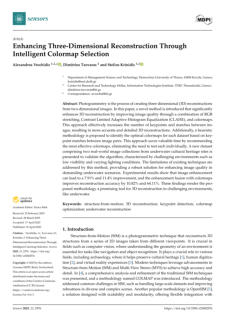
22 - Enhancing Three-Dimensional Reconstruction Through
Intelligent Colormap Selection
- Published by MDPI - sensors
Authors: Alexandros Vrochidis, Dimitrios Tzovaras, and
Stelios Krinidis
This article presents a novel photogrammetry method that
significantly improves three-dimensional (3D)
reconstructions by enhancing image quality using RGB
stretching, Contrast Limited Adaptive Histogram
Equalization (CLAHE), and optimized colormaps. The
methodology increases the number of keypoints and
matches between images, resulting in improved
reconstruction accuracy. A heuristic approach is introduced
to identify optimal colormaps, facilitating time-saving
recommendations for various datasets. The algorithm is
validated using a new dataset of underwater cultural
heritage images, particularly in challenging low-visibility
environments.
32 - Underwater Heritage documentation using photogrammetry:
the CRAB system
- Published by the International Journal on Advanced Science Engineering Information
Technology
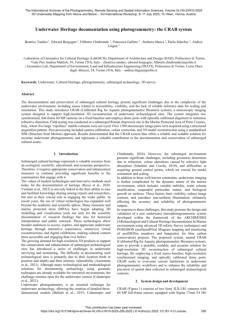
Authors: Beatrice Tanduo, Edward Borgogno, Filiberto
Chiabrando, Francesca Gallitto, Stefania Manca,
Paolo Maschio, Andrea Lingua
This article discusses the challenges of documenting and
preserving submerged cultural heritage due to
environmental factors. It introduces the CRAB (Calibrated
Rig for Aquatic photogrammetric Bicamera system), a
sophisticated imaging system designed for high-resolution
3D reconstruction of underwater archaeological sites.
Tested at a Roman shipwreck in Italy, CRAB utilizes
synchronized high-resolution cameras and a structured
image acquisition pattern, resulting in an effective method
for underwater photogrammetry that enhances the
documentation and conservation of submerged cultural
assets.
34 - Application and Challenges of Photogrammetry in Underwater
Excavations: Case Studies from the Jeju Sinchang-ri and Gunsan
Seonyudo Sites, Korea
- Published by the International Journal on Advanced Science Engineering Information
Technology
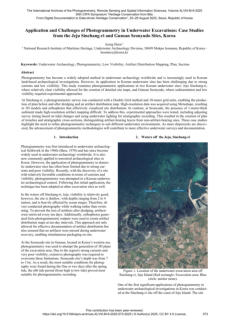
Author: Jeong Heon
This paper explores the challenges and applications of
photogrammetry in underwater archaeology, particularly
in two sites in Korea: Jeju Sinchang-ri and Gunsan
Seonyudo. At Sinchang-ri, conditions allowed for high-
resolution site mapping using effective surveying
methods, while at Seonyudo, issues like sedimentation
forced the use of experimental techniques to capture
stratigraphy and artifact mapping. The study emphasizes
the necessity of adapting photogrammetric methods to
varying underwater environments to enhance
archaeological documentation.
35 - Bridging Photogrammetry and GIS Through Workflow
Automation: A Scalable Approach for Spatially-Linked 3D Data in
Underwater Cultural Heritage
- Published by the International Journal on Advanced Science Engineering Information
Technology
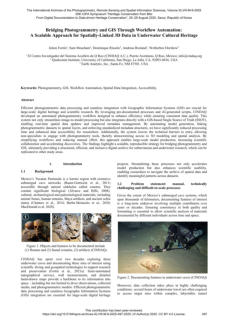
Authors: Julien Fortin, Sam Meacham, Dominique Rissolo,
Andreas Rosland, Wetherbee Dorshow
This article discusses the development of an automated
photogrammetry workflow that enhances the efficiency
and quality of data processing in digital heritage and
scientific research. By leveraging pre-defined processes
and AI-generated scripts, the automated system
streamlines image-to-model conversion and integrates
seamlessly with Geographic Information Systems (GIS).
This innovation not only reduces processing time and
improves data accessibility but also lowers the technical
barriers for non-specialists, fostering inclusivity in 3D
modeling and spatial analysis.

40 - Documenting Change on the SS Thistlegorm, Red Sea, Egypt:
Using Underwater Photogrammetry to Record Natural
Deterioration and Human Impacts on a World War II Shipwreck
- Published by MDPI - Heritage
Authors: Simon Brown, and Jon C. Henderson
The SS Thistlegorm, a British cargo ship sunk in 1941, has
become a popular dive site, leading to increased
deterioration and loss of artefacts due to environmental
and human impacts. The Thistlegorm Project conducted
detailed underwater surveys in 2017 and 2022,
establishing a baseline for monitoring the wreck’s
condition. The findings highlighted notable changes to
the wreck and its surroundings, emphasizing the
importance of photogrammetry in documentation and
conservation efforts. This approach not only aids in
preserving underwater cultural heritage but also sets a
precedent for managing heritage sites frequented by
divers.

Authors: Dylan S. Davis, Jessica W. Cook Hale, Nathan
L. Hale, Trevor Z. Johnston, Matthew C. Sanger
Critical data on global human history is found on
continental shelves, making underwater investigations
challenging due to high costs and specialized needs. A new
semi-automated analysis protocol using bathymetric LiDAR
helps identify archaeological deposits in shallow waters,
successfully re-identifying known sites and discovering new
ones.

Authors: Isaac Ogloblin Ramirez, Angeliki Simosi, Lorenz
Baumer, Orestes Manousos, Patrizia Birchler Emery
, Timothy Pönitz, Alexandros Sotiriou
Underwater excavations face logistical challenges and time
limitations, with factors like nitrogen toxicity and dive time
affecting the process. Effective methods are needed to
gather maximum information from small areas. An on-site
laboratory, featuring a microscope and other devices, helps
identify stratigraphic boundaries and archaeological
materials. Three case studies revealed seven stratigraphic
layers, facilitating the accurate identification of materials like
glass and bone. The laboratory also improved excavation
practices and informed post-excavation analysis, especially in
the Antikythera shipwreck case.

Authors: Rizzo Emanuela, Morelli Marco, Melchiorre Chiara,
Naso Alessandro, Amoresano Angela,
Carpentieri Andrea
Chemical analysis of archaeological artifacts requires
advanced nano/micro-invasive techniques to reveal their
historical context, production methods, and preservation
state, often uncovering remarkable material properties
preserved over centuries. This study characterizes a historical
resin, recovered from a 1980s excavation in Campese Bay
(Giglio Island), likely used to waterproof a wine transport
amphora. Molecular analysis was conducted via GC–MS
direct injection to detect specific markers, while SPME-
GC–MS was used to examine the volatile fraction, offering a
fast, solvent-free, and field-friendly preparation method.

Authors: D. Arano, N. C. Ciarlo, G. Carrasco-González,
H. Barba-Meinecke, M. Bethencourt
Maritime archeology faces challenges in correlating
historical records with archeological findings to accurately
date shipwrecks. During the late 18th and early 19th
centuries, European naval construction introduced metal
sheathing to protect wooden ships from wood-boring
organisms in tropical waters. This study analyzes copper
sheathing and fastenings from Gulf of Mexico shipwrecks
(late 18th to mid-19th century) using archeometallurgical
analysis. This approach reveals evolving shipbuilding
practices during the early industrial period and provides
chronological references for identifying wrecks when hulls
have degraded in tropical marine conditions.


Authors: Pierre Daniel, Guy Claireaux, Nicolas Cormier,
Michel L’Hour, Alexis Rochat, and Cécile Sauvage
The 1962 disappearance of the trawler *Ravenel*, which
claimed 15 lives from the Saint-Pierre-and-Miquelon
archipelago, was investigated using archival records,
eyewitness accounts, oceanic reanalyses, and drift
modeling. Simulations revealed that debris stranding time
uncertainty significantly impacts drift path reconstructions
more than stranding location. The 2025 wreck discovery
allowed forward simulations, identifying a probable sinking
time and validating the model’s accuracy against historical
observations. While the framework’s predictive skill is
confirmed, uncertainties persist regarding the events leading
to the sinking.

Author: Paolo Croce
The 2022 discovery of a 16th-century carvel-built shipwreck
at Cemex’s Denge Quarry, Kent, significantly expands the
limited archaeological record of English Tudor-period
vessels. Analysis of the wreck’s timber indicates it was
constructed as early as the mid-1530s and modified after
1561, with wood sourced from South-East England and
East Anglia. Notably, its construction features closely
resemble those of the Gresham Ship (c. 1574), suggesting a
distinct regional shipbuilding tradition in South-East England
that contrasts with other known English shipbuilding
practices of the period.

Author: James P. Delgado
The S.S. Lewis (1851–1853), a Philadelphia-built propeller
steamer, exemplified American maritime innovation in mid-
19th century transatlantic competition. Named after
Cunard's Boston agent Samuel Shaw Lewis, the vessel was
strategically marketed as a showcase of American
technology. After its transatlantic partnership failed, the ship
relocated to isthmian service between Nicaragua and San
Francisco during the Gold Rush. It wrecked without
casualties in April 1853 north of the Golden Gate. The
wreck site, long known to pioneering divers, has now
undergone its first archaeological assessment, contributing
significantly to California's maritime archaeology history.

Authors: Helena Barba-Meinecke, Josué Guzmán, Josefa
Martí-Solano, Fabrizio Ciacchella
The Animas de la Victoria wreck site, off Mexico’s Caribbean
coast, features 19 iron cannons, four anchors, and other
artifacts from a likely mid-18th-century, lightly armed
merchant ship. Unusually distant from Spanish ports or
major sailing routes, the site’s chronology and origin are
explored through anchor/ordnance analysis and
oceanological/historical data, revealing insights into its
formation and context.

Authors: Shinwoong Kim, and Petri Valanto
Since the 1994 MV Estonia disaster, investigations have
established the root cause and sinking process. However, a
2020 underwater ROV video revealed new penetrating
damage on the wreck’s starboard side.
The Estonian Safety Investigation Bureau (ESIB) reassessed
this evidence, as the timing of the New Side Damage (NSD),
whether it existed before sinking or resulted from seabed
impact, could challenge prior conclusions.
The Hamburg Ship Model Basin (HSVA) is investigating this
via numerical simulations under varying damage scenarios,
including statistical analyses, to clarify the damage’s origin
and its implications.

Authors: Armelle Charrie-Duhaut, Quentin Couillebault, Igor
Miholjek, and Giulia Boetto
Shipbuilding requires hull waterproofing against corrosion
and pests, historically using resins, bitumen, plant tars, and
mixtures like zopissa (pitch and beeswax) noted by Pliny the
Elder; expansion from the 13th-19th centuries created a tar
industry. This study presents an interdisciplinary method
combining molecular, palynological, and statistical indicators
to characterize ancient materials, revealing manufacturing
details and surrounding vegetation. Applied to the Roman
wreck Ilovik–Paržine 1 (mid-2nd c. BC, Croatia), it advances
naval archaeology.

Authors: Marco Procaccini, and Federico Ugolini
Recent surveys using remote sensing technologies (MBES,
ROVs) and photogrammetry identified and documented
the SS Samuel J. Tilden, a Liberty-class cargo ship that sank
during the German raid on Bari in December 1943. The 3D
models and remote sensing data revealed a well-preserved
wreck within a complex maritime landscape, confirming
earlier avocational findings. This study demonstrates the
effectiveness of non-invasive technologies in conflict
archaeology and establishes a foundation for future
research on World War II wrecks in Italy.

Authors: Dominic Bush, Jason T. Raupp, and Alexander
Unrein
In June 1942, Japan occupied the Aleutian Islands of Attu
and Kiska, the only foreign takeover of U.S. soil since 1812.
The indigenous Saskinaˆx people were later imprisoned,
and the U.S. reclaimed the islands by 1943. Despite this,
their role in WWII’s North Pacific theater remains
overlooked. A 2020s underwater survey using sonar and
video identified two wrecks: Japan’s Kotohira Maru and
America’s SS Dellwood. These discoveries highlight wartime
details while reviving awareness of Alaska’s WWII history
and guiding heritage preservation.

Authors: Wenyang Gan, Haozhe Liang, and Caixia Cai
Multi-ROV cooperative systems are critical for sunken ship
search missions but face challenges like redundant
coverage from overlapping regions and trajectory tracking
errors due to hydrodynamic disturbances and actuator
limitations. To overcome these, an improved dynamic
window approach (DWA) with a search distance penalty
mechanism is proposed for trajectory planning, paired with
a cascaded control architecture combining a model
predictive kinematic controller and an adaptive sliding mode
dynamic controller with an extended state observer.

Authors: Elisa Pecoraro, Nicola Macchioni, Giorgia Musina,
Emma Cantisani, Sveva Longo, Marta Novello, and
Benedetto Pizzo
The Iulia Felix, a 2nd-century AD Roman shipwreck
discovered off Grado in 1986, underwent recovery and
treatment with PEG 4000, completed by 2003. Prolonged
storage led to salt efflorescence on wood surfaces,
prompting an investigation. Analyses using SEM-EDS, XRPD,
and FTIR identified iron- and sulphur-based compounds,
indicating corrosion-related degradation. Environmental
testing at 35% and 85% humidity showed PEG migration to
the surface under humid conditions, leading to dimensional
changes and structural damage.

Authors: Evren Türkmenoglu, and Dan Davis
This study analyzes three Byzantine-era amphora carriers
(Knidos F, L, N) found off Knidos, using ROV deep-water
surveys, seabed mapping, and amphora typology. Knidos F
and L, dating to the 10th–12th centuries, carried
predominantly Günsenin Type I amphorae, signaling a
Byzantine maritime trade revival. Knidos N, likely from the
13th century, features a distinct amphora assemblage.
Collectively, these wrecks underscore the Carian maritime
corridor’s enduring role in Byzantine shipping networks.

Authors: Jiani Dai and Jie He
Side-scan sonar is vital for detecting shipwrecks in turbid
waters where optical methods fail, but automated
segmentation is hindered by speckle noise and seabed
reverberations. SW-Net addresses this by combining a multi-
scale input strategy, a Directional Filter Bank for physical
priors, and a directional attention mechanism to enhance
structural feature extraction and noise resilience. On the
AI4Shipwrecks dataset, SW-Net surpasses seven
architectures, achieving 39.43% IoU and a 56.56% F1-score
while maintaining robustness against interference and low
computational complexity (4.01M parameters), making it
practical for deployment on resource-limited autonomous
underwater vehicles.