










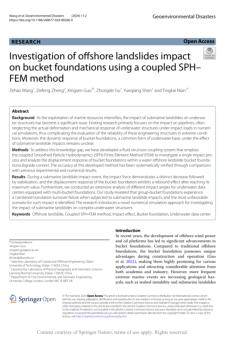
Non Destructive Testing (NDT) 2024










Click on the
octopus to return to
the top of the page

Authors: Zehao Wang, Defeng Zheng, Xingsen Guo,
Zhongde Gu, Yueqiang Shen, & Tingkai Nian
This study explains the impact of submarine landslides on
underwater structures, focusing on bucket foundations. It
introduces a fluid-structure coupling system using the
coupled Smoothed Particle Hydrodynamics (SPH)-Finite
Element Method (FEM) to analyze the displacement
response of these foundations during landslide impacts.
The research aims to provide a new numerical simulation
approach and offers insights into underwater structures'
dynamic response and failure mechanisms under extreme
conditions.


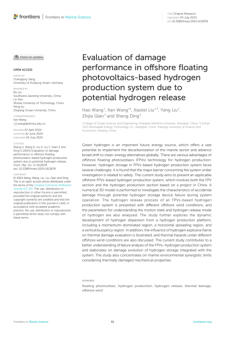
Authors: Hao Wang, Kan Wang, Xiaolei Liu, Yang Liu,
Zhijia Qian, and Sheng Ding
This study explains the development and analysis of an
offshore floating photovoltaics (FPV)-based hydrogen
production system. It addresses the challenges, particularly
safety concerns, associated with hydrogen storage in such
systems. It involves creating a numerical 3D model to
investigate the characteristics of accidental damage and
hydrogen release under different offshore wind
conditions. It also explores the dynamic development of
hydrogen dispersion and evaluates the evolution of
thermal hazards and damage in the marine environment.


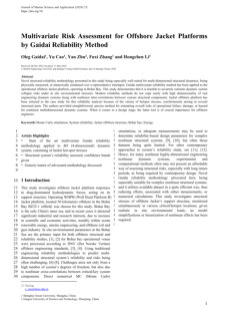
Authors: Oleg Gaidai, Yu Cao, Yan Zhu, Fuxi Zhang, and
Hongchen Li
A new reliability method suitable for multi-dimensional
structural dynamics is introduced in this study, using the
Gaidai multivariate method on an offshore Jacket
platform in Bohai Bay. It estimates collapse risks under
environmental stress, addressing challenges of high
dimensionality and nonlinear correlations. This method is
essential for offshore engineers during design to assess
operational failure, damage, or hazards.

06 - Multivariate Risk Assessment for Offshore Jacket Platformsby
Gaidai Reliability Method.
Authors: Jingzhou Xin, Guangjiong Tao, Qizhi Tang, Fei
Zou, Chenglong Xiang
This study proposes a new damage identification method
using Swin Transformer and continuous wavelet
transform (CWT). It converts structural vibration data into
a time-frequency diagram to capture damage
characteristics. The Swin Transformer extracts damage
information from this diagram. The method's accuracy is
analyzed with various sample lengths and noise levels,
confirming its robustness. Laboratory tests show it
recognizes damage with 99. 6% accuracy for single
damage and 99. 0% for multiple damages.

11 - Structural damage identification method based on Swin
Transformer and continuous wavelet transform.

Authors: Andrei Nazarov, Tatiana Yurasova, and Andrey
Marshakov
This review examines how different aqueous electrolytes
impact hydrogen absorption and self-corrosion in
magnesium anodes. It discusses historical and recent
studies on mechanisms of self-corrosion and hydrogen
evolution under specific effects. The focus is on
magnesium hydride formation and oxidation during
active dissolution and how anodic dissolution occurs
through protective films in other conditions. It also looks
at factors influencing hydride formation and self-
corrosion.
20 - Hydrogen Absorption and Self-Corrosion of Mg Anode:
Influence of Aqueous Electrolyte Species

Authors: Yuheng Chen, Haicheng Zhang, Weisheng
Zou, Haihua Zhang, Bin Zhou, Daolin Xu
This study proposes a new ROV-based deep-sea mining
system to address slippage and sinking issues of
traditional vehicles. A learning-based control strategy is
introduced, utilizing a nonparametric learning method to
improve path-tracking performance.
27 - Dynamic modeling and learning based path tracking control
for ROV-based deep-sea mining vehicle.
Authors: Beate Oswald-Tranta
Inductive thermography is a strong inspection method for
finding defects in metals. The technique has improved
over decades from lab tests to industry use. This paper
reviews its theory and key technical aspects. While it can
find various defects, the focus is on detecting surface
cracks in metals, with examples of current industrial
applications.
30 - Inductive thermography – review of a non-destructive
inspection technique for surface crack detection
Authors:
Emmanuella Onyinye Nwulu, Tari Yvonne Elete,
Friday Emmanuel Adikwu, and Fidelis Othuke Onyeke
The durability of coatings is crucial for protecting
infrastructure from damage. This study suggests a
framework using advanced non-destructive testing
(NDT) technologies for inspecting coating durability. It
incorporates methods like ultrasonic testing and data
analytics to find defects and predict lifespan. Case studies
show this approach improves decision-making and saves
costs. The framework promotes better inspection
practices across different sectors for enhanced
performance and sustainability.
31 - Advancing inspection techniques for coating durability: A
framework for integrating non-destructive testing technologies.
Authors: Jun Ito, Yudai Igarashi, Ryota Odagiri, Shigetaka
Suzuki, Hiroshi Wagatsuma, Kazuhiro Sugiyama,
and Mikihiko Oogane
The magnetic hammer test (MHT) is a nondestructive
inspection method that uses a tunnel magnetoresistance
(TMR) sensor to detect weak magnetic fields generated by
natural pipe vibration. The method can accurately
evaluate wall thickness with tens of microns and
underwater with less than 100 µm accuracy. This
noncontact, fast, and accurate method contributes to
unmanned, manpower-saving nondestructive testing
(NDT) in the future.
04 - Evaluation of Pipe Thickness by Magnetic Hammer Test with a
Tunnel Magnetoresistive Sensor
Authors: Jianghai He
This essay discusses the practical application of remote-
operated underwater vehicles for inspecting dams and
bridges, addressing safety issues like leakage, erosion, and
cracks. It highlights the advantages of these vehicles
compared to traditional divers, their operation in low-
visibility water, stabilizing positions in turbulence, and
overcoming cable entanglement issues. The paper also
provides an outlook for their development in underwater
detection and reinforcement to address future
maintenance challenges.
05 - Introduction Remote-operated Underwater Vehicle for
Inspection of Underwater Structure
Authors: Manuela Ammann
Switzerland's hydropower plants are the primary source of
renewable energy, accounting for 57% of electricity
production. However, high maintenance costs and
manual inspections are costly. A workflow for underwater
photogrammetry using Remotely Operated Vehicles
(ROV) has been developed, enabling accurate 3D
reconstruction of underwater objects. The system provides
sub-centimere accuracy at object distances.

09 - Robotic photogrammetric underwater inspection of
hydropower plants

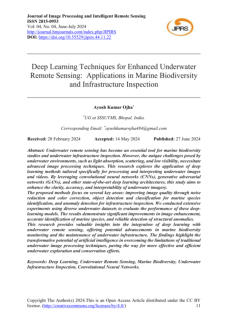
Author: Ayush Kumar Ojha
This study explores the use of deep learning methods for
processing and interpreting underwater images and
videos. The suggested methods, utilizing convolutional
neural networks and generative adversarial networks
(GANs), improve image quality, identify marine species,
and detect anomalies for infrastructure inspection. The
findings highlight the transformative potential of artificial
intelligence in overcoming the limitations of traditional
underwater image processing techniques, paving the
way for more effective and efficient underwater
exploration and conservation efforts.
10 - Deep Learning Techniques for Enhanced Underwater Remote
Sensing: Applications in Marine Biodiversity and Infrastructure
Inspection
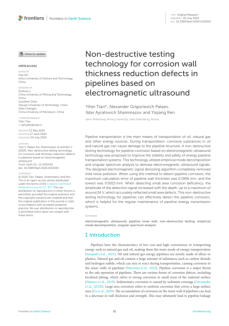
Authors: Yifan Tian, Alexander Grigorievich Palaev, Ildar
Ayratovich Shammazov and Yiqiang Ren
This study proposes a non-destructive testing technology
for pipeline corrosion based on electromagnetic
ultrasound technology to improve stability and safety in
energy pipeline transportation systems. This technology
uses empirical mode decomposition and singular
spectrum analysis to denoise electromagnetic ultrasound
signals, removing mild noise pollution and accurately
detecting small area defects, thereby aiding in the regular
maintenance of pipeline energy transmission systems.

14 - Non-destructive testing technology for corrosion wall thickness
reduction defects in pipelines based on electromagnetic
ultrasound
Authors: M. Mwelango, X. Yin, M. Zhao, Z. Zhang, Z.
Han, R. Fan, P. Ma, X. Yuan, and W. Li
This paper explores the use of coplanar capacitive sensors
for underwater structural integrity assessment. It compares
the performance of bare-electrode and insulated-
electrode sensors, revealing that electrical conductivity
significantly influences response. The study also highlights
the feasibility of defect detection, characterisation, and
imaging under water, highlighting the potential of
underwater NDE techniques for inspecting structures and
equipment in underwater environments. This research
broadens underwater NDE knowledge.

15 - Feasibility Study on the Use of the Coplanar Capacitive Sensing
Technique for Underwater Non-Destructive Evaluation

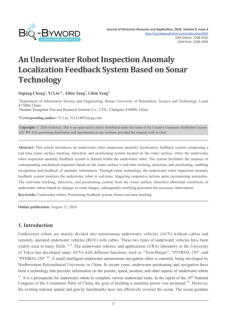
Authors: Siqiang Cheng, Yi Liu, Aibin Tang, Libin Yang
This document introduces an underwater robot
inspection anomaly localization feedback system, which
uses real-time water surface tracking, detection, and
positioning. The system is housed within the underwater
robot, enabling the system to issue mechanical responses
based on the water surface's tracking and positioning.
The system uses sonar technology to monitor the
underwater robot in real-time, triggering responsive
actions upon anomalies. This system identifies abnormal
conditions and informs personnel for intervention.
17 - An Underwater Robot Inspection Anomaly Localization
Feedback System Based on Sonar Technology
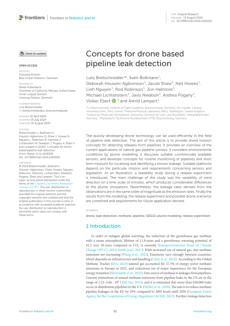
Authors:
Lutz Bretschneider, Sven Bollmann, Deborah Houssin-
Agbomson, Jacob Shaw, Neil Howes, Linh Nguyen, Rod
Robinson, Jon Helmore, Michael Lichtenstern, Javis
Nwaboh, Andrea Pogany, Volker Ebert, and Astrid
Lampert
The application of drone technology to pipeline leak
detection is examined in this article. It covers
environmental conditions, appropriate commercial
sensors, routine pipeline monitoring, and contemporary
uses of natural gas pipeline surveys. Additionally, the study
presents a feasibility assessment conducted during a
release experiment, emphasizing the minute-by-minute
change of wind direction. Requirements for future
applications are also produced.
18 - Concepts for drone based pipeline leak detection
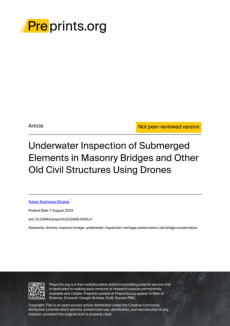
Authors: Ruben Rodríguez Elizalde
This study presents a novel underwater drone model for
examining submerged components of historic bridges.
Three bridges spanning various rivers were inspected
underwater as part of the study, which showed that
underwater drones are safer than existing techniques and
useful for this kind of assessment. Additionally, the drones
enable the investigation of characteristics like pier or
butment rotation or settlement that can forecast future
foundation issues that will impact the entire bridge.
19 - Underwater Inspection of Submerged Elements in Masonry
Bridges and Other Old Civil Structures Using Drones
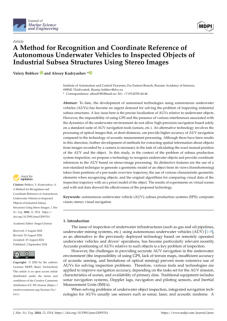
Authors: Valery Bobkov and Alexey Kudryashov.
The development of unmanned underwater vehicles
(AUVs) is crucial for inspecting industrial subsea structures,
but GPS is impractical due to underwater environment
interferences. Optical image processing offers higher
accuracy for AUV navigation. This study proposes a
technology to recognize underwater objects and provide
coordinate references to AUVs using stereo-image
processing. It uses a non-standard technique to generate
a geometric model of an object, uses characteristic
geometric elements, and compares visual data with an a
priori model.
21 - A Method for Recognition and Coordinate Reference of
Autonomous Underwater Vehicles to Inspected Objects of
Industrial Subsea Structures Using Stereo Images.
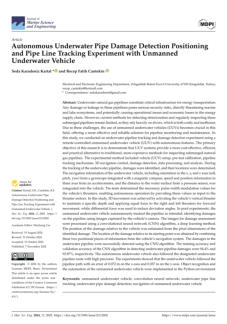
Authors: Seda Karadeniz Kartal, and Recep Fatih Cantekin
This study emphasizes the importance of using
unmanned underwater vehicles (UUVs) for pipeline
monitoring based on an experiment with a remote-
controlled UUV to detect pipeline damage. It mentions
that the UUV autonomously tracked the pipeline and
identified damages through camera images processed by
a convolutional neural network (CNN), achieving high
detection accuracy. It also mentions that the UUV
followed the pipeline precisely, with minimal navigation
errors.
28 - Autonomous Underwater Pipe Damage Detection Positioning
and Pipe Line Tracking Experiment with Unmanned
Underwater Vehicle
29 - Experimental Activity with a Rover for Underwater Inspection
Authors: Erika Ottaviano, Agnese Testa, Pierluigi Rea,
Marco Saccucci, Assunta Pelliccio, and Maurizio
Ruggiu
This paper discusses the use of an underwater rover to
implement automated imaging techniques for
underwater structure inspections. The research aims to
improve monitoring, reduce operational complexity, and
offset the financial burden of periodic inspections. The
research uses the FIFISH V6 rover with a Brave 7 camera
and experimental photogrammetry tests of an anchor.
The results confirm the validity of the proposed approach
and encourage future development for underwater
inspections.
Author: Alexandre Cardaillac
This thesis introduces a novel and comprehensive solution
for inspecting underwater ship hulls using a cost-effective
Remotely Operated Vehicle (ROV). It addresses safety
concerns linked to ship hull integrity and environmental
impacts due to inefficient fuel consumption resulting from
hull negligence. Traditional dry dock inspection methods
are often slow, prompting a shift to more efficient remote
inspections. The ROV is equipped with advanced
navigation and perception sensors, allowing for
automated inspections, a combination of acoustic-visual
data, and deep learning for enhanced analysis. The
solution has been tested in various harbors and on
multiple ships, demonstrating adaptability for different
structures and opening avenues for future research.
03 - Towards autonomous underwater navigation and perception
for end-to-end ship hull inspection
Authors: Paul Dario Toasa Caiza, Daiki Shiozawa, Thomas
Ummenhofer, Takahide Sakagami
This article discusses a novel, portable system that utilizes
the Eddy currents principle in combination with inductive
thermography for the real-time detection of cracks in
metallic components. Traditional systems face challenges
such as high power consumption and lengthy image
processing times, making them unsuitable for large
structures like bridges and oil platforms. This newly
developed system operates efficiently with a square-wave
AC voltage, significantly reducing energy requirements
while improving detection capabilities, as demonstrated
by simulations and experiments conducted on structural
steel specimens.

12 - Real time detection of fatigue cracks on steel structures by
applying square wave induction
Authors: Jiangpei Zhu, Mei-Ling Zhuang, Yuting Qi, Bin
Chen, Xiaojian Cao
This study investigates the impact of ultrasonic impact
treatment (UIT) on the microstructural characteristics and
mechanical properties of 316L stainless steel. The findings
reveal that UIT leads to a significant grain size reduction,
increased hardness, and improved tensile and fatigue
strengths. The analysis also uncovers the mechanisms of
fatigue fracture, indicating that UIT alters the
microstructure, resulting in a gradient nanostructure and
martensitic transformation, which contributes to
enhanced mechanical performance.

13 - Effect of ultrasonic surface impact on the microstructural
characterization and mechanical properties of 316L austenitic
stainless steel

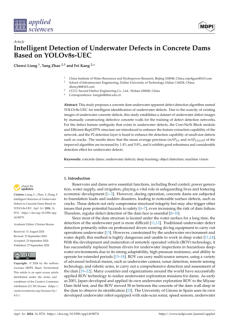
Authors: Chenxi Liang, Yang Zhao, and Fei Kang
This study introduces the YOLOv8s-UEC algorithm
designed for the intelligent identification of underwater
defects in concrete dams. Addressing the challenges
posed by the limited availability of underwater defect
images, the researchers constructed a dataset by creating
defective concrete walls. Enhancements in the algorithm’s
feature extraction and detection capabilities are achieved
through the introduction of the ConvNeXt Block and
Efficient-RepGFPN structure, along with the fusion of the
P2 detection layer for improved recognition of small
defects. The results demonstrate significant improvements
in mean average precision, indicating the algorithm’s
robustness in detecting underwater defects effectively.
23 - Intelligent Detection of Underwater Defects in Concrete Dams
ased on YOLOv8s-UEC
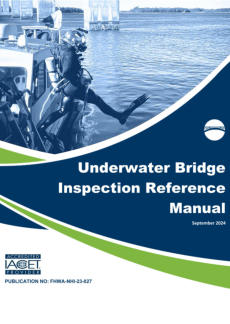
Authors: Michael D. Dukes, James M Karalekas, Dustin W.
Noel, Heath K. Pope, David R. Reser, Jeffrey B.
Rowe, Andrew Young
This article outlines the essential practices and techniques
for conducting underwater inspections of bridges to
ensure public safety and protect investment. It emphasizes
the need to assess structural conditions of underwater
components, including streambeds, utilizing various
inspection methods, ranging from visual inspections in
shallow waters to diving techniques in deeper waters. The
manual aims to equip bridge safety personnel, including
engineers and inspectors, with knowledge about
inspection methods, equipment, and common defects
found during assessments.
24 - Underwater Bridge Inspection Reference Manual
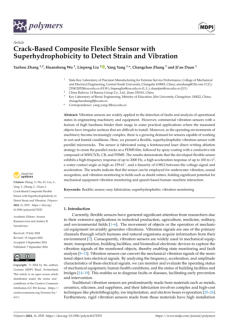
Authors: Yazhou Zhang, Huansheng Wu, Linpeng Liu,
Yang Yang, Changchao Zhang, and Jian Duan
The article discusses the development of a flexible,
superhydrophobic vibration sensor designed to address
the challenges faced by commercial sensors in detecting
faults in engineering machinery, particularly on irregular
surfaces and in complex environments. Through the use
of femtosecond laser ablation to create microcracks on a
PDMS film, and subsequent coating with conductive
materials, the sensor demonstrates impressive
performance metrics including a high-frequency response
and improvements in functionality for underwater and
human-machine interaction applications.
25 - Crack-Based Composite Flexible Sensor with
Superhydrophobicity to Detect Strain and Vibration
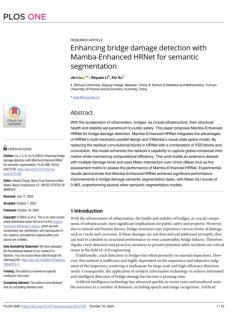
Authors: Jie Liu, Deyuan Li, & Xin Xu
This article introduces the Mamba-Enhanced HRNet, a
novel model designed for detecting damage in bridges,
essential infrastructure that supports public safety amid
rapid urbanization. The model combines the strengths of
HRNet’s multi-resolution parallel design and a visual state
space model (VSS) to enhance its capability for global
contextual understanding, while also improving
computational efficiency. An extensive dataset
encompassing various types of bridge damage was
created for evaluation, demonstrating that this enhanced
model significantly outperforms other semantic
segmentation models with a Mean Intersection over
Union (Mean IoU) score of 0.963.
26 - Enhancing bridge damage detection with Mamba-Enhanced
HRNet for semantic segmentation
02 - Recording the SS Thistlegorm: Rapid Multi-Image Underwater
Photogrammetric Survey of a Large Second World War Wreck
- Published by MDPI - Journal of Marine Science and Engineering
Authors: Simon Brown, and Jon C. Henderson
This paper outlines a methodical approach to surveying
and monitoring the SS Thistlegorm, a significant metal
wreck in the Red Sea, using digital photogrammetry with
a straightforward single-camera setup.
The study emphasizes a cost-effective and replicable
means for change monitoring in shipwrecks that complies
with professional standards and invites participation from
non-specialists in data collection. Key components include
an in-depth description of the SS Thistlegorm, equipment
utilized, surveys performed in 2017 and 2022, the
necessity of an organized data management system,
accuracy testing of collected data, and a detailed post-
processing workflow.
07 - Quantitative Evaluation of Color Enhancement Methods for
Underwater Photogrammetry in Very Shallow Water: a Case
Study
- Published by The International Society for Photogrammetry and Remote Sensing
Authors: Alessio Calantropio, Filiberto Chiabrando, Fabio
Menna, Erica Nocerino
This document explores the challenges of achieving
accurate color representation in underwater
photogrammetry due to factors like chromatic aberration
and light scattering. It evaluates various color
enhancement methods, including gray-world assumption
techniques, physical light property considerations, and
artificial intelligence approaches, and applies these
methods to images of a Roman shipwreck situated in the
Porto Cesareo Marine Protected Area, providing a
comparative analysis of their effectiveness in restoring
natural colors and enhancing image clarity.
08 - POSER: an open source Simulation platform for teaching and
training underwater photogrammetry
- Published by The International Society for Photogrammetry and Remote Sensing
Authors: Fabio Menna, Scott McAvoy, Erica Nocerino,
Beatrice Tanduo, Louise Giuseffi, Alessio
Calantropio, Filiberto Chiabrando, Lorenzo
Teppati Lose, Andrea Maria Lingua, Stuart
Sandin, Clint Edwards, Brian Zgliczynski,
Dominique Rissolo, Falko Kuester
This paper discusses the challenges of underwater
photogrammetry and the need for proper training for
underwater surveying professionals. It introduces POSER,
a 3D simulation framework built on Blender (open source
freeware), aimed at educating users about underwater
imaging principles. The framework incorporates realistic
water physics to enhance learning experiences through
practical scenarios relevant to various fields, including
marine ecology, archaeology, and subsea metrology.
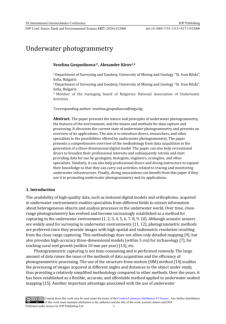
Authors: Veselina Gospodinova & Alexander Kirov
This paper examines underwater photogrammetry,
detailing its nature, principles, and methodologies for data
capture and processing. It provides a current snapshot of
its applications, including how divers and researchers can
leverage this technology to enhance their professional
skills and contribute valuable data to various scientific
fields. Additionally, it discusses the potential benefits for
recreational divers, professional divers, diving instructors,
and diving associations in adopting and promoting
underwater photogrammetry.