










Underwater construction 2026







Click on the
octopus to return to
the top of the page


01 - Monitoring-Based Assessment of Excavation Risk Using Data-
Driven Models
Authors: Sachin Admane, Tejas Admane
This study proposes a practical, data-driven approach for
assessing excavation risk using monitoring data. By
analyzing a comprehensive dataset of geotechnical,
environmental, and excavation parameters, conventional
machine learning models were used to classify risk levels.
The models revealed that excavation depth and
deformation indicators are the primary drivers of risk
classification, with environmental factors playing a
secondary role in typical scenarios. This research
demonstrates that interpreting monitoring data through
data-driven methods can effectively enhance traditional
geotechnical assessments for practical excavation risk
evaluation.

03 - Investigation of underwater shield tunnel excavation face
stability in lower dense and upper loose strata
Authors: Fei Jia, Chuang Wang, Pengfei Li, Xiaopu Cui,
Qing Xu, & Zhaoguo Ge
This study investigates excavation face stability in saturated
sandy-pebble strata with lower dense and upper loose
layers using physical model tests and numerical
simulations. It examines progressive failure under varying
burial depths and proposes a stratum-specific theoretical
model, including a formula for limiting effective support
compressive stress.
Key findings: surface settlement evolves in three stages as
the baffle advances; reduced burial depth increases
settlement magnitude and range, accelerates loss of
stratal equilibrium, raises seepage velocity, and expands
the unstable zone, more so than in homogeneous strata
at the same depth.
02 - Intelligent Fault-Tolerant Control for Wave Compensation
Systems Considering Unmodeled Dynamics and Dead-Zone
Authors: Zhiqiang Xu, Xiaoning Zhao, Zhixin Shen, Yingjia
Guo, and Yougang Sun
This paper proposes a neural network-based intelligent
fault-tolerant control for wave compensation in floating-
body salvage equipment. It compensates hydraulic dead-
zones via inverse models, learns unmodeled dynamics
online with NNs, and handles actuator failures using
adaptive laws, with Lyapunov theory proving global
stability. Integrating data-driven learning and model-based
compensation, the approach reduces model dependence
versus traditional sliding-mode methods. Simulations and
experiments confirm high-precision tracking under varied
sea conditions.

04 - Comparing distributed knowledge: the effects of visualization
format and comparison strategy on task performance
Authors: Nicole Hynek, and Dietrich Albert
This study investigates how comparative knowledge
visualizations aid users in understanding distributed
knowledge, focusing on design choices like knowledge
representation (concept maps vs. proposition lists) and
visual comparison strategies (juxtaposition vs.
superimposition). In a mixed-design experiment with 133
participants, results showed that superimposition
improved accuracy and speed, particularly with higher
task complexity, while juxtaposition was favored for its
perceived cognitive usability. Despite varying knowledge
representation formats, no significant performance
differences were observed.

05 - Research on AE method for thermal fatigue damage in heat
transfer oil pipes
Authors: Zhenlong Hu, Xinxin Luo, Junjiao Zhang,
Qiufeng, Changhui Huang, Chao Lu, and Xin Li
This study addresses the unmet need for dynamic
monitoring of thermal fatigue damage in thermal oil pipes
used in concentrated solar power systems. Using acoustic
emission (AE) technology, it designs U-shaped 20# steel
specimens mimicking real pipe geometry and material
properties, develops an inner-wall thermal cycling device
to replicate operational stress conditions, and establishes
an AE detection system. AE signal characteristics,
particularly energy, are analyzed across thermal fatigue
initiation and propagation stages.
06 - Time grabbing as a chronopolitical mechanism in wind power
development.
Authors: Henrikke Sæthre Ellingsen
This article examines Norway's onshore wind power
conflicts via Fosen and Frøya cases. Fosen's Supreme
Court ruling found turbines violated Indigenous Saami
rights in reindeer pastures; Frøya saw rural community
resistance. Introducing 'time grabbing' from
chronopolitics—as governmental reconfiguration of
temporal horizons complementing land grabbing—the
study identifies mechanisms of acceleration, protraction,
and epistemic exclusion. These subordinate local
temporalities and decision-making to national energy
agendas, displacing agency and weakening democratic
legitimacy in the transition.

07 - Technical screening of wind turbine installation vessel
compatibility for offshore wind deployment in Brazil
Authors: Victor C. H. A. Carvalho, Marcos Aurélio
Vasconcelos Freitas, Julian Hunt
This study assesses WTIV suitability for Brazil’s offshore
wind (>80 GW proposed) amid limited infrastructure and
vessels. Screening 77 vessels on crane height, lifting
capacity, and depth for 15 MW turbines found only 22%
meet requirements. Restricted to technical feasibility, it
provides a replicable framework for aligning ambitions
with capacity in Brazil and other emerging markets.
08 - Advanced and Emerging Marine Engineering Technologies -
Proceedings of 2024 3rd International Joint Conference on Civil
and Marine Engineering (JCCME 2024)
Editors: Decheng Wan, Dezhi Ning, Hao Tian
These proceedings cover a wide range of topics related to
civil and marine engineering, highlighting pioneering
research and emerging trends. They include
developments in port and coastal engineering, offshore
engineering, fluid-structure interactions, intelligent
maritime structures, maritime rescue and salvage
technologies, ocean energy extraction, maritime sensor
technologies, mechatronic systems for ocean
environments, and polar region technologies.
Overall, these proceedings reflect the state-of-the-art
research and technological progress presented at the
2024 conference, contributing to the advancement of
knowledge and innovation in marine and civil
engineering disciplines.

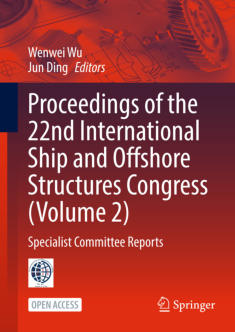
09 - Proceedings of the 22nd International Ship and Offshore
Structures Congress (Volume 2)
Editors: Wenwei Wu, Jun Ding
This document is a collection of eight specialist committee
reports presented at the ISSC 2025 held in Wuxi, China.
This volume #2 focuses on advancing the understanding
of marine structural design, production, and operation
through international collaboration among experts. It
covers a broad range of topics including environmental
loads, design methods, ship structural integrity, and
integrates quasi-static and dynamic responses with
fatigue-fracture analysis to ensure holistic marine system
reliability.
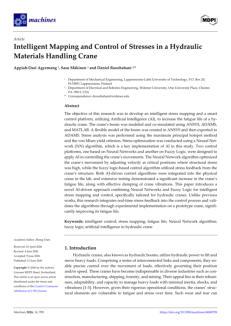
11 - Intelligent Mapping and Control of Stresses in a Hydraulic
Materials Handling Crane
Editors: Appiah-Osei Agyemang, Sasu Mäkinen, and
Daniel Roozbahani
This research aimed to create an intelligent stress mapping
and control system using Artificial Intelligence (AI) to
enhance the fatigue life of a hydraulic crane. The crane's
boom was modeled and analyzed using ANSYS, ADAMS,
and MATLAB (specialized software tools commonly used
in engineering and scientific research for modeling,
simulation, and analysis). Stress optimization utilized a
Neural Network algorithm. Two AI-based control
platforms, one using Neural Networks and the other
Fuzzy Logic, were developed to improve crane
movements and manage structural stress. Testing showed
a notable increase in the crane's fatigue life and reduced
vibrations.
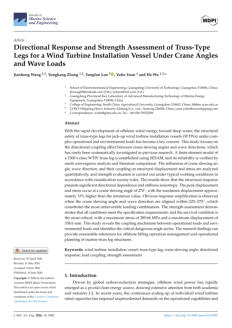
10 - Directional Response and Strength Assessment of Truss-Type
Legs for a Wind Turbine Installation Vessel Under Crane Angles
and Wave Loads
Editors: Jianhong Wang, Yongkang Zhang, Yangfan Luo,
Yubo Yuan, and He Wu
This study addresses the structural safety of truss-type legs
for jack-up wind turbine installation vessels (WTIVs) under
complex operational and environmental loads. Focusing
on the directional coupling effect between crane slewing
angles and wave directions, it establishes a finite element
model using SESAM and verifies its reliability. The analysis
reveals significant directional dependence and stiffness
anisotropy in structural response. Peak displacement and
stress occur at a crane slewing angle of 270°, with the
maximum displacement being about 33% higher than the
minimum.
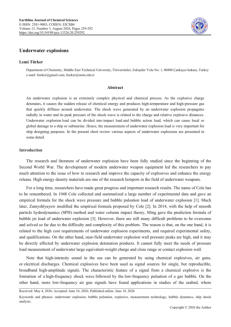
12 - Underwater explosions
Editor: Lemi Türker
An underwater explosion is a complex physical and
chemical process that releases energy, producing high-
temperature and high-pressure gas. The resulting shock
wave propagates radially in water, with its peak pressure
dependent on the explosive charge and distance. The
explosion load can be divided into impact load and
bubble action load, both of which can cause damage to
ships or submarines. Accurate measurement of
underwater explosion loads is crucial for ship design.