










Scientific papers 2022 - Part D










Authors: Jan Risberg, & Pieter-Jan van Ooij
Depending on pO2 and exposure time hyperoxic
breathing gas may cause injury in many organs including
the lungs. Pulmonary oxygen toxicity (POT) may be
asymptomatic, but will initially present as a tracheo-
bronchitis in symptomatic subjects. A number of objective
measurements of POT have been investigated, but the
decrement in vital capacity (VC) has remained the most
accepted outcome measure.
The unit pulmonary toxic dose (UPTD). based on the pO2
and exposure time, has been established as the most
common exposure index for POT in diving.
Nevertheless, the K-index suggested by Arieli performs
better and allows estimation of recovery.

Authors: HanWei Zhang, ZhiRen Tsai, Victor C. Kok,
HsiaoChing Peng, YauHung Chen, Jeffrey J. P.
Tsai, & Chung Y. Hsu
We publish this report as many divers, ROV pilots, and
supporting people are confronted with hydrocarbons.
Major ambient air pollutants include particulate matter and
volatile organic compounds, including total hydrocarbons
(THCs). Primary non-methane hydrocarbons (NMHCs)
originate from vehicle emissions. The association between
air pollution and urinary bladder cancer (UBC) is
debatable. The authors investigated whether long term
exposure to ambient hydrocarbons increases UBC risk
among people aged ≥ 20 years in Taiwan.

Authors:
Josep M. Casadesús, Javier NietoMoragas,
Maria T. Serrando, Pere BoadasVaello, Ana Carrera,
Fernando Aguirre, R. Shane Tubbs, Francisco Reina
This study evaluates the usefulness of a histomorphometric
digital analysis in detecting air space over-distension due to
pulmonary barotrauma. It was performed on lung
parenchyma specimens of 12 divers: six had died due to
arterial gas embolism following pulmonary barotrauma
(mean age at death of 54 years, range of 41–61 years),
and six had drowned in saltwater without a diagnosis of
pulmonary barotrauma (mean age at death of 54 years,
range of 41–66 years) (positive controls).

Authors: Vincenzo Zanon, Silvia Magri, Giulia Bonera, and
Enrico Camporesi.
Gas embolism is a potentially fatal occurrence in which
bubbles are introduced into the arterial/venous
circulation.
Multi-focal ischemia could be a life-threatening scenario
occurring after diving-related activities, pulmonary
barotrauma, or even an iatrogenic procedure capable of
causing an accidental introduction of gas into the
vasculature. The reported case concerns the good
outcome of one of these rare occurrences thanks to a
prompt diagnosis and proper management of the
ongoing gaseous lesion.

Authors: Connor TA Brenna, Shawn Khan, Rita Katznelson,
Richard Brull
This scoping review seeks to characterize rehabilitative
outcomes when hyperbaric oxygen therapy is applied as
an adjunct therapy in the treatment of perioperative
peripheral nerve injury.

Authors: Beibei Dong, Yuanyuan Bai, Qi Jia , Lin Su, Xinyue
Zhang, Shiquan Wang , Zongping Fang
Stroke is a major health concern and a leading cause of
mortality and morbidity. The authors and other groups
have documented that hyperbaric oxygen preconditioning
could significantly alleviate neuronal damage in ischemia-
reperfusion models through various mechanisms.
However, they found that some of the subjects did not
benefit from preconditioning with hyperbaric oxygen. The
preconditioning phenomenon is similar to vaccination, in
which the endogenous survival system is activated to fight
against further injuries.

Authors:
Ilaria Tarozzi, Lorenzo Franceschetti, Gianfranco Simonini,
Silvia Raddi, Davide Machado, Valentina Bugelli
The present study shows how the cooperation between a
forensic underwater expert and a forensic pathologist
played a crucial role in interpreting radiological findings,
guiding the autopsy and confirming/denying
circumstantial data emerging from the
investigations.

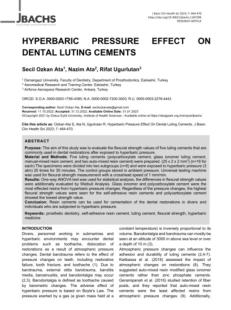
Authors: Secil Ozkan Ata, Nazim Ata, Rifat Ugurlutan
The aim of this study was to evaluate the flexural strength
values of five luting cements that are commonly used in
dental restorations after exposed to hyperbaric pressure.

Authors:
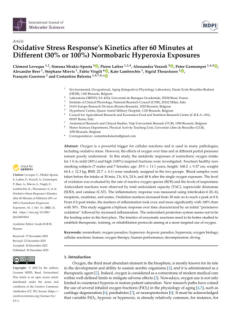
Clément Leveque, Simona Mrakic-Sposta, Pierre Lafère,
Alessandra Vezzoli, Peter Germonpré, Alexandre Beer,
Stéphane Mievis, Fabio Virgili, Kate Lambrechts, , Sigrid
Theunissen, François Guerrero, and Costantino Balestra
The effects of oxygen over time and at different partial
pressures remain poorly understood. In this study, the
metabolic responses of normobaric oxygen intake for 1 h
to mild (30%) and high (100%) inspired fractions were
investigated.

Authors:
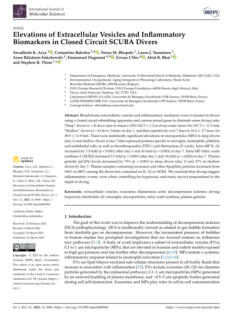
Awadhesh K. Arya, Costantino Balestra, Veena M.
Bhopale, Laura J. Tuominen, Anne Räisänen-Sokolowski,
Emmanuel Dugrenot, Erwan L’Her, Abid R. Bhat, and
Stephen R. Thom
Blood-borne extracellular vesicles and inflammatory
mediators were evaluated in divers using a closed circuit
rebreathing apparatus and custom-mixed gases to
diminish some diving risks.

Authors:
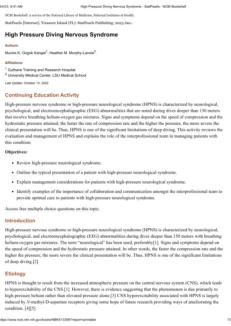
Munire K. Ozgok Kangal, Heather M. Murphy-Lavoie
HPNS is one of the significant limitations of deep diving.
This document reviews the evaluation and management
of HPNS and explains the role of the interprofessional team
in managing patients with this condition.

Published by the International Bioethics Study Group
Animal experimentation is widely used around the world
for the identification of the root causes of various diseases
in humans and animals and for exploring treatment
options. Among the several animal species, rats, mice and
purpose-bred birds comprise almost 90% of the animals
that are used for research purpose. However, growing
awareness of the sentience of animals and their
experience of pain and suffering has led to strong
opposition to animal research among many scientists and
the general public. In addition, the usefulness of
extrapolating animal data to humans has been questioned.

Authors:
Yu Bai, Shengsong Chen, Zeyu Zhang, Xu Huang, Jingen
Xia, Min Li, Qingyuan Zhan
Although acute respiratory distress syndrome (ARDS)
patients are provided a lung rest strategy during
extracorporeal membrane oxygenation (ECMO)
treatment, the exact conditions of barotrauma is unclear.
Therefore, The authors analyzed the epidemiology and risk
factors for barotrauma in ARDS patients using ECMO in a
single, large ECMO center in China.

Authors: James P. Fisher, Johanna Roche, Rachel Turner,
Anna Walzl, Giulia Roveri, Hannes Gatterer, and
Christoph Siebenmann
The authors sought to determine the effects of prolonged
moderate hypobaric hypoxia (HH) on cardiac baroreflex
sensitivity (cBRS) in young women and whether these
effects are a consequence of the reduced arterial oxygen
(O2) tension and/or increased pulmonary ventilation in
HH. They hypothesized that HH would reduce cBRS, and
that this effect would be counteracted by the acute
restoration of the inspiratory partial pressure of O2 and/or
voluntary attenuation of pulmonary ventilation.

Authors:
Johanna Roche, Peter Rasmussen, Hannes Gatterer, Giulia
Roveri, Rachel Turner, Gerrit van Hall, Marc Maillard, Anna
Walzl, Michael Kob, Giacomo Strapazzon, Jens Peter
Goetze, Simon Thomas Schafer, Tobias Kammerer, Elie
Nader, Philippe Connes, Melanie Robert, Thomas Mueller,
Eric Feraille, and Christoph Siebenmann
The authors previously reported that hypobaric hypoxia
(HH) reduces plasma volume (PV) in men by decreasing
the total circulating plasma protein (TCPP). In this study,
the researchers investigated whether this applies to
women and whether an in flammatory response and/or
endothelial glycocalyx could facilitate the TCCP reduction.

Authors:
Takayuki Tanaka, Shinichiro Ito, Takahiro Ikeda, Shun
Yamaguchi, Shunsuke Kawakami, Tomoo Kitajima, Yusuke
Inoue, Kengo Kanetaka, Toru Iwata, Susumu Eguchi
The authors report a case of transverse colon perforation
caused by a compressed-air gun in a 20-year-old male.
He used a compressed air machine to dust after work,
and a coworker inserted compressed air transanally as a
joke. Although he returned home once, he consulted a
hospital due to worsening abdominal pain. Radiography
and computed tomography (CT) revealed a massive
amount of free air.

Authors: Yun Mukmin Akbar, Ani Melani Maskoen, Endah
Mardiati, Ganesha Wandaw, Arlette Suzy
Setiawan
This review article aims to describe animal studies on the
potential effects of hyperbaric oxygen therapy in
orthodontic treatment. It was conducted using a
systematic literature review method, which involved
searching PubMed and Google Scholar for publications
relevant to the research topics. The search was filtered to
include only research on orthodontic treatment and
hyperbaric oxygen therapy and was published in any year.

Authors:
Hannes Gatterer, Johanna Roche, Rachel Turner, Giovanni
Vinetti, Giulia Roveri, Maja Schlittler, Michael Kob, Anna
Walzl, Tomas Dal Cappello, Tadej Debevec, and Christoph
Siebenmann
Altitude exposure may suppress appetite and, hence,
provide a viable weight-loss strategy. While changes in
food intake and availability, as well as physical activity, may
contribute to altered appetite at altitude, herein, we aimed
to investigate the isolated effects of hypobaric hypoxia on
appetite regulation and sensation. Twelve healthy women
completed two 4-day sojourns in a hypobaric chamber,
one in normoxia,and one in hypobaric hypoxia equivalent
to 3,500 m altitude.

Authors:
Emmanuel Gouin, Costantino Balestra, Jeremy Orsat,
Emmanuel Dugrenot, and Erwan L’Her
The use of closed-circuit rebreathers (CCRs) in recreational
diving is gaining interest. However, data regarding its
physiological effects is still scarce. Immersion, cold water,
hyperoxia, exercise, or the equipment itself could
challenge the cardiopulmonary system. The purpose of
this study was to examine the impact of CCR diving on
lung function and autonomous cardiac activity after a
series of CCR dives in cold water..

Authors: Agni Febrina Pargaputri, Dwi Andriani,
Mardiyanto Riski Hartono, Kharinna Widowati
he liver is an organ that plays a role in metabolism and the
detoxification of chemical substances. The excessive use of
immunosuppressive drugs not only becomes a
predisposing factor for oral candidiasis but also can cause
damage and impairs liver function. Hyperbaric oxygen
treatment is known to preserve hepatocytes and prevent
liver damage. This study aimed to investigate the effect of
hyperbaric oxygen treatment on liver hepatocyte damage
in oral candidiasis immunosuppressed rats.

Click on the octopus
to return to the top
of the page

Authors: Oscar Plogmark, Carl Hjelte, Magnus Ekström,
Oskar Frånberg
The objective of this study was to analyze the agreement
between ultrasound bubble grades obtained from a
handheld self-positioning product, the O'Dive, and 2D
cardiac ultrasound after decompression. The conclusion is
that the O'Dive produced lower venous gas embolism
(VGE) grades compared to 2D cardiac ultrasound
imaging, resulting in a low level of agreement (fair to
poor) with weighted kappa* (weighted kappa* is a
statistical measure used to evaluate the level of agreement
between two raters or observers).

Authors: Muhammad Aulia Hikmah Romadoni, Dwi
Rahmat, Eka Arie Yuliyani
The aim of this study was to identify inner ear
decompression sickness (IEDCS) in divers. The authors
conclude that hyperbaric oxygen is the preferred therapy.
However, there may be residual deficits in balance and
hearing. In addition, they believe that diving
should be conducted according to protocol, and
information about decompression sickness should be
provided to at-risk groups through education, counseling,
or other media, in order to generate knowledge that is
relevant to taking precautions.

Authors:
Kaitlin J. Mayne, Jennifer S. Lees, & William G. Herrington
This document intends to explain bioimpedance devices,
mainly focusing on their use in estimating body water and
fat. It highlights the differences between bioimpedance
spectroscopy (BIS) and bioimpedance analysis (BIA) and
emphasizes the capabilities of the Fresenius Body
Composition Monitor (BCM) in quantifying fluid overload
independently of body composition.

Authors: Gerrit A. Martens, Lars P. Folkow, Thorsten
Burmester, and Cornelia Geßner
This study presents scientific research findings on the
antioxidant defense mechanisms in the brains of marine
mammals, specifically harp seals and hooded seals. The
study focuses on the expression and activity of various
antioxidant genes and enzymes in different brain regions
and compares these findings to those in mice. It also
explores whether there is evidence of positive selection in
these antioxidant genes.

Authors: Sotiris Evgenidis, Thodoris Karapantsios
This paper describes a study that uses Computational Fluid
Dynamics (CFD) simulations to investigate pulsatile bubbly
flow in a column, which mimics the flow inside the
human vena cava during Decompression Sickness (DCS)
to understand the effects of specific parameters on bubbly
blood flow to aid in designing in-vitro experiments and in-
vivo trials. It outlines the methods used, including specific
software, highlighting the impact of bubble size on flow
characteristics and the potential improvements in
experimental design for bubble detection in DCS.


13 - Right cardiac chambers echo- bubble contrast in a patient with
decompression sickness: A case report and a literature review
- Published by Clinical Case Reports - Wiley.
Authors: Allam Harfoush, Mohammad Ramadan,
Hanady Hamdallah
Decompression sickness (DCS) diagnosis relies on clinical
suspicion, without full confirmation methods.
Transthoracic echocardiography (TTE) detects
microbubbles in DCS cases. A case of a 54-year-old
fisherman with symptoms after diving showed TTE
findings, leading to hyperbaric oxygen therapy (HBOT).
TTE could assist in diagnosing and monitoring DCS
patients.

21 - Decompression Illness in a Scuba Diver With Significant
Esophageal Injury
- Published by the ACG Case Reports Journal
Author: Eyal Avivi, Dana Zelnik Yovel, Daniel L. Cohen,
and Haim Shirin
This report covers an incident that happened to an
experienced diver who had a rapid ascent due to
mechanical failure, leading to severe esophageal injury
with ulcerations and, later, an esophageal stricture
requiring dilation. This is the first case report of such an
injury from decompression illness in a scuba diver.
Authors: Muhammad Aulia Hikmah Romadoni, Dwi
Rahmat, Eka Arie Yuliyani
Inner ear decompression sickness (IEDCS) is common
among divers in Indonesia, especially diver fishermen. It
occurs due to gas bubbles forming in blood vessels
during rapid ascents. This study aims to identify IEDCS
symptoms and treatments such as hyperbaric oxygen
therapy, which is preferred. Post-recovery, some may have
balance and hearing deficits. Education and precautions
are necessary for at-risk groups.
Authors: Kara D. Wyatt, Neha N. Goel, and Jessica S.
Whittle
High-flow nasal oxygen (HFNO) is a novel treatment for
respiratory failure that improves breathing and lung
function. While its physiological benefits are established,
its clinical effectiveness across different types of
respiratory failure (Type I, II, III, and IV) in both adults and
children, and in various settings like emergency
departments, ICUs, outpatient, and procedural areas, is
still being actively researched. This article reviews the
latest findings on HFNO's clinical efficacy in these diverse
contexts.

12 - Carbon dioxide tolerability and toxicity in rat and man: A
translational study
- Published by Frontiers
Authors: Rutger van der Schrier, Monique van Velzen,
Margot Roozekrans, Elise Sarton, Erik Olofsen,
Marieke Niesters, Chantal Smulders, and Albert
Dahan
This research provides crucial data on the physiological
changes in humans and fatalities in rats following acute
exposure to high CO2 levels. The findings suggest that
current governmental risk assessment levels for CO2
exposure (currently < 7.5%) should be reconsidered and
potentially raised to ≤ 9%, as humans showed tolerance
and functional coherence at this level for limited durations.

31 - Descriptive study of decompression illness in a hyperbaric
medicine centre in Bangkok, Thailand from 2015 to 2021
- Published by Diving and Hyperbaric Medicine
Author: Pitchaya Chevasutho, Hansa Premmaneesakul,
Atipong Sujiratana
This study focused on decompression illness patients at
the Center of Hyperbaric Medicine in Thailand.
Researchers reviewed medical records from 2015 to 2021,
analyzing 98 cases involving 97 divers, primarily male and
Thai. Most divers had at least open water certification, and
17 received on-site first aid oxygen. The main health issues
were neurological (57%), mixed organs (28%),
musculoskeletal (13%), and pulmonary (2%). Three cases
involved arterial gas embolism. Ninety divers received
treatment, with 65% recovering completely after
hyperbaric oxygen therapy.

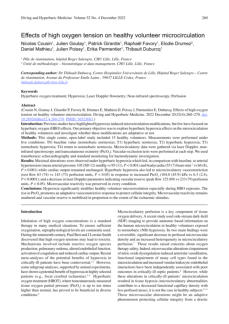
32 - Effects of high oxygen tension on healthy volunteer
microcirculation
- Published by Diving and Hyperbaric Medicine
Author: Nicolas Cousin, Julien Goutay, Patrick Girardie,
Raphaël Favory, Elodie Drumez, Daniel Mathieu,
Julien Poissy, Erika Parmentier, Thibault Duburcq
This study assessed hyperbaric hyperoxia's effect on
microcirculation in 15 healthy volunteers under five
conditions. Hyperbaric hyperoxia produced arterial
hypertension and bradycardia, with stable cardiac output.
It caused marked microvascular vasoconstriction due to
elevated tissue oxygen tension, reducing vascular reserve.
Despite these changes, microvascular reactivity remained
intact.
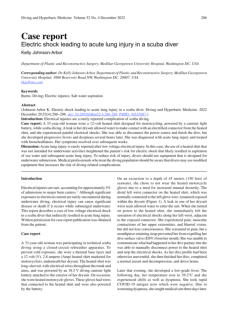
33 - Electric shock leading to acute lung injury in a scuba diver
- Published by Diving and Hyperbaric Medicine
Author: Kelly Johnson-Arbor
Electrical injury during scuba diving is rare. A 33-year-old
woman using a 12-volt motorcycling heated
shirt—powered by a canister light battery—suffered painful
shocks when seawater contacted an exposed connector
due to a drysuit leak. Though she disconnected the
power and completed the dive, she later developed
fevers, dyspnoea, and was diagnosed with acute lung
injury, treated successfully with bronchodilators;
symptoms resolved over weeks.
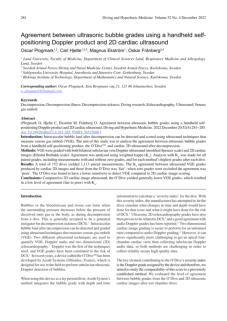
34 - Agreement between ultrasonic bubble grades using a
handheld self-positioning Doppler product and 2D cardiac
ultrasound
- Published by Diving and Hyperbaric Medicine
Author: Oscar Plogmark, Carl Hjelte, Magnus Ekström,
Oskar Frånberg
This study compared the agreement between venous gas
emboli (VGE) grades detected by the handheld O’Dive
device and cardiac 2D ultrasound after decompression.
Using weighted kappa (Kw) analysis on 1,113 paired
measurements from 152 dives, the agreement was 'fair'
overall but 'poor' when excluding zero-grade detections.
The O’Dive demonstrated lower sensitivity in detecting
VGE compared to 2D cardiac imaging.
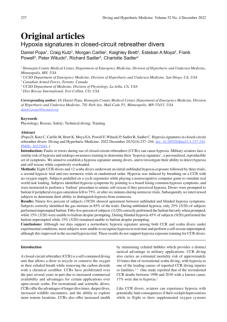
35 - Hypoxia signatures in closed-circuit rebreather divers
- Published by Diving and Hyperbaric Medicine
Author: Daniel Popa, Craig Kutz, Morgan Carlile, Kaighley
Brett, Esteban A Moya, Frank Powell, Peter
Witucki, Richard Sadler, Charlotte Sadler
Faults in using closed-circuit rebreathers (CCRs) can lead
to hypoxia, similar to risks faced by military aviators who
receive training to recognize their own hypoxia
symptoms. This study aimed to identify a hypoxia
signature in divers and their ability to detect hypoxia and
self-rescue under cognitive load. Eight CCR divers and 12
scuba divers participated in trials with hypoxia induced by
lacking oxygen supply while performing tasks. Results
showed that 95% of subjects agreed on hypoxia
symptoms. However, only 25% performed self-rescue
without prompts during unblinded hypoxia, while
performance improved under prompting, indicating
varied abilities among divers to respond to hypoxia.
36 - Delayed treatment for decompression illness: factors associated
with long treatment delays and treatment outcome
- Published by Diving and Hyperbaric Medicine
Author: Sofia A Sokolowski, Anne K Räisänen-Sokolowski,
Laura J Tuominen, Richard V Lundell
This retrospective study of 546 DCI patients treated in
Finland (1999–2018) found that hyperbaric oxygen
therapy (HBOT) remained effective even when delayed
beyond 48 hours, with no significant difference in final
recovery rates compared to earlier treatment. Cardio-
pulmonary symptoms correlated with shorter delays,
while mild sensory symptoms were linked to longer delays
and better recovery. Patients needing only one HBOT
session had shorter delays. Tinnitus and hearing
impairment predicted poor outcomes, whereas nausea,
motor weakness, and visual disturbances showed
intermediate residual symptom rates. Severe symptoms led
to faster treatment initiation but lower full recovery rates.