










Vessel design, maintenance, & management 2024 - 2026









Click on the
octopus to return to
the top of the page
Publisher: Bureau Veritas
This document defines the process within the scope of
classification of ships fitted with wind propulsion systems.

Authors:
Menelaos Zetas, Sotirios Spantideas, Anastasios
Giannopoulos, Nikolaos Nomikos and Panagiotis Trakadas
This study proposes a new approach to Smart Shipping
(SMS) in the maritime sector to address the challenges
associated with conventional centralized learning
schemes by introducing a joint adoption of Federated
Learning (FL) principles and the Over-the-Air computation
(AirComp) wireless transmission framework. It describes
the mathematical considerations, communication network
enhancements, and workflow of the proposed
FL/AirComp scheme. It also evaluates the performance of
this methodology.



3 - A review on the research progress and application of
compressed hydrogen in the marine hydrogen fuel cell power
system
Authors: Ji-Chao, Heng Xu, Ke Zhou, Ji-Qiang Li
The International Maritime Organization (IMO) has issued
stringent directives to reduce greenhouse gas emissions
from maritime vessels. Hydrogen, a crucial fuel for global
economies, is being explored for its transportation and
propulsion applications. However, the development of
hydrogen-powered vessels faces technical hurdles and
requires thorough examination. This study aims to
understand these challenges and their potential trajectory.

5 - A Study on Fishing Vessel Energy System Optimization Using
Bond Graphs
Authors: Sang-Won Moon, Won-Sun Ruy, and Kwang-
Phil Park
This study explores the use of electric-diesel hybrid
propulsion for small ships, using a Bond graph to model
energy sources. The goal is to find optimal operational
scenarios and reduction ratios for the entire voyage,
considering navigation features in different maritime
regions. The reduction gear is crucial for efficient
operation performance with minimal design changes.
6 - Hydrodynamic Development and Optimisation of a Retrofittable
Dual-Mode Propeller Turbine
Authors: Joylan Rao Erriah, Pengfei Liu, and Serkan
Turkmen
Dual-mode propellers are widely used in renewable
energy systems for marine vehicles, but they often lack
hydrodynamic optimization. A study on the Princess
Royale vessel aimed to design a dual-mode propeller
turbine rotor that achieves balanced performance in
propulsion and energy generation. The optimized fixed-
pitch propeller exhibits dual functionality, suitable for low-
speed vessels and sailboats.

7 - Evaluation of a multiphase cascaded H-bridge inverter for
induction motor operation
Authors: B. Jyothi, P. Srinivasa Varma, C. V. Ravikumar, C.
Dhanamjayulu, Tai-hoon Kim, K. P. Prasad Rao,
A. Rajesh & Shafiq Ahmad
Multi-phase systems are increasingly popular for high
power and precise motor control, with three-phase
systems being the most widely used. Different phase
values can be investigated for specific applications, such as
electric ship propulsion, rocket satellites, and traction
systems. This study focuses on an induction motor drive
powered by a five-phase multilevel cascaded H-Bridge
inverter, assessing its dynamic performance using pulse
width modulation converters and an FPGA controller.
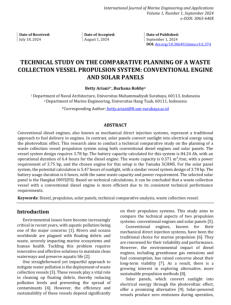
8 - Technical Study on the Comparative Planning of a Waste
Collection Vessel Propulsion System: Conventional Engine and Solar
Panels
Authors: Betty Ariani & Burhana Robby
This research compares two propulsion systems for a
waste collection vessel: conventional diesel engines and
solar panels. Both systems are designed for 3.78 hp with
0.371 m³/ton waste capacity.
The diesel engine (Yamaha 5CHMS) operates for 6.4
hours with an 84.24 Ah battery, while the solar panel
system (Hangkai DNYSJYSJ) provides 5.47 hours of
sunlight utilization with 6 hours of battery usage.
Technical analysis concludes that the conventional diesel
engine is more efficient due to its consistent and reliable
performance characteristics
10 - Impact of automation and zero-emission propulsion on design
of small inland cargo vessels
Authors: Igor Backalov, Hans-Christoph Burmeister,
Ljubisav Isidorovic, Justin Jasa, Marko Josipovic,
Kristoffer Kloch, Alexandros Koimtzoglou,
Vladimir Krasilnikov, Stefan Krause, Denys
Mateienko, Håvard Nordahl, Nathalie Reinach
This paper explores modernizing small inland waterways'
cargo transport capacity by analyzing the impact of
automation and zero-emission propulsion technology on
reference designs of European inland cargo vessels. The
study identifies the most promising vessel classes for
future small autonomous inland ships, focusing on
general arrangement, cargo capacity, safety, and
structural design.
14- Advancing a sustainable maritime future: Integrating energy
efficiency and underwater radiated noise reduction strategies in
commercial shipping
Authors: Seyedvahid Vakili, Paul White, Stephen Turnock
This paper explores the relationship between energy
efficiency measures and reducing Underwater Radiated
Noise (URN) from ships, aligning with the International
Maritime Organization's greenhouse gas reduction
strategy. Various EE measures, such as speed reduction,
wind-assisted propulsion systems, energy saving devices,
and air lubrication systems, show promise in achieving
GHG emissions reductions. The adoption of EE measures
is expected to grow, leading to individual vessel URN
reduction. The effectiveness of GHG emission regulations
depends on achieving zero-emission shipping by 2050.
Publishers:
BIMCO, International Chamber of Shipping, INTERCARGO,
INTERMANAGER, International Group of P&I Clubs,
INTERTANKO, Oil Companies International Marine Forum.
The Best Management Practices (BMP) Marine Security
initiative involves several key maritime organizations
working together to enhance maritime security. Guidance
and links that are region specific are included under the
relevant regions, whereas universally applicable guidance
and links are included under 'Global'.
The BMP guidelines are widely recognized and used
across the maritime industry to help ensure the safety and
security of vessels and their crews

15 - BMP Marine Security - 2025

16 - Energy Saving Potential of Hybrid Propulsion System for Fishing
Vessels in Indonesia
Authors: Samsul Maarif, Sunaryo, Muhammad Arif
Budiyanto
Indonesia's fishing fleet, primarily powered by
conventional diesel engines, contributes to greenhouse
gas emissions and unstable operating costs. This study
suggests that implementing hybrid propulsion systems
can reduce energy consumption by up to 29.4%, fuel
consumption by 25%, and CO2 emissions by up to 23%
per trip. It recommends ideal propulsion designs and
supports the transition to sustainable electricity
technology in the Indonesian maritime sector.
17 - Integration of Renewable Energy in the Electrical System of
Small-Scale Fishing Vessels: a Sustainable Marine Solution
Authors: Edy Prasetyo Hidayat, Imam Sutrisno, Fais
Hamzah, Fahmi Umasangadji
This research investigates the use of renewable energy in
small-scale fishing vessels as a sustainable solution for
coastal communities. It develops a solar-powered electrical
system with battery storage, reducing dependence on
fossil fuels and enhancing energy reliability at sea.

Authors:
BIMCO, Cruise line international association, International
Chamber of Shipping, Intertanko, IMCA, Intercargo.
The MISTO provides general and situational information
on maritime threats, focusing on physical threats such as
piracy, armed robbery, terrorism, and war. It does not
provide legal, operational, or financial advice and does
not replace the need for ship operators to implement their
own security protocols, risk assessments, and adhere to
regulations.

18 - Maritime Industry Security Threat Overview - 2025
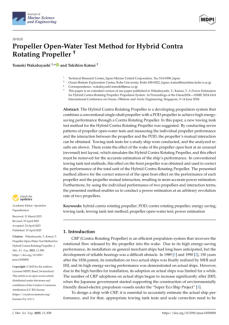
19 - Propeller Open-Water Test Method for Hybrid Contra Rotating
Propeller
Authors: Tomoki Wakabayashi, and Tokihiro Katsui
The Hybrid Contra Rotating Propeller combines a
traditional single-shaft propeller with a POD propeller for
energy savings. A new towing tank testing method was
proposed, involving seven propeller tests to measure
performance and interactions. The method aims to
correct the impact of wake effects for accurate ship
performance estimation.

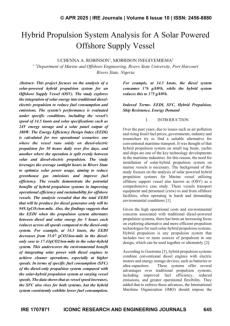
20 - Hybrid Propulsion System Analysis for A Solar Powered Offshore
Supply Vessel
Authors: Uchenna a. Robinson, Morrison Inegiyemiema
This study examines a solar-powered hybrid propulsion
system for an Offshore Supply Vessel (OSV) to reduce fuel
consumption and emissions. The system's performance is
evaluated under specific conditions, including a vessel
speed of 14.5 knots and solar specifications. The Energy
Efficiency Design Index (EEDI) is calculated for two
operational scenarios: one solely on diesel-electric
propulsion for 10 hours daily over five days, and another
where operation is split evenly between solar and diesel-
electric propulsion. The results show potential benefits of
hybrid propulsion systems in improving operational
efficiency and sustainability for offshore vessels.
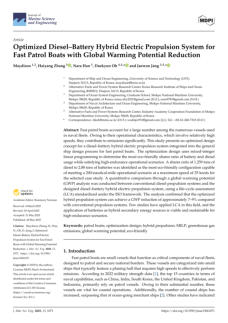
21 - Optimized Diesel–Battery Hybrid Electric Propulsion System for
Fast Patrol Boats with Global Warming Potential Reduction
Authors: Maydison, Haiyang Zhang, Nara Han, Daekyun
Oh, and Jaewon Jang
Fast patrol boats contribute significantly to emissions due
to their high speeds. This study presents an optimized
design concept for a diesel-battery hybrid electric
propulsion system for these boats. The system uses mixed-
integer linear programming to determine the most eco-
friendly battery-diesel usage ratio. A GWP analysis showed
a 7-9% reduction in GWP compared to conventional
diesel propulsion systems, making batteries a viable and
sustainable alternative for high-endurance scenarios.
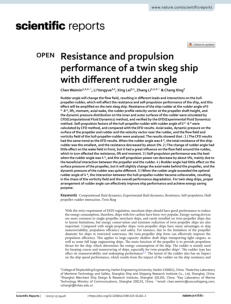
24 - Resistance and propulsion performance of a twin skeg ship with
different rudder angle
Authors: Chen Weimin, Li Yongyue, Xing Lei, Zhang Li, &
Chang Xing
Rudder angle affects ship resistance and self-propulsion
performance, especially on twin skeg ships. Simulations
using the CFD and EFD methods showed that rudder
angle changes had minimal effect on wake field, but
affected flow field around the rudder. Self-propulsion
performance was best at 4°, with a 4% decrease in power
due to beneficial interaction.
25 - Design and Study of a New Wave Actuator for a Boat
Authors: Phan Huy Nam Anh, Hyeung-Sik Choi,
Dongwook Jung, Rouchen Zhang, Mai The Vu,
and Hyunjoon Cho
This paper presents a new wave actuator for boats that
converts hydrodynamic forces from rising waves into
translational thrusting forces. The actuator consists of a
flexible water tank, revolving springs, and nozzles. The
system achieves a cruising speed of 6.098 m/s and a
high energy conversion efficiency of 67.9% at a wave
frequency of 0.3 Hz, demonstrating its potential for
efficient and sustainable marine propulsion.
26 - Novel Hybrid Aquatic–Aerial Vehicle to Survey in High Sea
States: Initial Flow Dynamics on Dive and Breach
Authors: Matthew J. Ericksen, Keith F. Joiner, Nicholas J.
Lawson, Andrew Truslove, Georgia Warren,
Jisheng Zhao, and Ahmed Swidan
This study examines the feasibility of a recoverable sonar-
search child aircraft for maritime patrol, aiming to
overcome the sea state limitations of current Hybrid
Aquatic-Aerial Vehicles (HAAVs). The research uses
computational fluid dynamic (CFD) simulations to analyze
the impact force magnitudes of a HAAV diving into static
seawater at low speeds. The results provide insights into
the structural, propulsive, buoyancy, and control
requirements for future design iterations. The research
now focuses on validating these simulations with pool
experiments and examining the effects of realistic ocean
sea states.
27 - Ship trajectory prediction via a transformer-based model by
considering spatial-temporal dependency
Authors: Xinqiang Chen, Peiyang Wu, Yuzheng Wu,
Loay Aboud, Octavian Postolache, Zichuang
Wang.
The study presents a ship trajectory prediction model
using the Crossformer architecture, which efficiently
captures spatiotemporal dependencies in ship movement
patterns. The model outperforms traditional models,
reducing average error by over 60% in complex scenarios
and up to 70% in smooth scenarios. This research
provides a high-precision solution for intelligent ship
scheduling, maritime traffic management, and navigation
safety assurance.
22 - A Framework for Risk Evolution Path Forecasting Model of
Maritime Traffic Accidents Based on Link Prediction
Authors: Shaoyong Liu, Jian Deng, and Cheng Xie
This article presents a quantitative framework that
integrates complex network theory and link prediction
methods to analyze the evolving risks associated with
maritime traffic accidents. By examining 371 maritime
accident investigation reports, the study identifies key risk
factors and builds a risk evolution network model to assess
the interconnections among these factors and accident
types. Findings reveal distinct relationships between
specific risk factors and accident occurrences, providing
valuable insights for improving safety in water
transportation and aiding in effective accident prevention
and mitigation strategies.
12 - Guidelines for Underwater Noise from Ships and Trends in the
IMO, Etc
Authors: ClassNK’s Research Institute and R&D Division
The ClassNK R&D Forum, held in January, aimed to
identify maritime industry needs for services and R&D,
fostering new collaborations. A key presentation focused
on ship-generated underwater noise, a growing
environmental concern. The article summarizes
discussions on IMO initiatives for reducing commercial
shipping's underwater radiated noise and responses to
related guidelines. It outlines the history of IMO guidelines,
the nature of underwater noise, international reduction
efforts, classification society guidelines, technical
challenges, and ClassNK's future plans.

Authors: Rudianto, Pratama Yuli Arianto, Jangka Rulianto,
Nauval Maulana Yusuf Wahyudinata
This study analyzes marine safety in transporting
dangerous goods, focusing on how risk management
influences safety outcomes for hazardous cargo. It
highlights challenges and the need for stringent measures
to prevent accidents and protect the environment,
drawing on regulations, safety protocols, and real-world
incidents. The findings assess safety measures, identify
gaps, and stress rigorous protocols, crew training, real-
time cargo monitoring, and emergency response plans. It
emphasizes proactive risk assessment and improvements,
with a well-trained, alert crew playing a pivotal role.
Overall, the study supports ongoing efforts to enhance
vessel safety through regulatory compliance and proactive
safety management.
28 - Operating autonomous tanker vessels in Malaysian territorial
waters: Focus on security and emergency response
preparedness
Authors: Rasyidah Mohd Sani, and Mohammed Ismail
Russtam Suhrab
This study assesses Malaysia’s readiness for autonomous
tanker vessels, focusing on cybersecurity and emergency
response. Based on interviews and surveys with 100
maritime stakeholders, including shipowners, port
authorities, regulators, and cybersecurity experts, it
identifies key challenges: moderate awareness of
autonomous technologies, serious cybersecurity
vulnerabilities, lack of robust regulatory frameworks, port
infrastructure gaps, and low public acceptance.
The research recommends strengthening cybersecurity
measures, establishing integrated emergency response
systems, and promoting regional collaboration to enable
safe, effective adoption of autonomous shipping.
32 - Collisions at Sea Involving Maritime Autonomous Surface Ships:
Notes on Prevention and Liability Rules
Authors: Zuzanna Pepłowska-Dabrowska, Krzysztof
Wróbel, Mateusz Gil, Ryszard Wawruch
As Maritime Autonomous Surface Ships (MASS) approach
global implementation, unresolved technical and legal
challenges remain, currently under review by the
International Maritime Organisation. The authors
emphasize critical gaps in collision avoidance protocols
and liability frameworks, specifically the 1972 COLREGs
and the 1910 Collision Liability Convention. The study
examines technical limitations of MASS collision avoidance
from a legal perspective, evaluates existing liability rules for
autonomous ship collisions, and proposes policy
recommendations for an optimal international regulatory
approach.
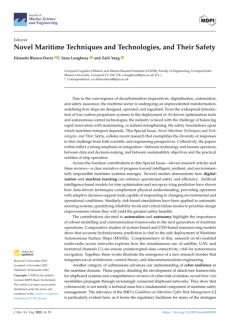
33 - Novel Maritime Techniques and Technologies, and Their Safety
Authors: Eduardo Blanco-Davis, Sean Loughney, and Zaili
Yang
The maritime sector is transforming due to the need for
decarbonisation, digitalisation, automation, and safety
assurance. It is adopting low-carbon propulsion systems
and AI-driven tools while striving to enhance safety in ship
design and operation. This Special Issue, "Novel Maritime
Techniques and Technologies, and Their Safety," presents
recent research showcasing varied responses to these
challenges from scientific and engineering viewpoints.
The papers highlight the importance of integrating
technology with human operators, data with decision-
making, and sustainability with practical ship operations.

34 - Anti-vibration method for sensing ring of fiber optical current
transformer integrating structural design and adaptive signal
processing
Authors: Lin Cheng, Jianyong Luo, Weibin Si, Yanhua
Han, Kun Zuo , Haitao Sun, Bo Niu, Shuangzan
Ren
This paper studies vibration resistance and fault
identification for fiber-optic current transformers (FOCTs).
It analyzes FOCT principles—Faraday magneto-optical
effects and Ampere’s law—and models optoelectronic
components to assess vibration impacts. Experimental
results show vibration-induced performance variations.
ANN-based and FIR filtering methods compensate errors
under sinusoidal and impact vibrations to improve
accuracy.

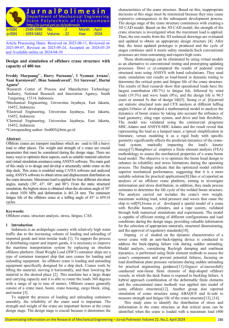
4 - Design and simulation of offshore crane structure with capacity of
400 ton
Authors: Freddy Marpaung, Harry Purnama, Nyoman
Artana, Nani Kurniawati, Dian Samodrawati, Tri
Surawan, Harini Agusta
This study focuses on designing a structurally stable
offshore crane for ship decks, emphasizing weight and
strength optimization through material selection and
virtual simulation. The crane is modeled in CATIA and
analyzed in ANSYS for stress, displacement, and fatigue life
under maximum load at four elevation angles (30°, 43°,
60°, 80°). Static analysis reveals peak stress (1030 MPa) and
deformation (461.24 mm) at 30°, while the lowest fatigue
life (659.14 cycles) occurs at 43°.
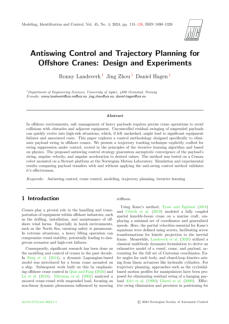
9 - Antiswing Control and Trajectory Planning for Offshore Cranes:
Design and Experiments
Authors: Ronny Landsverk, Jing Zhou, Daniel Hagen
Offshore crane operations demand precise control to
prevent collisions and equipment damage caused by
uncontrolled payload swinging. This paper presents an
anti-swing control methodology based on iterative
learning algorithms and physics principles that suppresses
payload oscillation by ensuring convergence of swing,
angular velocity, and angular acceleration to desired
values. Testing on a Comau robot with Stewart platform at
the Norwegian Motion Laboratory demonstrated the
method's effectiveness through simulation and
experimental validation.

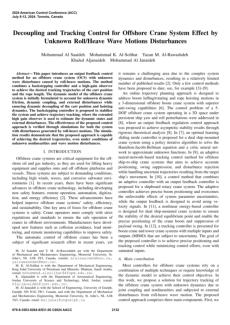
11 - Decoupling and Tracking Control for Offshore Crane System
Effect by Unknown Roll/Heave Wave Motions Disturbances
Authors: Mohammad Al Saaideh, Mohammad K. Al-
Solihat, Yazan M. Al-Rawashdeh, Khaled
Aljanaideh, Mohammad Al Janaideh
This paper proposes an output feedback control method
for offshore crane systems with unknown wave
disturbances from roll-heave motions. It combines a
backstepping controller and high-gain observer to track
cart position and rope length. The dynamic model
accounts for friction, coupling, and disturbances with
decoupling. Simulations confirm effective trajectory
tracking despite unknown nonlinearities.
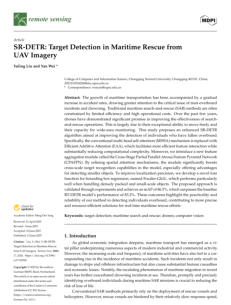
23 - SR-DETR: Target Detection in Maritime Rescue from UAV
Imagery
Authors: Yuling Liu, and Yan Wei
Rising maritime accidents have spotlighted man-
overboard incidents, where traditional SAR methods
remain inefficient and costly. Drones offer mobility and
wide-area monitoring advantages. This study proposes an
enhanced SR-DETR that replaces MHSA with Efficient
Additive Attention (EAA) for lower-complexity feature
interaction, introduces CPAFPN to boost cross-scale small-
object detection, and uses Focaler-GIoU loss for precise
localization. Experiments yield 86.5% mAP, surpassing RT-
DETR’s 83.2%, supporting efficient real-time maritime
rescue.
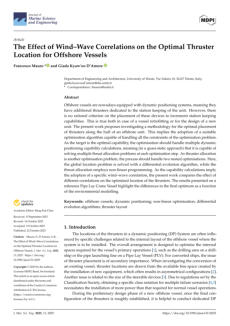
29 - The Effect of Wind–Wave Correlations on the Optimal Thruster
Location for Offshore Vessels
Authors: Francesco Mauro, and Giada Kyaw’oo D'Amore
This paper addresses the lack of criteria for optimally
placing thrusters on offshore vessels equipped with
dynamic positioning systems. It proposes a methodology
using an optimization algorithm to determine the best
placement of thrusters, considering multiple constraints.
The optimization process involves two nested problems:
global location solved by differential evolution and thrust
allocation by non-linear programming. The study
examines how different wind-wave correlations affect the
optimal placement. Results from a Pipe Lay Crane Vessel
demonstrate variations in optimal thruster locations based
on environmental modeling.
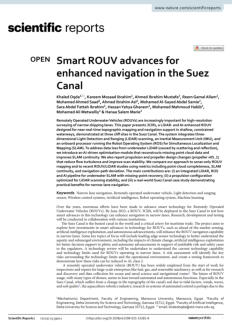
30 - Smart ROUV advances for enhanced navigation in the Suez
Canal
Authors: Khaled Oqda, Kareem Mosaad Ibrahim, Ahmed
Ibrahim Mustafa, Reem Gamal Allam, Muhamed
Ahmed Saad, Ahmed Ibrahim Asl, Mohamed Al-
Sayed Abdel Samie, Sara Abdel Fattah Ibrahim,
Hassan Yahya Ghanem, Mohamed Mahmoud
Habib, Mohamed Ali Metwalliy, & Hanaa Salem
Marie
3Clifs is a LiDAR- and AI-enhanced ROUV for near-real-
time mapping in shallow Suez Canal waterways. It
integrates LiDAR, IMU, and ROS for SLAM, using an AI
module to reconstruct missing point clouds from
scattering and modified propellers (v05_1) for stability.
Evaluations against sonar methods show gains in
completeness and continuity, contributing an integrated
pipeline, optimized propulsion, and practical navigation.
31 - Design of a parameter self-tuning PID controller based on an ER-
SLP for a variable-frequency air compressor in a rapid
deballasting System
Authors: Shouwen Pang, & Jingxin Zhou
This study tackles high energy use and inefficiency in
power frequency air compressors for semisubmersible
platform deballasting by proposing an ER-SLP-based
fractional PID controller. Simulated in Simulink, it
outperforms power frequency, traditional PID, and
fractional PID controls, delivering 7.2% energy savings and
4.7% shorter task time than traditional PID while
improving robustness under dynamic conditions. The
work provides a data-driven framework for industrial
energy-time optimization.