










Vessel design, maintenance, & management 2018 - 2020









Author: Cdr (Dr) Nitin Agarwala
This paper discusses the developments made for the
dynamic positioning system over the years and traces the
evolutions that are helping in the conceptualization of
autonomous ships.


Authors: Anil Kumar D, Manoj C V, Hariprasad S A,
Rakshith D, Poornachandra N U, & Mahalakshmi P
This paper discusses the control algorithm for precise track
keeping even in the presence of sea disturbances.


Author: Hamid Zeraatgar, M. Hossein Ghaemi.
Many research works and related industries currently
address the reduction of greenhouse gas emissions in
shipping. There are many existing and visionary
technologies and ideas, which are conceptually defined
or practically realized. This goal can be achieved in
different ways, and reducing fuel consumption is one of
the effective methods. In these circumstances, this study
aims to analyze the possibility of fuel consumption
reduction by using an alternative control strategy
for low-speed marine diesel engines that would consider
the interactions between hull, propeller, and main
engine.

These Guidelines deal with invasive plants, animals,
disease agents, and other organisms in marine,
freshwater, and terrestrial environments and their impacts
on the environment, biodiversity, ecosystem services,
human health, economies, and society. All of the main
thematic areas and their objectives are required to
manage the invasive species threat comprehensively.
These Guidelines reflect and are compatible with relevant
international conventions and standards and are intended
to assist planners and practitioners in meeting accepted
standards and best practices.


Author: New Zealand Government
This Craft Risk Management Standard (CRMS) specifies the
requirements for management of biofouling risk
associated with vessels (sea craft) that are entering New
Zealand territorial waters.


Author: New Zealand Government
This guidance document provides best practice guidance,
information and recommendations to help operators and
persons in charge of vessels to meet the requirements of
the Craft Risk Management Standard (CRMS) for
Biofouling on Vessels arriving into NZ (referred to in this
document as the “biofouling standard”).

Author: Government of new Zealand
The IMO (International Maritime Organisation) (2011)
Guidelines for the Control and Management of Ships’
Biofouling to Minimize the Transfer of Invasive Aquatic
Species contain examples of current best practices.
Following these will be considered as compliance with
New Zealand’s requirements. The guidelines include
that vessels should have a vessel-specific biofouling
management plan (notably including a hull
maintenance program), documentation, inspections
and antifouling systems, a record of actions under the
plan, and, where relevant, design and construction to
reduce areas prone to biofouling growth.

Authors: B.T. Watermann & K. Broeg for the European
Regional Devellopment Fund.
Due to its characteristics as a semi-enclosed brackish water
sea with a shallow connection to the North Sea and
heavy maritime traffic, the Baltic Sea already faces strong
anthropogenic pressures and impact. Effects are, besides
others, eutrophication, pollution with hazardous
substances, and the introduction of invasive species. Thus,
this Best Practice Guide aims at providing information and
guidance for effective biofouling management strategies
suitable for the Baltic Sea Region based on international
and regional experiences and research.

Authors: Pedro Almeida Vinagre, Teresa Simas, Erica Cruz,
Emiliano Pinori, & Johan Svenson.
Abstract:
Biofouling is a significant problem shared among all
maritime sectors employing submerged structures where
it leads to substantially increased costs and lowers the
operational lifespans if poorly addressed. Insight into the
ongoing processes at the appropriate marine locations is
key to effective management of biofouling. Of specifc
concern for the marine renewable energy (MRE) sector is
that information on biofouling composition and
magnitude across geographies is dispersed throughout
published papers and consulting reports. The present
work describes a European biofouling database to
support the MRE sector and other maritime industries to
enable rapid access to relevant key biofouling events.


This Guide outlines the ABS requirements for the design
and survey of accommodation modules installed
onboard ABS-classed Mobile Offshore Drilling Units
(MODUs), and Mobile Offshore Units (MOUs),
Offshore Installations (fixed or floating), Steel Barges, and
Steel Vessels. The Guide may be voluntarily
applied to other type of portable modules.

This Guide sets forth requirements for the optional
underwater noise notation UWN (Type) and UWN+
(Type). It is applicable to self-propelled commercial and
research vessels.

This Rule Note gives the certification scheme of materials
and equipment (products) intended to be fitted on board
units to be classed or classed with the Society in
accordance with the relevant requirements of the
Society's rules for classification.

The Classification process consists of:
a) The development of Rules, Guides, standards and other
criteria for the design and construction of marine vessels
and structures, for materials, equipment and machinery,
b) The review of design and survey during and after
construction to verify compliance with such Rules,
Guides, standards or other criteria,
c) The assignment and registration of class when such
compliance has been verified, and
d) The issuance of a renewable Classification certificate
with annual endorsements valid for five years.
- 2020

Requirements of these Rules are applicable to crew boats
of less than 500 GRT, with hull made of steel, aluminium
or composite materials, and proceeding in the course of
their voyage not more than four hours at operational
speed from a place of refuge.


This Rule Note covers ships able to sail in planning mode
in adapted sea state at high speed (light ship), or in
planning mode in adapted sea state and speed, and in
displacement mode otherwise (bi-mode ship), or in
displacement mode only (conventional ship).

Author: Alam Baheramsyah, Juniarko Prananda, Darwin
Setiyawan
A limitation of freshwater supply in a lifeboat during sea
survival situation caused by a ship accident could
endanger survivor’s life. An availability of freshwater is
critical for people to survive during search and rescue
time. Therefore, it is very important to have a device that
can produce freshwater continuously in a lifeboat.

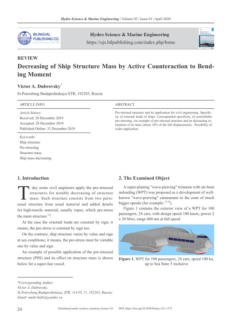
Authors: Victor A. Dubrovsky
Some civil engineers apply the pre-stressed structures for
notable decreasing of structure mass.
Such structure consists of two parts: usual structure from
usual material and added details for high-tensile material,
usually ropes, which pre-stress the main structure.

Publisher: Oil management International Marine Forum
Unsafe events in the offshore marine industry have
indicated that deck cargo operations pose a high safety
risk with the following main contributing factors:
• Large amounts of water on deck (green water).
• Unsecured cargo on deck.
• Personnel in the line of fire.
• Lack of combined operations communications.
These events highlight the need to provide guidance and
align stakeholders across the industry to increase safety,
which is the purpose of this document.

Publisher: International Maritime Organization (IMO)
Abstract:
The Maritime Safety Committee, at its 102nd session (4 to
11 november 2020), having considered a proposal by the
Sub-Committee on Ship Design and Construction, at its
sixth session, and recognizing the importance of
inspection and maintenance of mooring equipment
including lines, approved the Guidelines for inspection
and maintenance of mooring equipment including lines,
as set out in the annex.



Click on the
octopus to return to
the top of the page
14 - The impact of propulsion factors on vessel performance in
waves
Authors: Bhushan Taskar, Pelle Bo Regener, and Poul
Andersen
This study examines the impact of waves on vessel
performance, considering four different ships and
simulations for a transpacific journey. Results show
predicted energy consumption varies from -12% to +4%,
with propulsion efficiency significantly affected. It
emphasizes the importance of considering these factors
for accurate vessel performance prediction.


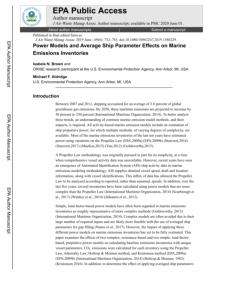
15 - Power Models and Average Ship Parameter Effects on Marine
Emissions Inventories.
Authors: Isabela N. Brown, Michael F. Aldridge
Shipping contributes 2.8% of global greenhouse gas
emissions, with projections of a 50% to 250 percent
increase by 2050. Marine emission models estimate ship
propulsive power using various methods, including the
Propeller Law and Automated Identification System (AIS)
data. This paper examines the effects of complex and
simple propulsive power models on calculating baseline
emissions inventories with unique vessel parameters.

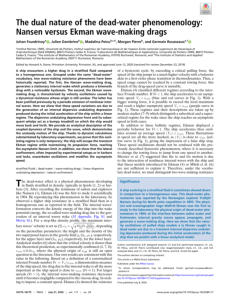
19 - The dual nature of the dead-water phenomenology: Nansen
versus Ekman wave-making drags
Authors: Johan Fourdrinoy, Julien Dambrine, Madalina
Petcu, Morgan Pierre, and Germain Rousseaux
This study explores the higher drag experienced by ships
in stratified fluids, focusing on two wave-making resistance
phenomena: Nansen wave-making drag and Ekman
wave-making drag. The study reveals that these speed
variations are due to an internal dispersive undulating
depression during initial acceleration, acting as a bumpy
treadmill. The study also demonstrates that this oscillating
regime is temporary, and that lateral confinement can
exacerbate oscillations and modify the asymptotic speed.

Authors: Paulo Alexander Jacobsen Jardim, Jan Tore Rein,
Øystein Haveland, Thorstein R. Rykkje, Thomas J.
Impelluso
This article introduces a novel theoretical framework, the
moving frame method (MFM), leveraging Lie group
theory for deriving equations of motion efficiently. The
MFM offers a unified notation for multi-body and single-
body dynamics in both 2D and 3D contexts. The research
emphasizes a variation of angular velocity within
Hamilton’s principle and includes a numerical integration
approach for solving motion equations. Additionally, it
showcases a 3D simulation of the ship’s rotation that can
be viewed on mobile devices, suggesting the MFM’s
potential for advancing “smart ships.”