











Scientific papers 2017 - Part A









Authors: Jandhyala Sridhar & Rajeev Deo
This article describes the various dermatoses that can be
contracted during occupational and recreational diving.

Authors: E. Spisni, C. Marabotti, S. Brambilla, M. C. Valerii,
E. Cavazza, K. Hoxha,L. De Fazio, A. L’Abbate, &
P. Longobardi.
This study aimed to compare two decompression
procedures commonly adopted by technical divers:
The ZH-L16 algorithm, modified by 30/85 gradient factors
(compartmental decompression model, CDM) versus the
‘ratio decompression strategy’ (RDS).
The comparison was based on an analysis of changes in
diver circulating inflammatory profiles caused by
decompression from a single dive.

Authors:
István Vadász & Jacob I. Sznajder
This review discusses recent discoveries on the sensing
and signaling events initiated by hypoxia and hypercapnia
and the relevance of these results in the identification of
potential novel therapeutic targets in the treatment of
acute respiratory distress syndrome (ARDS).

Authors: Pierre Lafère, Costantino Balestra, Dirk Caers,
Peter Germonpré.
The authors have crossed information from Belgian
Hyperbaric Centers, DAN. Emergency Hotline, the press,
and Internet diving forums to consider the majority of
decompression sickness (DCS) occurred in Belgium from
January 1993 to June 2013. From the available 594
records, the authors excluded all cases with tentative
diagnosis, medullary DCS, or unreliability of reported dive
profile, leaving 209 divers records with cerebral DCS for
analysis. Dive parameters and patent foramen ovale (PFO)
were recorded. Twenty-three injured divers were tested
using the Zuckerman’s Sensation Seeking Scale V and
compared to a matched group not involved in risky
activities.

Authors:
Anne-Kathrin Brebeck, Andreas Deussen, Henning
Schmitz-Peiffer, Ursula Ranged, Costantino Balestra, Sinclair
Cleveland, and Jochen D. Schipke.
This study compares the effects of nitrox28 and air on two
psychometric tests. In this double-blind, open-water study,
108 advanced divers were randomized to air or a nitrox
group for a 60-min dive to 24 m saltwater. Breathing gas
effects on cognitive performances were assessed during
the dive using a short and long-term memory test and a
number connection test.

Authors: Shopov Nikola, VazharovIvaylo.
The most likely factor initiating Decompression Sickness
(DCS) is believed to be the formation of bubbles in the
blood and the tissues. Bubbles form during
decompression due to supersaturation of the dissolved
gas from the gas nuclei present in the tissues even at
normal atmospheric pressure and provoke the symptoms
of DCS. Ascent rate is known to be a critical factor for DCS
risk. Individual factors, such as age, weight, and fat tissues,
are also recognized for their implication in DCS risk. This
study aimed to contribute to enhanced safety of divers by
measuring the rate of off-gassing utilizing Doppler after
decompression and relating it to ascent rate and some
individual factors.

Authors: Seol-Jung Kang, Gi-Chul Ha, & Kwang-Jun Ko.
The present study aimed to investigate the association
between metabolic syndrome and cardiorespiratory
fitness according to the resting heart rate of Korean male
adults..

Authors: Peter Germonpré & Costantino Balestra.
Vascular gas emboli (VGE) are observed after
asymptomatic scuba dives and are considered a key
element in the potential development of decompression
sickness (DCS). Diving is also accompanied by vascular
dysfunction, as measured by flow-mediated dilation
(FMD). Previous studies showed significant intersubject
variability to VGE for the same diving exposure and
demonstrated that VGE could be reduced with even a
single pre-dive intervention. Several preconditioning
methods have been reported recently, seemingly acting
either on VGE quantity or inflammatory endothelial
markers.

Authors:
Daniel Mathieu, Alessandro Marroni and Jacek Kot
The tenth European Consensus Conference on
Hyperbaric Medicine took place in April 2016, attended by
a large delegation of experts from Europe and elsewhere.
The focus of the meeting was the revision of the
European Committee on Hyperbaric Medicine (ECHM) list
of accepted indications for hyperbaric oxygen treatment
(HBOT), based on a thorough review of the best available
research and evidence-based medicine (EBM)

Author: Barbara Shykoff
This text has been published on the Shearwater website in
May 2017
https://www.shearwater.com/
Direct link: https://www.shearwater.com/monthly-blog-
posts/uptd-calculations-not-used/

Authors:
Charles H. Van Wijk, Jarred H. Martin, Willem A.J. Meintjes
This paper considers the relationship between measures
of personality and mood states and susceptibility to inert
gas narcosis. It briefly reviews the topics of inert gas
narcosis affecting personality and personality affecting the
susceptibility to inert gas narcosis. There appears to be a
theoretical argument for a possible relationship between
measures of personality, mood states, and susceptibility to
narcosis. Practically, such a relationship may speak to
selection, training and preparation issues, risk assessments,
and even accident investigation in the diving and/or
hyperbaric environment.

Authors:
Sara Farshchi Zarabi, Matteo Parotto, Rita Katznelson,
James Downar
Air embolism into the systemic arterial circulation
secondary to pulmonary barotrauma has rarely been
reported. Herein, we report the clinical course of an
extremely rare presentation of cerebral air embolism likely
due to ruptured pulmonary bullae during commercial air
travel.


Click on the octopus
to return to the top
of the page

Author: Andreas Fahlman
A probabilistic model was used to predict the outcome of
decompression sickness (DCS) in pigs (70 and 20 kg),
hamsters (100 g), rats (220 g), and mice (20 g) following
air-saturated dives.
The final model accurately predicted 58 out of 61 dive
profiles for pigs, hamsters, rats, and mice. Body mass
helped improve the prediction of DCS risk in four
mammalian species across a body mass range spanning
three orders of magnitude.

Authors:
Kate Lambrechts, Costantino Balestra, Michaël Theron,
Anne Henckes, Hubert Galinat, Fanny Mignant, Marc
Belhomme, Jean-Michel Pontier, François Guerrero
The authors of this study aimed to evaluate the effect of
bubble formation on vascular function and hemostasis. To
achieve this, they used vibration preconditioning to
influence bubble levels without altering other parameters
associated with the dive.
The results suggest that macrovascular impairment, but
not microvascular impairment, is at least partly due to
bubbles, possibly related to platelet activation and the
generation of procoagulant microparticles.

Authors: Laurens E. Howle, Paul W. Weber, Ethan A.
Hada, Richard D. Vann, and Petar J. Denoble
This study analyzed 3322 cases of air and N2-O2 dives,
which included 190 cases of decompression sickness
(DCS). These were categorized into serious and mild types
using U.S. Navy medical standards. Researchers developed
a three-state model to predict the likelihood of mild and
serious DCS from dive exposure. This model showed a
significant improvement over the two-state model.
Applying the Type I/II definition, longer bottom times are
permitted for a 2% mild DCS risk, but a significant
decrease in allowable bottom time is observed for serious
DCS at a 0.1% risk.

Author: Claire Walsh
This paper describes research on the formation and
dynamics of bubbles in the body due to ambient pressure
changes, which are linked to decompression sickness
(DCS). The author outlines the use of an in vitro matrix
model (collagen type I gel) to validate and further develop
a 3D computational model of extravascular bubble
dynamics and discusses the challenges in validating dive
computer algorithms that incorporate mechanistic bubble
models, the necessity of direct bubble observation, and
the potential of biomimetic in vitro models to address
these challenges.

Author: Yun Jung Oh, Ji Yong Jung, Sung Soo Kim,
Kyong-Suk Chae, Jiwon Rhu, & Chungsik Lee
This study investigates the long-term effects of repetitive
breath-hold diving (BHD) on kidney function. Using a
cross-sectional propensity score-matched analysis, it
specifically examines the prevalence of chronic kidney
disease (CKD) among female breath-hold divers
compared to non-divers. The results indicate that breath-
hold divers have a significantly higher prevalence of CKD,
suggesting that repetitive apnea associated with BHD
may lead to kidney dysfunction over time.

Authors: Kun Zhang, Mengmeng Wang, Haowen Wang,
Yinuo Liu Peter Buzzacott, & Weigang Xu
This paper presents the findings of a scientific study
investigating the relationship between decompression
stress, endothelial injury, and bubble formation in rats to
understand the time course of endothelial injury and its
correlation with bubble amounts following
decompression. The authors detail the methodology,
including the simulated air dive, the detection of bubbles,
and the measurement of specific biomarkers (MDA, ET-1,
ICAM-1). They conclude that endothelial dysfunction
correlates with bubble counts and that these biomarkers
can serve as sensitive parameters for assessing bubble
load and decompression stress

Author: Ran Arieli & Abraham Marmur
The authors of this document present a new biophysical
model for understanding and predicting the formation
and behavior of vascular bubbles during decompression,
which is relevant for improving diver decompression
procedures. They discuss the mechanisms of bubble
formation and expansion, the role of active hydrophobic
spots, the factors influencing bubble dynamics, and
propose a model that aligns more closely with
physiological processes by offering better predictability for
decompression illness.

Authors: Surg Capt D K Ghosha, Surg Cdr C Kodangeb,
Surg Cdr C S Mohanty, Surg Cdr Rohit Vermad
This study focuses on the incidence and management of
diving-related injuries such as Decompression Sickness
(DCS) and Pulmonary Overinflation Syndrome (POIS) with
the purpose of informing on the causes, prevention, and
treatment of these conditions, highlighting the low
incidence of such injuries among navy divers due to strict
adherence to safety procedures and rigorous training.

Authors: S. Lesley Blogg, Andreas Møllerløkken, Mikael
Gennser
This article discusses the results of a retrospective analysis
of post-dive bubbling and DCS incidents from seven
studies, using a particular dive profile. It evaluates the
safety of this dive profile by comparing observed DCS
incidents and bubble measurements with predicted
models and historical data.

Authors: Ilaria Marrocco, Fabio Altieri, and Ilaria Peluso
This document discusses the challenges and biases
associated with the methods used to evaluate oxidative
stress in humans. It highlights the lack of consensus on the
validation, standardization, and reproducibility of these
methods and suggests that using a combination of
markers could provide a more comprehensive assessment
of oxidative stress. Its authors also emphasize the
importance of selecting appropriate markers based on the
study's objectives and the clinical relevance to the subjects
involved.


01 - Physical and physiological aspects of submarine tower escape
- Published by the University of Portmouth
Author: Geoff A.M. Loveman
This work focused on studying submarine escape and
rescue issues, using animal experiments with goats and
human trials. Its author developed mathematical models
to predict equipment performance and decompression
effects and contributed to over sixty reports for the UK
Ministry of Defence. His research supports the use of
surface oxygen for treating decompression illness and has
led to changes in escape policy accepted by the UK Royal
Navy and being part of NATO guidelines.

16 - A comparative evaluation of two decompression procedures for
technical diving using inflammatory responses: compartmental
versus ratio deco
- Published by Diving and Hyperbaric Medicine.
Authors: Enzo Spisni, Claudio Marabotti, Luigia De Fazio,
Maria Chiara Valerii, Elena Cavazza, Stefano
Brambilla, Klarida Hoxha, Antonio L’Abbate and
Pasquale Longobardi
This study compared two decompression methods used
by technical divers: the ZH-L16 algorithm with modified
gradient factors (CDM) and the ratio decompression
strategy (RDS). Fifty-one divers completed a single trimix
dive followed by different decompression schedules.
Results showed no significant differences in bubbles
between the methods, but RDS increased inflammatory
markers, indicating a higher risk of vascular damage
compared to CDM. No decompression sickness cases
were reported.
39 - A technical diving-related burns case: treatment in a remote
location
- Published by Diving and Hyperbaric Medicine
Authors: Fiona C Sharp, Martin DJ Sayer
Injuries from a rebreather oxygen explosion and fire
affected a diver on vacation in Chuuk, Micronesia. The
management of the diver's care in a remote area is
described. The causes of the fire and the resulting injuries
are discussed. Prevention and preparation for such
incidents are highlighted due to the growing popularity
of diving and adventure travel to remote locations.
38 - Executive Functions of Divers Are Selectively Impaired at 20-
Meter Water Depth
- Published by Frontiers
Authors: Fabian Steinberg, and Michael Doppelmayr
This study analyzed executive functions in recreational
and occupational activities underwater, focusing on
nitrogen narcosis. The researchers found that nitrogen
narcosis can affect self-regulation, coping with new
situations, and decision-making abilities. The study
involved 20 young, healthy, and certified divers who
performed three tests: Stroop, Number/Letter, 2-back,
and a simple reaction time test. Results showed no
difference in performance between underwater and
land testing. However, in 20-meter water depth, the
Stroop test showed decreased performance, indicating a
potential impairment in inhibitory control ability. This is
crucial for diver safety, as inhibition is essential for self-
control.
15 - Comparison of lung function values of trained divers in 1.5 ATA
hyperbaric chamber after inhaling 100% oxygen and regular air:
a crossover study
- Published by Viamedica
Authors: Muhammad Irfan Ilmi, Faisal Yunus, Mohammad
Guritno Suryokusumo, Triya Damayanti, Erlang
Samoedro, Ahmad Muslim Nazaruddin, Fariz
Nurwidya
This article presents a study comparing lung function
values in trained divers subjected to two different
gases—100% oxygen and regular air—while in a 1.5 ATA
hyperbaric chamber. Eighteen divers participated in a
crossover design experiment that involved inhalation of
the gases for 30 minutes each, separated by a one-day
washout period. Significant differences in various lung
function metrics were observed, particularly after
inhalation of 100% oxygen, though no significant
changes were noted in lung capacity.

Authors: Thijs T Wingelaar, Pieter-Jan AM van Ooij, and
Rob A van Hulst
This study looked at otitis externa (OE) in military divers
during initial training from 2011 to 2016. It found 30 cases
of OE, with a much higher incidence in 2016 (49%)
compared to previous years (10%). Most cases appeared
after three weeks of diving, with no seasonal influence.
Early treatment did not help in completing courses, and
only three divers stopped training due to OE. The results
suggest OE is common in military divers, often
manageable without halting training.

Authors: Bin Peng, Miao-Miao Chen, Zheng-Lin Jiang, Xia
Li, Guo-Hua Wang and Li-Hua Xu
This study investigated rosiglitazone's preventive effects on
liver injury in mice after rapid decompression. Vehicle-
treated mice showed elevated ALT, RBCs, platelets, iNOS,
E-selectin and NO, plus reduced neutrophils. Rosiglitazone
pretreatment prevented these increases, reduced
iNOS/NO overexpression, preserved neutrophils and
promoted hepatic iNOS phosphorylation. It concluded
that rosiglitazone ameliorates DCS-induced liver injury
partly by stimulating endothelial NO production,
improving endothelial function and limiting inflammation.

Authors: Stephen Perks, Denise F Blake, Derelle A Young,
John Hardman, Lawrence H Brown, Iestyn Lewis
and Tilley Pain
This study assessed the Baxter LV10 Infusor elastomeric
pump flow rate under normobaric (101.3 kPa) and
hyperbaric pressures (203, 243, 284 kPa). Pumps delivered
antibiotic solution collected in containers, with flow rates
calculated by weighing at 0–2 h and 19–21 h. Mean rates
ranged 9.4–12.2 ml/h. Initial faster rates at 203 kPa were
attributed to ceftazidime; retesting with flucloxacillin
showed no significant effects of pressure or time. Rates
stayed within the clinically acceptable 9–12 ml/h range,
indicating ambient pressure up to 284 kPa does not
significantly affect performance.

Authors: Lachlan Frawley, Bridget Devaney, Theo Tsouras
and Geoff Frawley
The BBraun Perfusor Space syringe driver, used by
ambulance services but untested in hyperbaric chambers,
was assessed for flow accuracy (1–40 ml/h) and occlusion
alarms with three 50 ml syringe brands under a profile to
284 kPa. Performance depended heavily on syringe type;
two brands showed stiction, especially during
pressurization, so only BBraun Omnifix results were
reported. At 284 kPa, delivered rates remained within the
manufacturer’s 10% specification across all tested flows,
though pressurization lowered rates and decompression
raised them. Limited testing at 405 kPa was also
acceptable.

Authors: P David Cooper and David R Smart
This text critically evaluates a Grattan Institute report
proposing disinvestment in five hospital procedures,
focusing on hyperbaric oxygen treatment (HBOT) in
Australia. The authors aimed to assess the report’s validity
by analyzing HBOT metadata against government and
independent data sources. Their analysis revealed
significant methodological flaws, including data
misinterpretation, incorrect clinical classifications, reliance
on flawed datasets, lack of expert input, and inconsistent
references. These errors led to a seventy-fold
overestimation of inappropriate HBOT use. The study
concludes that the Grattan report’s conclusions are invalid
due to these flaws and calls for a formal retraction.

Authors: Ali Erdal Gunes and Maide Cimsit
This retrospective study assessed ECG changes in 225
professional divers (2009–2012). The most frequent
abnormality was incomplete right bundle branch block
(IRBBB) in 13.3%, often with right QRS axis deviation; other
findings included sinus tachycardia, early repolarization,
ventricular extrasystoles, and isolated ST/T-wave changes.
No serious abnormalities were found, yet IRBBB merits
further evaluation due to its association with patent
foramen ovale. Telecardiography is recommended for
rapid specialist review and prompt additional testing
when indicated.

30 - Divergent roles of a peripheral transmembrane segment in
AMPA and NMDA receptors
- Published by The Journal Of General Physiology (Rockfeller University Press)
Authors: Johansen B. Amin, Catherine L. Salussolia,
Kelvin Chan, Michael C Regan, Jian Dai,
Huan-Xiang Zhou, Hiro Furukawa, Mark E.
Bowen, and Lonnie P. Wollmuth
iGluRs (AMPARs/NMDARs) are excitatory synaptic ion
channels whose pore relates to inverted K+ channels; M4
helices interact with adjacent subunits. In AMPARs, M4
alignment drives oligomerization, but NMDARs are
obligate GluN1/GluN2 heterotetramers. Tryptophan
scanning reveals NMDAR M4 contributes minimally to
biogenesis yet is essential for activation—extracellular-end
mutations abolish gating—and exerts robust, subunit-
specific control over desensitization. Thus M4 roles
diverged evolutionarily, positioning NMDAR M4 as a
potential synaptic modulation pathway.
31 - All atom NMDA receptor transmembrane domain model
development and simulations in lipid bilayers and water
- Published by Plos One
Authors: Samaneh Mesbahi-Vasey, Lea Veras, Michael
Yonkunas, Jon W. Johnson, & Maria G. Kurnikova
NMDARs mediate excitatory transmission, being Ca²+-
permeable yet Mg²+-blocked, properties key to synaptic
plasticity. Poor understanding of these mechanisms stems
from limited TMD structural data. An atomistic GluN1/2A
TMD model was built via homology from NaK/AMPAR
structures and partial GluN1/2B X-ray data, then refined
through extensive MD simulations in explicit bilayers using
targeted MD with annealing. Putative Mg²+/Ca²+ binding
sites were identified; Mg²+ binding reduced
conformational flexibility unlike Ca²+ or no ion.
Coordination differed (Mg²+: 6 ligands including 4 Asn
oxygens; Ca²+: 7–8 including 4–5 Asn oxygens and
waters).
32 - Understanding scuba diving fatalities: carbon dioxide
concentrations in intra-cardiac gas
- Published by Diving and Hyperbaric Medicine
Authors: Vincent Varlet, Alejandro Dominguez, Marc
Augsburger, Maisy Lossois, Coraline Egger,
Cristian Palmiere, Raquel Vilarino, Silke Grabherr
MDCT advances aid scuba fatality diagnosis via gas
distribution mapping, yet post-mortem delays blur
distinctions between dive-related gases and
decomposition artifacts. In six cases, gas chromatography
measured cardiac CO2 and detected decomposition
gases (H2, H2S, CH4), with RAI calculated from scans.
Results attributed gas to decomposition (RAI 61), post-
mortem artifacts (RAI 60-85), or barotrauma/AGE (RAI 85-
100). MDCT must combine with intra-cadaveric gas
analysis for diagnosis; CO2 concentration aids cause
determination in short-delay cases alongside dive profiles.
33 - Transcutaneous oximetry measurements of the leg: comparing
different measuring equipment and establishing values in
healthy young adults
- Published by Diving and Hyperbaric Medicine
Authors: Vincent Varlet, Alejandro Dominguez, Marc
Augsburger, Maisy Lossois, Coraline Egger,
Cristian Palmiere, Raquel Vilarino, Silke Grabherr
MDCT advances scuba fatality diagnosis but post-mortem
delays obscure gas origins. In six cases, cardiac gas
chromatography measured CO2 and detected
decomposition gases (H2, H2S, CH4), with RAI calculated
from scans. Gases were attributed to decomposition (RAI
61), post-mortem artifacts (RAI 60-85), or barotrauma/AGE
(RAI 85-100). MDCT must be paired with intra-cadaveric
gas analysis; CO2 levels, interpreted with dive profiles, aid
diagnosis in short-delay cases.
34 - Identifying and acting on potentially inappropriate care?
Inadequacy of current hospital coding for this task
- Published by Diving and Hyperbaric Medicine
Authors: P David Cooper, David R Smart
Australian government datasets used to identify
inappropriate care for disinvestment are flawed,
correlating poorly with professional body data due to
retrospective clerical coding versus contemporaneous
clinical collection. A Royal Hobart Hospital study of 2010-
2011 hyperbaric coding found errors in
diagnoses/procedures for 70% of patients, including
missing/additional cases, treatments, and incorrect codes.
Similar issues appear in other specialties and centres.
Conclusions: datasets are irretrievably compromised and
unfit for healthcare policy; urgent clinical engagement
with coding departments is needed.
35 - Scuba diving and otology: a systematic review with
recommendations on diagnosis, treatment and post-operative
care
- Published by Diving and Hyperbaric Medicine
Authors: Devon M Livingstone, Kristine A Smith, Beth
Lange
Scuba diving carries risks from barotrauma and
decompression illness that often affect hearing and
balance, with most injuries impacting the ears. This
document is a review of 62 papers that examined the
pathophysiology, diagnosis, and treatment across ear
subsites, as well as related issues such as facial nerve
complications and fitness to dive post-surgery. The authors
provide succinct evidence-based recommendations to
guide otolaryngologists and other clinicians.
36 - Ischaemia-reperfusion injury and hyperbaric oxygen pathways:
a review of cellular mechanisms
- Published by Diving and Hyperbaric Medicine
Authors: Ashish Francis, Richard Baynosa
Ischaemia causes tissue injury in conditions like myocardial
infarction and stroke, but reperfusion triggers greater IR
injury via ROS, vasoconstriction, and neutrophil infiltration,
seen in thrombolysis, transplants, and trauma. Hyperbaric
oxygen protects tissues by modulating these mechanisms,
offering therapeutic value. This reviews IR biochemistry
and HBO effects.

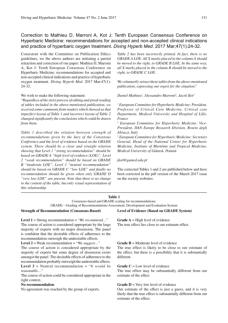
37 - Correction to Mathieu D, Marroni A, Kot J: Tenth European
Consensus Conference on Hyperbaric Medicine:
recommendations for accepted and non-accepted clinical
indications and practice of hyperbaric oxygen treatment
- Published by Diving and Hyperbaric Medicine
Authors: Mathieu D, Marroni, A, Kot J
In accordance with the Committee on Publication Ethics
guidelines, the authors are issuing a partial retraction and
correction of their 2017 paper on hyperbaric medicine
recommendations. Despite thorough editing and
proofreading, reader feedback revealed that flawed
layouts of Table 1 and Table 2 significantly altered the
conclusions that could be drawn from the publication.

Click here