













United Nations Decade of Ocean
Science for Sustainable Development
(UNESCO Ocean Decade 2021–2030)
C - Bibliography
Ocean Decade produces a lot of supporting documents that can be
found at this internet address:
https://unesdoc.unesco.org/search/87dc7567-1e4c-4a4b-bd9e-
7d01a48cd9a7
These documents can be classified as:
•
Founding documents such as the “Implementation Plan” used above
to describe this United Nations initiative,
•
“Progress Reports”, which describe the achievements of the Initiative.
•
“Guidelines” provide information on how to implement the programs
planned.
•
Statements, which are emitted to reinforce the elements mentioned in
the “Implementation Plan”, and the documents mentioned above.
•
“Advisory Board Reports”, which inform decisions to align with goals.
See below some of these documents that can serve as references to
explain the history and evolution of this United Nations initiative.

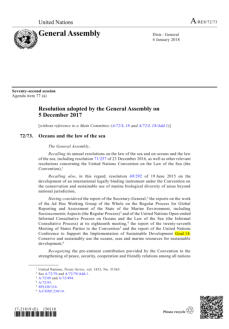
This resolution emphasizes the oceans' importance for
sustainable development, environmental protection, and
international cooperation. It reaffirms the commitment to
the United Nations Convention on the Law of the Sea
(UNCLOS) as the legal framework governing ocean use. It
also calls for enhanced efforts to combat marine pollution,
protect marine biodiversity, and ensure the sustainable
management of marine resources. In addition, it can be
considered the starting point of the "United Nations
Decade of Ocean Science for Sustainable Development"
initiative.

Founding documents

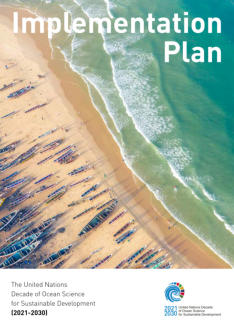
This founding document is the one summarized above,
which describes the rationales and elements for
implementing the “United Nations Decade of Ocean
Science for Sustainable Development 2021–2030”
initiative.

Progress Reports

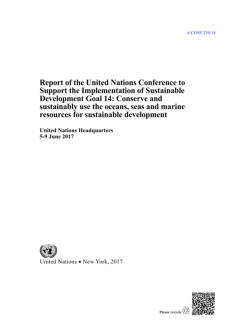
The United Nations Conference to Support the
Implementation of Sustainable Development Goal 14 took
place at UN Headquarters in New York from 5 to 9 June
2017. The conference recalled General Assembly
resolution 70/303, deciding to adopt a concise
declaration. The conference adopted the declaration titled
“Our ocean, our future: call for action” as its outcome
document. It also recommends that the General Assembly
endorse this call for action at its seventy-first session.
Goal 14 can be considered a founding initiative of the
United Nations Resolution 72/73, on oceans and the law
of the sea, adopted by the General Assembly on 5
December 2017

At the halfway point, the focus shifted to evaluating
strategies, enhancing collaboration, and planning for
long-term results. The Mid-Term Milestone report included
an independent evaluation to assess progress and guide
future efforts.
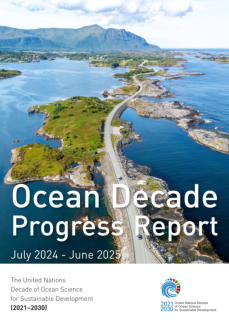
By June 2025, there were 62 Programmes, 535 Projects,
and 109 Contributions, with over half led by women. The
GenOcean campaign improved literacy, and the Ocean
Decade Alliance grew to 14 Patrons and 21 institutional
members. Preparations began for the 2027 Ocean
Decade Conference in Rio de Janeiro.


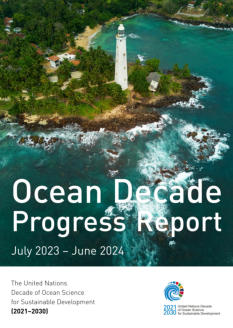
This year saw significant growth and global engagement
in ocean initiatives. The number of Decade Actions
exceeded 500, including 56 Programmes, 401 Projects,
and 99 Contributions in 66 countries.
The 2024 Ocean Decade Conference in Barcelona
brought together over 2,600 experts and produced the
Barcelona Statement. The website reached over 6 million,
with 217,000 users. There were 29,700 capacity
development initiatives and 10,000 knowledge products,
benefiting 260,000 individuals. The focus included
amplifying underrepresented groups.

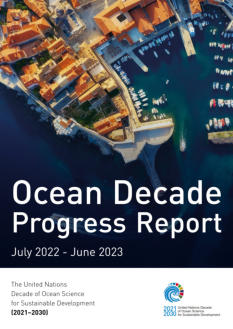
This period saw a significant rise in engagement,
establishing the Decade as the largest global ocean
science initiative.
The network grew to over 77,000 individuals from 4,000
institutions, including 4,500 Early Career Ocean
Professionals (ECOPs).
A total of 47 Programmes, 277 Projects, and 85
Contributions were endorsed across 58 countries.
Over 25,000 knowledge products were created,
benefiting over 200,000 people.
The Coordination Matrix expanded to include 37 National
Decade Committees, 11 Decade Collaborative Centres,
and 12 Implementing Partners.


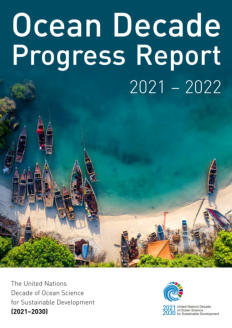
The first year of the Decade's implementation set up a
global framework for ocean science. It focused on co-
designing transformative science to address ten Ocean
Decade Challenges. Key issues included mobilizing
resources, leadership from Small Island Developing States
(SIDS) and Least Developed Countries (LDCs), and
capacity development.
The first Advisory Board Meeting took place in March
2022.

Guidelines

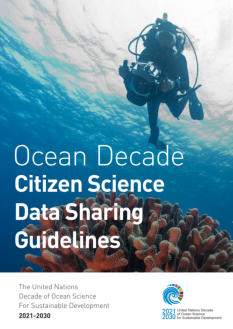
This guidance suggests converting public contributions
into reliable scientific data by standardizing, ensuring
quality, promoting radical data sharing, and co-designing.
It promotes open data platforms and emphasizes the
importance of involving local communities in research to
ensure their needs are met.


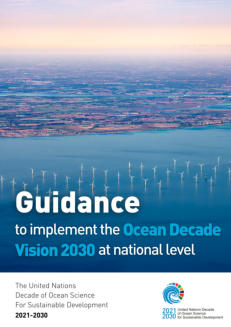
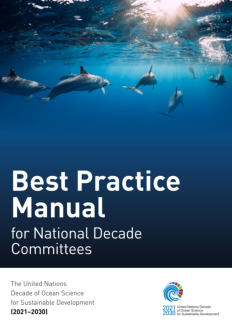
This document outlines a strategic roadmap for National
Decade Committees to implement the Ocean Decade
Vision 2030 at a national level. It emphasizes aligning the
Ocean Decade Challenges with national policies,
providing flexible tools for developing local action plans. Its
aim is to integrate scientific knowledge into policymaking
to support sustainable development. Special attention is
given to strengthening capacities in Small Island
Developing States and Least Developed Countries. The
document promotes inclusive partnerships involving
diverse stakeholders to ensure effective decision-making.

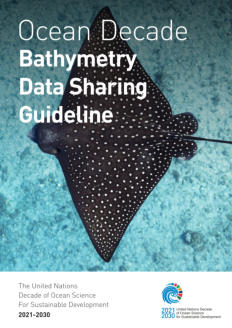
These guidelines aim to encourage companies in offshore
energy, telecommunications, and fisheries to share
bathymetric data that is often privately archived.
They outline a workflow for contributing to the Seabed
2030 Project, which seeks to map the ocean floor
completely by decade's end, specifying technical
submission requirements and promoting mutual benefits
of data sharing as a business advantage.

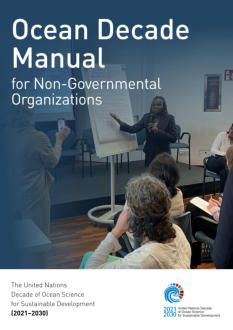
This manual provides non-governmental organizations
with a co-design framework for relevant projects. It
outlines access to capacity-building resources, emphasizes
diversity, equity, and inclusion in project leadership, and
offers guidance on navigating funding and partnerships.

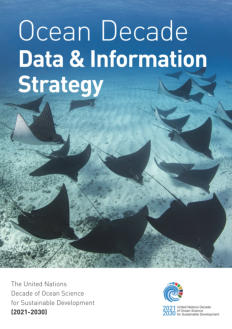
This document establishes a plan for a "digital ocean
ecosystem", focusing on a unified global network rather
than a single database.
It emphasizes a distributed, interoperable system for data
access by all stakeholders. Its objectives include creating a
seamless "web of data" that is findable, accessible,
interoperable, and reusable. Therefore, establishing quality
protocols, developing digital decision-support tools, and
empowering underserved communities through training.

This manual ensures consistency, repeatability, and global
comparability in ocean science by standardizing
procedures, promoting transparency through open-
access documentation, and encompassing the entire
scientific process from calibration to policy application.
It aims to assist researchers in developing nations, reduce
trial-and-error, and evolve continuously through peer
review as technology advances. Ultimately, it acts as the
"Quality Control" for cohesive global ocean data.
Statements

This document assesses mid-term progress of the initiative,
revealing significant achievements, including the
engagement of over 4,500 institutions and the
mobilization of nearly $1 billion. Progresses such as early-
career professionals and youth leadership are noted, but
challenges persist, including regional funding imbalances,
slow science-to-policy translation, and technical difficulties
in data sharing. Recommendations for 2026–2030 include
refining targets, strengthening decentralized governance,
and addressing new priority areas to enhance localized
impact, especially in the Global South.

Advisory board meetings

This statement from the 2024 Ocean Decade Conference
outlines a roadmap for 2025–2030, emphasizing
actionable solutions from scientific knowledge.
It highlights three priorities: enhancing ocean knowledge
and science generation for biodiversity and climate,
improving infrastructure for monitoring and data sharing,
and addressing co-design with Indigenous groups and
youth.
It incorporates the 2030 goals into a unified strategy,
emphasizes funding for disadvantaged states, promotes
financial mobilization, and advocates integrating ocean
science into policies and communities.

This document outlines activities and the ultimate impact
of a harmonious society on the ocean. It emphasizes
transforming humanity's relationship with the ocean and
aims for "Global Ocean Literacy" by 2030. The suggested
strategies include using behavioral science, integrating
ocean science into education, and connecting cultural
perspectives to foster supervision.
It highlights targeted outcomes that involve increased
political will, a diverse workforce, and sustainable lifestyle
choices.


Click on the
octopus to return to
the top of the page

This meeting focused on the initial results of the Mid-Term
Evaluation.
The Board began translating the "Barcelona Statement"
into operational tasks, prioritizing the "Science-Policy" gap.

This meeting resulted in the approval of the official
Management Response to the Mid-Term Evaluation.
Another focus was the Ocean Decade Financing Initiative,
which aimed to move beyond ad hoc grants to sustained
investment.

This meeting focused on the participation of Small Island
Developing States (SIDS) and Least Developed Countries
(LDCs). The "Ocean Decade Gender Action Plan" was
refined, and the board reviewed the first drafts of the
"National Decade Committee" (NDC) expansion strategy.

This final meeting for the 2024–2025 cohort focused on
reviewing the impact of Calls for Action. It also allowed the
participants to finalize the selection of the new 2026–2027
Board members.

This meeting was inaugural for the newly appointed
experts. A strategic shift toward the 2027 Rio Conference
and the integration of the new "Theory of Change" for the
final five years were discussed during this session.

This meeting took place at the Food and Agriculture
Organization of the United Nations (FAO) Headquarters
in Rome. It formalized the 2026 Work Plan, emphasizing
Challenge 10 (Society's relationship with the ocean) and
food security.
Continuation of page #1
D - Contacts
•
Ocean Decade website: https://oceandecade.org/
•
Join the Ocean Decade: https://oceandecade.org/sign-up/
•
Ocean Decade publications: https://oceandecade.org/decade-
publications/ocean-decade-publications/
•
UNESCO underwater cultural heritage convention:
https://www.unesco.org/en/underwater-heritage/
•
Ocean Decade Email: oceandecade@unesco.org