













United Nations Decade of Ocean
Science for Sustainable Development
(UNESCO Ocean Decade 2021–2030)
The United Nations Decade of Ocean Science for Sustainable
Development (2021–2030), often called the “Ocean Decade”, is a global
framework to boost ocean research and translate it into solutions for
sustainable development, led by UNESCO's Intergovernmental
Oceanographic Commission under a UN General Assembly mandate.
It aims to reverse the decline in ocean health through science,
innovation, and inclusive governance by supporting the 2030 Agenda,
especially the oceans-related Goal 14 of the UN Convention on the Law
of the Sea, "Conserve and sustainably use the oceans, seas and marine
resources for sustainable development", adopted in June 2017.
This program was proclaimed by the UN General Assembly Resolution
72/73 in December 2017, following years of UNESCO advocacy for a
coordinated international effort in ocean science and the suggestion of
such a framework during the 2016 Intergovernmental Oceanographic
Commission (IOC) meeting. It is detailed in paragraphs 292 to 295 of
section XI, "Marine science", of that December 2017 resolution 72/73,
which set its launch date as 1 January 2021 with the support of
member States, UN specialized agencies, funds, programs, and bodies,
as well as other intergovernmental organizations, non-governmental
organizations, and relevant stakeholders. It was decided that this global
framework had to be led by UNESCO’s Intergovernmental
Oceanographic Commission (IOC/UNESCO).
Before the launch of the program, an Executive Planning Group (EPG) of
19 leaders in ocean science was created in 2018 to establish the global
Plan. Their work was supported and reinforced by written submissions
from leading institutions and by regional planning meetings convened
for approximately 1,900 participants from the scientific community,
governments, UN entities, non-governmental organizations (NGOs), the
private sector, and donors across ocean basins, held between June
2019 and May 2020. That resulted in the publication of the
“Implementation Plan” at the project’s launch in 2021, which describes
this initiative in detail and is summarized below.
A - Main purpose and quick history of the creation of this
United Nations program:
B - Implementation Plan summary:
The implementation plan consists of three parts detailing the reasons
for this initiative, the environment in which it is undertaken, and how it
is organized and managed.
Part 1 - “Why Ocean Decade?”
This part explains the rationale for the Ocean Decade and its mission
outcomes, summarized in the following three points.
•
The ocean economy generated $1.5 trillion in 2010. It could reach $3
trillion by 2030, driven by emerging sectors such as minerals and
marine genetic resources, leading humanity to increasingly rely on it
for life-supporting services, including climate regulation, food,
energy, and cultural benefits. However, the ocean is undergoing
rapid, accelerating changes due to multiple stressors, including
warming, acidification, deoxygenation, the creation of 'dead zones,'
harmful algal blooms, and cumulative impacts affecting 40% to 66%
of its surface. These changes threaten biodiversity and the
livelihoods of hundreds of millions of people. Significant knowledge
gaps remain, especially in areas beyond national jurisdiction and
polar regions. To address these challenges, a transformative, large-
scale campaign is needed to mainstream ocean science, requiring
collaboration among governments, scientists, and society. This effort
must prioritize least developed countries (LDCs), Small Island
Developing States (SIDS), and landlocked developing countries
(LLDCs), while addressing gender disparities and fostering
intergenerational knowledge transfer.
•
The UN proclaimed the "Ocean Decade 2021–2030" to mobilize global
action, guided by an 'Implementation Plan' which aims to strengthen
scientific capacity, advance 'Sustainable Development Goals (SDGs)',
and address climate change through collaborative research,
technological innovation, and policy frameworks.
It should contribute to multiple Sustainable Development Goals,
including zero hunger, affordable energy, climate action, and gender
equality, by advancing ocean-based solutions such as food
production, renewable energy, and adaptive climate resilience.
The Ocean Decade also bridges other global initiatives, such as the
UN Decade of Ecosystem Restoration and the Paris Agreement (an
international treaty adopted in 2015 to limit global warming), while
addressing inequalities in ocean science capacity exacerbated by the
COVID-19 pandemic.
By fostering multinational partnerships and interdisciplinary
approaches, the Ocean Decade seeks to transform ocean science
into actionable solutions, ensuring no one is left behind in achieving
sustainable ocean governance and human welfare.
•
The transition from the current ocean to a desired sustainable ocean
requires collaborative innovation and the creation of accessible
decision-support systems and knowledge platforms that serve
diverse users, from governments to local communities. Seven key
outcomes define the Ocean Decade's vision:
1.
A clean ocean: Identifying and eliminating pollution sources
(plastic, chemicals, noise) through circular economy solutions.
2.
A healthy ocean: Understanding and protecting marine
ecosystems resilient to multiple stressors and climate change
impacts.
3.
A productive ocean: Supporting sustainable fisheries, aquaculture
expansion, and a diversified ocean economy that ensures food
security and livelihoods.
4.
A predicted ocean: Mapping and understanding ocean conditions
to enable adaptive management of changing ocean systems.
5.
A safe ocean: Developing forecasting systems and risk-
assessment mechanisms to protect coastal communities from
ocean-related hazards.
6.
An accessible ocean: Eradicating inequalities in ocean science
capacity by improving equitable access to data, technology, and
knowledge generation opportunities.
7.
An inspiring ocean: Fostering ocean literacy and societal
understanding of the ocean's economic, social, and cultural
values to drive behavioral change and sustainable development.
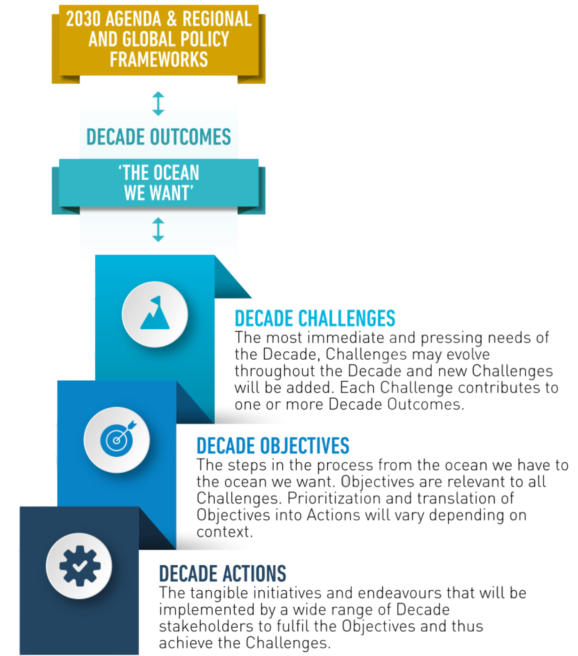
Part 2 - “The Ocean Decade Action Framework”:
This part guides the design and implementation of actions throughout
the Ocean Decade through a series of challenges, objectives, and
actions through the following sections:
•
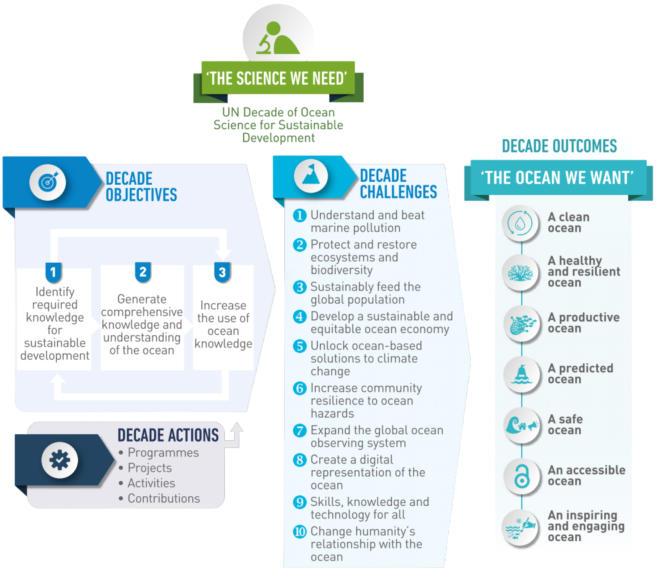
Section “Designing the science we need” outlines and illustrates in
the figure below the framework for challenges, objectives, and
actions, which are detailed in the next sections:
•
Section “Ocean Decade Challenges” defines the most immediate
priorities for uniting partners in collective action and advancing the
2030 Agenda and other policy frameworks. This includes the
following essential knowledge and infrastructure challenges:
1.
Understand and map land and sea-based sources of pollutants
and contaminants, their impacts on human health and ocean
ecosystems, and develop solutions to remove or mitigate them.
2.
Understand the effects of multiple stressors on ocean
ecosystems and develop solutions to monitor, protect, manage,
and restore them under changing environmental, social, and
climate conditions.
3.
Generate knowledge, support innovation, and develop solutions to
optimize the ocean's role in sustainably feeding the world's
population under changing conditions.
4.
Generate knowledge, support innovation, and develop solutions
for equitable and sustainable development of the ocean economy
under changing conditions.
5.
Enhance understanding of the ocean-climate nexus and
generate knowledge and solutions to mitigate, adapt, and build
resilience to climate change effects across all geographies and
scales, including improving ocean, climate, and weather
prediction services.
6.
Enhance multi-hazard early warning services for all ocean and
coastal hazards, mainstreaming community preparedness and
resilience.
7.
Ensure a sustainable ocean observing system across all ocean
basins that delivers accessible, timely, and actionable data and
information to all users.
•
Section “Ocean Decade Objectives” presents the process to guide the
development and delivery of Actions towards the fulfillment of the
Ocean Decade Challenges:
1.
Identifying knowledge gaps for sustainable development by
prioritization of research gaps, enhancing observing systems,
integrating indigenous knowledge, and addressing capacity
disparities through inclusive, sustainable investment.
2.
Generating comprehensive ocean data, information, and
knowledge by promoting ocean literacy and creating open data
platforms (This is what the Diving and ROV Specialists website
does).
3.
Applying this knowledge to implement solutions by co-developing
solutions with stakeholders, strengthening spatial planning and
management frameworks, and integrating natural capital
considerations into decision-making.
•
Section “Ocean Decade Action hierarchy and endorsement process”
presents the different types of Ocean Decade Actions and discusses
the criteria and process for endorsement of Actions as part of the
Decade.
These actions are global initiatives aimed at advancing ocean
knowledge to develop solutions, without prescribing policy, that are
proposed and implemented by diverse stakeholders and occur at
four levels:
1.
A program consists of component projects enabling activities
globally or regionally that contribute to the achievement of one or
more challenges. They are usually long-term and
interdisciplinary.
2.
A project is a discrete and focused undertaking. It may be
regional, national, or subnational, and typically contributes to an
identified program.
3.
An activity is a one-off, standalone initiative. It enables a
program or project or directly contributes to a challenge.
4.
A contribution supports the Ocean Decade through the provision
of a necessary resource, such as funding or an in-kind
contribution. It can support either the implementation of an action
or the coordination costs of the Ocean Decade.
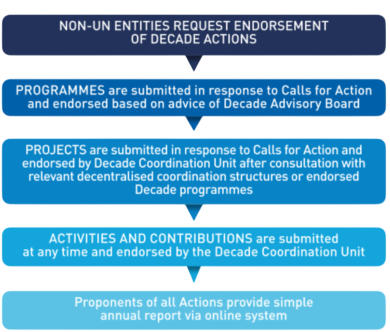
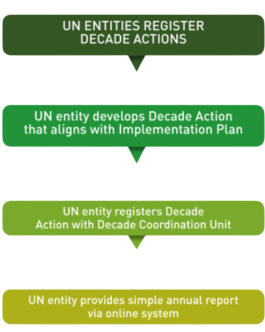
UN entities can register actions directly, while non-UN entities must
request endorsement through a structured process involving the
Decade Advisory Board, Coordination Unit, and regional structures.
Endorsement requests for programmes/projects are submitted
during periodic Calls for Action, targeting priority areas or themes.
Activities and contributions can be submitted anytime. Proponents
must demonstrate alignment with criteria such as contributing to
Ocean Decade Challenges, open data sharing, fostering partnerships,
and promoting equity. Denied requests can be revised and
resubmitted.
Endorsed actions are listed on the Ocean Decade website, and
proponents can use its logo. Annual progress reports are required,
and endorsement remains valid for the action's duration.
•
The "Data, information, and digital knowledge management" section
defines the knowledge sources and the framework for their
development.
1.
Data and information are central to achieving planned outcomes,
with digitizing, preserving, managing, exchanging, and using a
significantly increased volume and range of ocean-related data,
information, and knowledge as cornerstones of success. For
these reasons, it is necessary to enhance infrastructure,
establish common interoperable data-sharing approaches, and
foster collaboration between data providers and users through a
dynamic, continuously evolving digital ocean ecosystem that
integrates established and emerging technologies.
This ecosystem must be a distributed, integrated, interoperable
set of modular, scalable, and co-designed digital solutions
developed inclusively across academic, governmental, industrial,
philanthropic, Indigenous, local, and citizen-science communities.
It should represent the ocean's socio-ecological dimensions by
incorporating diverse data types, including physical, geological,
biogeochemical, biological, ecological, social, economic, cultural, and
governance data, as well as less-quantifiable knowledge such as
Indigenous and local insights, across global, regional, and local
scales, ensuring sustainability and adaptability beyond 2030.
It must also enable understanding of ocean conditions using
historical, real-time, and modeled data to support forecasting,
identify knowledge gaps, and prioritize data use or generation. In
addition, it should address challenges such as capacity building
where it is lacking, coordination across diverse stakeholders, and
overcoming digital divides caused by differing knowledge
systems, limited technology access, data fragmentation, siloed
activities, and barriers to data sharing and use.
2.
The Decade Coordination Unit, working with experts from UN
entities, governments, industry, philanthropy, and research
institutes, must coordinate ecosystem development by issuing
Calls for Action that invite stakeholders to develop ecosystem
components. Such initiatives must promote inclusive participation
by industry and indigenous groups, while respecting knowledge
ownership. Also, they must facilitate contributions from diverse
stakeholders, including those in low-technology environments;
respond proactively to user needs through co-development;
promote interoperability, scalability, and extensibility; and interlink
peer-reviewed, quality-controlled, auditable, and traceable
resources.
These actions require open-access, shared, discoverable data
deposited timely in appropriate repositories, with proponents
providing comprehensive data management and sharing plans
covering raw data, derived digital products, software, and code.
An open-membership working group is developing a detailed data
stewardship strategy aligned with global principles and
international policies, to be presented early in the Decade. Data
management initiatives will be linked to capacity development and
marine technology transfer to ensure all stakeholders have the
skills and technology access needed to produce, interpret, and
use ocean data, information, and knowledge
•
Section “Capacity development” describes the principles, expected
outcomes and priority activities for capacity development initiatives
undertaken during the Ocean Decade.
1.
The 2020 Global Ocean Science Report (GOSR) highlights that
ocean scientists are mostly from developed countries, with older
generations being more prevalent, while younger researchers are
common in Least Developed Countries (LDCs). Women make up
about 38% of ocean science researchers, but this varies widely
across countries. It is worth noting that the Ocean Decade
initiative focuses on capacity development and aims to ensure fair
distribution of knowledge and technology across regions,
generations, and genders, which requires significantly greater
efforts than before. Capacity development involves conducting
science and applying it for sustainable solutions, including the
Sustainable Development Goals (SDGs). The initiative prioritizes
Least Developed Countries (LDCs), Small Island Developing States
(SIDS), and Landlocked Developing Countries (LLDCs) with tailored
approaches that include low-technology tools, partnerships, and
engagement of local knowledge holders, aiming to overcome
barriers related to gender and access.
2.
Ocean literacy means understanding how humans and the ocean
influence each other. It is moving from a focus on formal
education to one that benefits various groups. The Ocean Decade
aims to enhance ocean literacy to change how the ocean is valued
and managed, encouraging good policies and responsible actions.
Key areas of focus include policy, education, corporate behavior,
and community involvement, with a focus on skill development
and partnerships.
•
Section “How to engage in the Ocean Decade” provides information on
the different engagement structures and mechanisms for the
Ocean Decade initiative that can be summarized in three points:
1.
The Ocean Decade Initiative aims to engage a diverse range of
stakeholders across geographies, generations, genders, and
disciplines to co-design, co-deliver, and use ocean science for
sustainable development. Key stakeholder groups include
scientists, local and indigenous knowledge holders, early career
ocean professionals, UN entities, regional organizations, national
and subnational governments, local coastal communities, private
sector stakeholders, technology and innovation hubs, professional
societies, philanthropic foundations, non governmental
organizations, aquariums, zoos, museums, youth, educators, and
the general public, including marginalized communities.
Engagement strategies must be flexible and evolve organically,
recognizing fluid boundaries between groups and promoting
multiple entry points. The Decade Coordination Unit should provide
guidelines, facilitate connections between networks, and co-
develop targeted engagement strategies.
2.
Voluntary stakeholder networks are self-organized. They must
register to become recognized Ocean Decade partners and
should report annually on activities. A Global Stakeholder Forum
with virtual and physical components serves as a central
platform for all engagement networks to convene, exchange ideas,
collaborate, and raise awareness. The Forum supports
communities of practice around Ocean Decade Challenges,
facilitates co-design workshops and training, showcases
successful initiatives, and enables members to engage with the
Decade Advisory Board. Regular regional and international
conferences, both virtual and in-person, are organized to share
progress, catalyze initiatives, and provide training.
3.
Communication is central to the Ocean Decade initiative's success.
The Decade Coordination Unit leads communication efforts,
encouraging stakeholders to become advocates. An evolving
communications strategy emphasizes the importance of a healthy
ocean for society and the economy, using tailored messaging and
branding. The 'Generation Ocean' campaign must unite all
generations under a shared brand to inspire action, featuring
testimonials and Ocean Decade Initiative champions. Toolkits,
digital products, and guidelines should be provided to partners to
amplify messages globally across diverse formats
Part 3 - “Enabling the Ocean Decade”:
This part describes the implementation of the Ocean Decade.
It presents the governance and coordination framework of the Decade,
the mechanisms for financing Ocean Decade Actions and coordination
costs, and the framework for measuring progress and adaptively
managing the Decade. These elements are summarized in the following
three sections.
•
Section “Governance and coordination framework” describes the
intergovernmental process required to guide and report on the
progress of Ocean Decade implementation, as well as the roles and
functions of the various implementing and coordinating entities, as
summarized in the following five points:
1.
Achieving the Ocean Decade intiative's goals requires a flexible,
multi-scale governance framework involving national, subnational,
and local governments, research institutes, UN entities, non
governmental organizations, and other stakeholders. The
framework aims to enable implementation through enhanced
dialogue, partnerships, financing, and knowledge sharing, while
ensuring inclusive global and regional coordination aligned with
the Sustainable Development Goals (SDGs) and guided by the
United Nations Convention on the Law of the Sea provisions..
2.
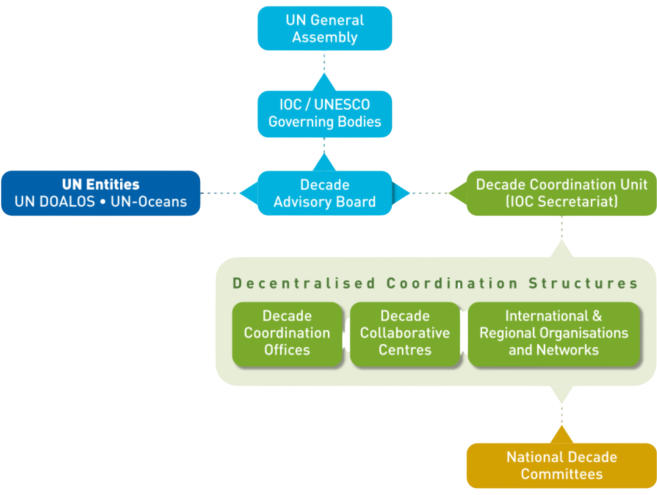
The governance structure includes the UN General Assembly and
Intergovernmental Oceanographic Commission (IOC) Governing
Bodies, which oversee reporting and strategic direction. An
Advisory Board, composed of up to 20 members representing UN
entities, scientific disciplines, and socio-economic sectors,
provides strategic advice on implementation, monitoring, resource
needs, and endorsement of programmes.
The Board operates on a rotational basis with hybrid meetings
and public reporting.
Engagement across the UN system is facilitated through UN-
Oceans and a dedicated contact group, promoting collaboration
among UN entities and leveraging existing bilateral agreements.
Regional implementation is emphasized through partnerships with
Regional Seas Conventions and other intergovernmental
organizations.
3.
The Coordination Unit, based within the Intergovernmental
Oceanographic Commission (IOC) Secretariat, serves as the
primary coordination office, secretariat for the Advisory Board
and Ocean Decade Alliance, and manages action plans, resource
assessments, reporting, communications, and outreach. It
promotes Alliance membership, identifies resource needs and
providers, and ensures Ocean Decade visibility in UN forums.
4.
Decentralized coordination structures include Decade Coordination
Offices, hosted by Member States or UN offices, responsible for
regional or thematic portfolios; Decade Collaborative Centres,
hosted by countries or organizations, providing technical, logistical,
and financial support for regional or thematic initiatives; and
National Decade Committees, encouraged to facilitate national
contributions, stakeholder engagement, resource mobilization, and
reporting. These committees act as conduits for information,
support co-design and implementation of national priorities, and
coordinate outreach activities.
5.
Existing international and regional organizations and networks play
a crucial role in regional coordination, stakeholder engagement,
and alignment with ongoing initiatives. The framework
emphasizes co-design, co-delivery, adaptive governance, and
leveraging existing structures to achieve transformative ocean
science and sustainable development outcomes.
•
Section “Resource mobilization” describes the different financing
mechanisms available for the Ocean Decade Initiative’s coordination
and action costs, detailed in the four points below:
1.
The Ocean Decade initiative aims to significantly increase funding
for ocean science, which currently receives only about 1% of
national research budgets, with additional support from
philanthropic, corporate, and industry sectors. To achieve its goals,
it must expand funding sources, including new models such as
blue bonds, ocean business impact investments, public-private
partnerships, and development banks, while engaging a broad
range of stakeholders, including those not traditionally focused on
ocean science.
2.
The Ocean Decade Initiative itself is not a funding mechanism;
rather, it encourages partners to align their funding and support
strategies with Decade priorities. A clear value proposition is
essential, offering funders participation in a visible, long-term
global effort that enables greater impact, collaboration, and new
partnerships while allowing them to maintain their own priorities
and processes. For proponents of Ocean Decade Actions,
endorsements increase their attractiveness to funders, provide
access to exclusive funding opportunities coordinated by the
Decade Coordination Unit, and support outreach efforts to raise
awareness of ocean science funding needs.
3.
Both financial and in-kind support are mobilized for implementing
programs, projects, and activities ('Action costs') and for
operational activities such as coordination, meetings, and
communications ('coordination costs'). Coordination costs,
estimated at US$1.5–2 million annually for the central unit, are
critical for the Decade's success. Biennial resource needs
assessments will track coordination and Action costs, secured
resources, and gaps, using common metrics to ensure
transparency and measure impact.
4.
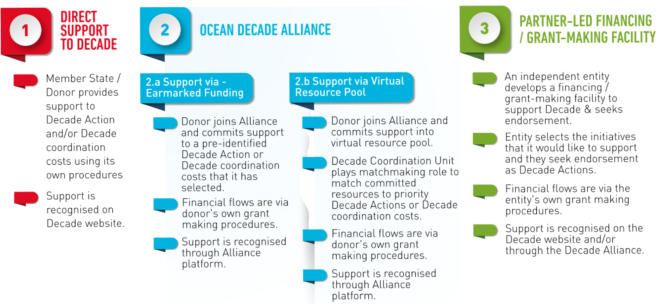
Resource mobilization mechanisms include:
- Direct support through existing partner processes, including
government funding, research projects, and in-kind
contributions such as staff secondments and event hosting.
- Support via the Ocean Decade Alliance, an engagement platform
connecting large-scale resource providers with proponents of
Ocean Decade Actions, allowing members to commit resources
either earmarked or to a virtual resource pool.
- Partner-led financing or grant-making facilities, where
independent entities mobilize resources for Decade actions,
potentially focusing on specific themes or regions.
All contributors will be recognized through the Alliance or an
'honor roll' on the Ocean Decade website. Ultimately, all actors are
encouraged to advocate for and secure support to realize the
Ocean Decade's ambitions.
•
Section “Measuring progress” outlines the key elements of the
framework for tracking Ocean Decade impact and progress and
describes the process for transforming it into a detailed monitoring
and evaluation strategy. It also describes the major review
processes embedded in the Ocean Decade. These are summarized
in the following 3 points:
1.
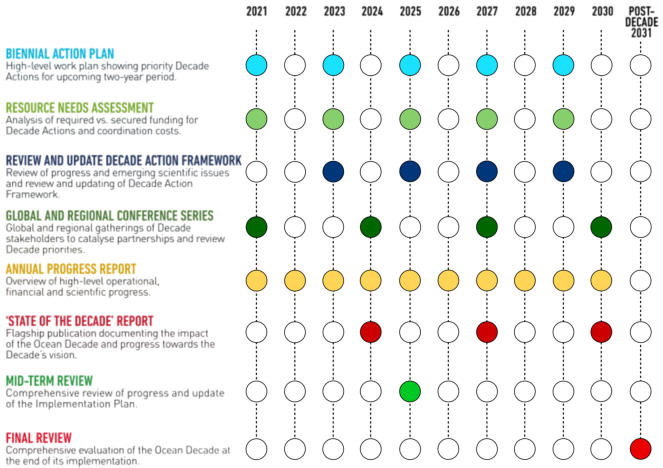
The Ocean Decade initiative, shaped by the post-COVID-19
landscape, implements a robust monitoring and reporting
framework to enable adaptive management and maintain
relevance. This framework supports regular reviews and
stakeholder engagement, including a biennial priority-setting and
resource needs assessment, a participatory update of the ‘Action
Framework’ every two years, a triennial 'State of the Decade'
report documenting achievements and emerging needs, and a
mid-term comprehensive review to inform revisions of the
Implementation Plan.
2.
Monitoring and evaluation operate at two levels.
- Impact-level monitoring measures ocean science success
beyond peer-reviewed publications by focusing on real-world
benefits, contributions to global policy frameworks such as the
2030 Agenda, progress toward Decade Outcomes and
Objectives, and tracking scientific capacity and ocean literacy.
- Operational-level monitoring collects data on the number, type,
and geographic distribution of Ocean Decade Actions,
stakeholder diversity, communication reach, spending, resource
commitments, and engagement activities.
3.
Endorsed Ocean Decade Initiative Actions report annually via
streamlined online templates to minimize administrative burden.
Decentralized coordination structures collect project-level data,
which the Decade Coordination Unit will collate into an Annual
Progress Report. Data and information generated will align with
and contribute to existing UN reporting systems, including the
World Ocean Assessment, Sustainable Development Goals (SDGs)
progress reports, and disaster risk reduction frameworks. The
monitoring and evaluation framework further defines
methodologies, responsibilities, baseline values, and resource
requirements to measure progress effectively.
Continued on the next page.




Click on the
octopus to return to
the top of the page