










Underwater mapping 2026







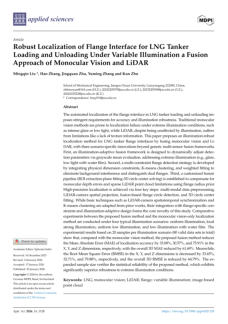
01 - Robust Localization of Flange Interface for LNG Tanker Loading
and Unloading Under Variable Illumination a Fusion Approach
of Monocular Vision and LiDAR
Authors: Mingqin Liu, Han Zhang, Jingquan Zhu, Yuming
Zhang and Kun Zhu
This paper addresses the challenge of accurately localizing
flange interfaces in LNG tankers under extreme
illumination conditions. While monocular vision fails in
glare or low light, and LiDAR lacks texture information, the
authors propose a vision-LiDAR fusion method with three
key innovations: an illumination-adaptive framework that
dynamically adjusts parameters based on grayscale
evaluation, a multi-constraint flange detection strategy
using physical constraints and K-means clustering, and a
customized fusion pipeline combining ROI extraction,
plane fitting, and 3D circle solving to compensate for
individual sensor limitations.

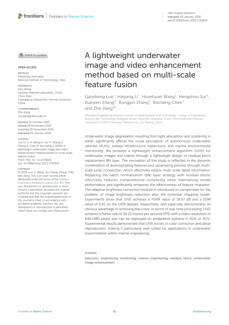
02 - A lightweight underwater image and video enhancement
method based on multi-scale feature fusion
Authors: Gaosheng Luo, Haiyang Li, Huanhuan Wang,
Hengshou Sui, Xuewen Zhang, Rongjun Zhang,
Bocheng Chen, and Zhe Jiang
Underwater image quality is reduced by light absorption
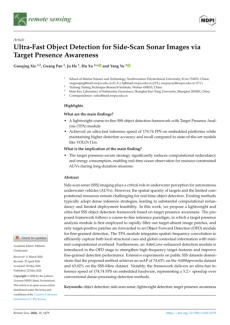
and scattering, affecting AUVs and marine monitoring.
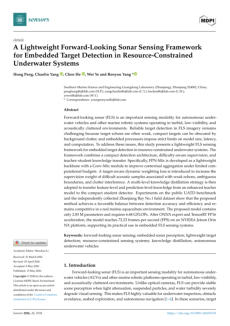
The authors propose UIVE, a lightweight enhancement
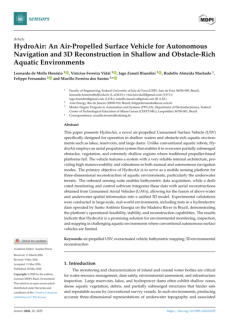
algorithm for underwater visuals. Key features include
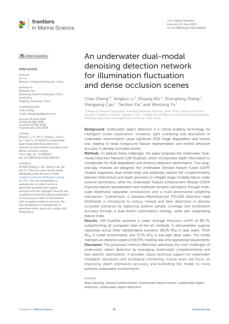
using residual blocks instead of batch normalization, multi-
scale connections for detail preservation, and an adaptive
brightness correction module.


Click on the
octopus to return to
the top of the page

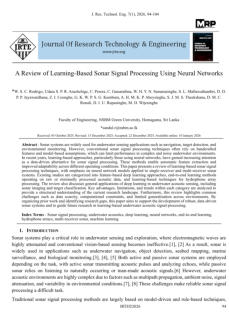
03 - A Review of Learning-Based Sonar Signal Processing Using
Neural Network
Authors: W. S. C. Rodrigo, Udara S. P. R. Arachchige, C.
Perera, C. Gunarathna, W. H. Y. N. Samarasinghe,
S. L. Mallawathanthri, D. D. P. P. Jayawardhana,
Z. I. Coonghe, G. K. W. P. S. G. Kumbura, A. H. M.
K. P. Abeysinghe, S. J. M. S. Theekshana, D. M. C.
Ronali, D. I. U. Rupasinghe, M. D. Wijesinghe
This paper reviews learning-based sonar signal processing
techniques, primarily neural networks, as a data-driven
alternative to conventional methods that are limited by
handcrafted features and model assumptions in complex
underwater environments. The review categorizes existing
studies into feature-based deep learning, end-to-end
learning from raw acoustic data, and hydrophone-array
processing. It also covers general applications like sonar
imaging and target classification.
04 - Underwater 3D target detection: Semi-analytic Monte Carlo
model and UAV-based scanning lidar system
Authors: Xinke Hao, Yan He, Huixin He, Deliang Lv, Yingjie
Ruan, Hui Qi, Guangxiu Xu, and Junwu Tang
A semi-Monte Carlo model (MCT) was developed to
simulate lidar detection of underwater targets, considering
interactions with the target, surface waves, and stratified
water. This model was validated by a UAV-based linear
scanning oceanic lidar system (SOL) and achieved less
than 5% error within 50m depth. Field experiments
confirmed SOL's consistent target localization. The MCT
model was then used to analyze SOL's detection
capabilities for different water types (Jerlov II and 3C),
introducing an extended detection range concept to
assess how horizontal scanning resolution changes with
target depth, offering guidance for optimizing detection
and efficiency.
05 - An explainable context-adaptive fusion and expert-in-the-loop
evaluation framework for underwater sonar image classification
Authors: Kamal Basha, Anukul Kiran, Athira Nambiar,
Suresh Rajendran, and Sooraj K Ambat
Sonar image interpretation is critical for identifying
submerged objects in underwater exploration. However,
conventional deep learning models often fail to capture
sonar-specific features such as acoustic shadows and
highlights, and they typically operate as black boxes,
limiting both performance and trust. To address these
challenges, the authors propose an explainable sonar
image classification system that fuses specialized classifiers
for shadows, highlights, and general features through a
context-adaptive fusion mechanism. The system further
incorporates expert-in-the-loop evaluation via the
Augmented QUality Assessment for eXplainability (AQUA-
X) framework to ensure interpretability and trust.
06 - Analysis of Underwater Single-Photon LiDAR Signals: A
Comprehensive Study on Multi-Parameter Coupling Effects
Authors: Ceyuan Wang, Shijie Liu, Shouzheng Zhu,
Wenhang Yang, Chenhui Hu, Yuwei Chen,
Chunlai Li, and Jianyu Wang
Underwater laser signal attenuation poses challenges for
conventional detection, but single-photon LiDAR (SPL)
with high sensitivity offers a promising solution. Prior
studies mainly examined isolated parameters, leaving the
coupled effects of environmental and system factors
underexplored. This research developed a 532 nm
underwater SPL system to systematically investigate multi-
parameter coupling in laboratory water tanks, varying
turbidity, detection distances, laser energy levels,
integration times, and target types.
07 - Comparison of Conventional, Rake, and Sonar-Based Biophysical
Habitat Measurements in a Shallow Ontario River
Authors: Karl A. Lamothe, Jason Barnucz, D. Andrew,
R. Drake
Accurate habitat data is vital for managing and restoring
freshwater species, but fine-scale sampling is labor-
intensive. This study in Ontario, Canada, compared sonar-
derived habitat measurements (depth, macrophyte
volume, substrate) with conventional point-based
methods in a shallow river. Both methods showed nearly
all areas were <2m deep, though conventional depth
readings were higher at 88% of sites. Depth correlations
were strong, but substrate and macrophyte
measurements showed weak alignment. Differences
stemmed from measurement scale and inherent errors in
both methods. The optimal approach depends on the
precision required for management decisions.
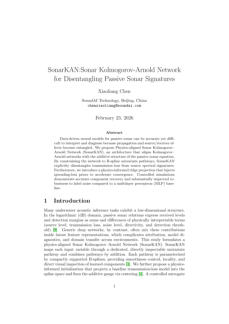
08 - SonarKAN:Sonar Kolmogorov-Arnold Network for Disentangling
Passive Sonar Signatures
Authors: Xiaoliang Chen
Data-driven neural models for passive sonar can be
accurate but hard to interpret. The proposed Physics-
aligned Sonar Kolmogorov–Arnold Network (SonarKAN)
aligns networks with the passive sonar equation's
structure. It separates transmission loss from source
signatures and uses a physics-informed ridge projection
for faster convergence. Simulations show improved
accuracy and robustness to label noise compared to a
multilayer perceptron (MLP).

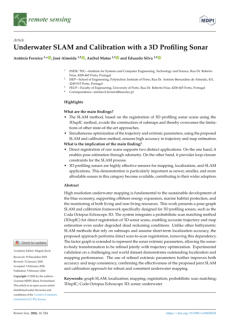
09 - Underwater SLAM and Calibration with a 3D Profi ling Sonar
Authors: António Ferreira, José Almeida, Aníbal Matos,
and Eduardo Silva
High-resolution underwater mapping is essential for the
sustainable blue economy, supporting offshore energy
expansion, marine habitat protection, and resource
monitoring. This work presents a pose-graph
Simultaneous Localization and Mapping (SLAM) and
calibration framework specifically designed for 3D
profiling sonars such as the Coda Octopus Echoscope 3D.
It employs a probabilistic scan-matching method for direct
scan-to-scan 3D sonar registration, enabling accurate
trajectory and map estimation even under degraded
dead-reckoning conditions.
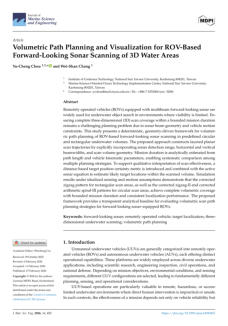
10 - Volumetric Path Planning and Visualization for ROV-Based
Forward-Looking Sonar Scanning of 3D Water Areas
Authors: Yu-Cheng Chou, and Wei-Shan Chang
Remotely operated vehicles (ROVs) equipped with
multibeam forward-looking sonar are widely used for
underwater object searches in low-visibility environments.
Achieving complete three-dimensional (3D) scan
coverage within a limited mission duration is challenging
due to sonar beam geometry and vehicle motion
constraints. This study presents a deterministic, geometry-
driven framework for volumetric path planning of
forward-looking sonar scans in predefined circular and
rectangular underwater volumes. The approach
constructs layered planar scan trajectories by explicitly
incorporating sonar detection range, horizontal and
vertical beamwidths, and scan volume geometry.
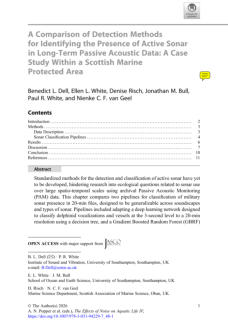
12 - A Comparison of Detection Methods for Identifying the Presence
of Active Sonar in Long-Term Passive Acoustic Data: A Case
Study Within a Scottish Marine Protected Area
Authors: Benedict L. Dell, Ellen L. White, Denise Risch,
Jonathan M. Bull, Paul R. White & Nienke C. F.
van Geel
Standardized methods for detecting and classifying active
sonar are lacking, which affects ecological research using
Passive Acoustic Monitoring (PAM) data. This chapter
compares two classification pipelines for identifying
military sonar in 20-minute files using deep learning and
Gradient Boosted Random Forest.

13 - The Principle and Application of Underwater Sonar Systems
Authors: Siyi Wang, Yiduo Wang, and Lang Yin
As underwater detection needs increase in marine
research and engineering, sonar systems have become a
key research focus. Enhancing their precision, efficiency,
and adaptability is urgent. The article outlines different
sonar types, detailing single-beam's lower cost and limited
precision versus multi-beam's higher cost but better
accuracy for complex seabeds. It summarizes current
sonar systems, highlighting their deficiencies for future
development.
11 - Spiking transformer with learnable threshold mechanism for
underwater image dehazing to aid vision-based navigation
Authors: Vidya Sudevan, Rizwana Kausar, Sajid Javed,
Hamad Karki, Giulia De Masi, and Jorge Dias
snnTrans-DHZ is a lightweight spiking transformer for
underwater image dehazing that uses a learnable
threshold membrane potential and only 0.57 million
parameters to boost clarity with low power through
temporal SNN dynamics. Static images are converted to
time-dependent RGB-LAB sequences and processed via
three modules: K estimator, background light estimator,
and soft image reconstruction, trained end-to-end with
surrogate-gradient backpropagation through time.
14 - Embedded very-low-frequency underwater acoustic acquisition
technology and experimental study for underwater explosion
Monitoring
Authors: Xuexu Li, Zhen Song, Xinliang Pang, Fan Yang,
Yu Lu, Yunfen Chang, Hao Yin, and Yunping Liu
This study presents an embedded acquisition device
designed to capture very-low-frequency (VLF) underwater
acoustic signals from underwater explosions, addressing
the lack of available off-the-shelf solutions. It effectively
records and exports data using the FATFS file system.
Successful experiments demonstrated the device's ability
to acquire initial shock waves and long-range VLF signals,
confirming its efficacy for VLF monitoring and underwater
acoustic research, thus providing essential support for
developing VLF monitoring equipment.
15 - Development and Testing of an In Situ Observation Device for
Seafl oor Boreholes
Authors: Haodong Deng, Jianping Zhou, Xiaotao Gai,
Chunhui Tao, and Bin Sui
Mid-ocean ridge hydrothermal systems exchange heat
and matter between seawater and lithosphere, yet high-
precision sub-surface monitoring remains difficult. This
study introduces a versatile in-situ penetration probe for
multi-parameter vent monitoring, deployable post-drilling
in boreholes or via ROVs. It features a titanium conical tip
and chamber with tri-axial accelerometers plus dual
temperature-pressure sensors. Design was optimized
using SST k-w turbulence modeling and finite element
analysis, then validated by lab vibration tests and shallow-
water trials, providing a scalable, cost-effective framework
for 3D sub-surface observation and resource exploration.
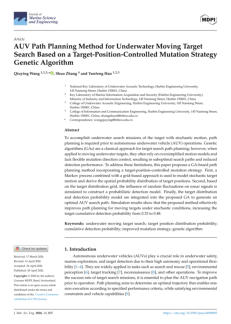
16 - AUV Path Planning Method for Underwater Moving Target
Search Based on a Target-Position-Controlled Mutation Strategy
Genetic Algorithm
Authors: Qiuying Wang, Shuo Zhang, and Yunfeng Han
his paper proposes a genetic algorithm (GA)-based path
planning method for autonomous underwater vehicles
(AUVs) searching for stochastically moving underwater
targets. To overcome limitations of conventional
GAs—such as oversimplified target motion models and
inflexible mutation—the method introduces a target-
position-controlled mutation strategy. It first models
stochastic target motion using a Markov process with grid-
based spatial discretization to obtain the target’s position
probability distribution. Second, it simulates sonar signal
fluctuations on this grid to build a probabilistic detection
model. These components are integrated into the GA to
optimize the AUV search path.
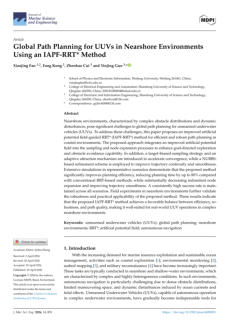
17 - Global Path Planning for UUVs in Nearshore Environments
Using an IAPF-RRT* Method
Authors: Xiaojing Fan, Fang Kong, Zhenhao Cui, and
Yinjing Guo
Nearshore environments present significant challenges for
global path planning in unmanned underwater vehicles
(UUVs) due to complex obstacles and dynamic
disturbances. To address these challenges, this paper
introduces an improved artificial potential field-guided
method for efficient and robust path planning in coastal
environments. The approach integrates an enhanced
artificial potential field into sampling and node expansion
to improve goal-directed exploration and obstacle
avoidance. Additionally, a target-biased sampling strategy,
an adaptive attraction mechanism, and a NURBS-based
refinement scheme are incorporated to accelerate
convergence and enhance trajectory smoothness.
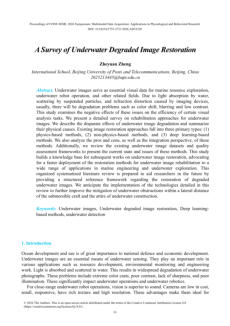
18 - A Survey of Underwater Degraded Image Restoration
Author: Zheyuan Zheng
Underwater images are vital for marine exploration and
robot operations but suffer degradation like color shift,
blurring, and low contrast from light absorption,
scattering, and refraction. This survey examines their
negative effects on visual tasks, categorizes restoration
methods into physics-based, non-physics-based, and deep
learning-based approaches, analyzes pros/cons and
integration, and reviews datasets plus quality frameworks.
It builds a structured knowledge base to aid researchers
and promote faster deployment in marine engineering
and underwater exploration.
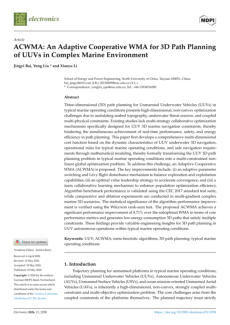
19 - ACWMA: An Adaptive Cooperative WMA for 3D Path Planning
of UUVs in Complex Marine Environment
Authors: Jingyi Bai, Yong Liu, and Xiaoyu Li
Underwater images are vital for marine exploration and
robot operations but suffer degradation like color shift,
blurring, and low contrast from light absorption,
scattering, and refraction. This survey examines their
negative effects on visual tasks, categorizes restoration
methods into physics-based, non-physics-based, and deep
learning-based approaches, analyzes pros/cons and
integration, and reviews datasets plus quality frameworks.
It builds a structured knowledge base to aid researchers
and promote faster deployment in marine engineering
and underwater exploration.
20 - An Integrated Framework for Safe and Efficient AUV Navigation:
Synergizing Enhanced Path Planning, Curvature-Adaptive
Tracking, and Information-Driven 3D Exploration
Authors: Mingming Xiao, Yuliang Wen, Jiaheng Li, Naiyao
Liang, and Dan Xiang
This paper introduces an integrated framework for
autonomous underwater vehicles (AUVs) in complex,
unknown environments, combining enhanced path
planning, curvature-adaptive trajectory tracking, and
sonar-constrained 3D exploration. The path planner
incorporates safety margins, 3D obstacle avoidance, and
online replanning, while the tracking module uses B-spline
optimization and speed control for smooth trajectories.
The exploration strategy employs frontier clustering,
information gain evaluation, and TSP optimization.
21 - Quasi-Static In Situ Deep Learning for Forward-Looking Sonar
Target Detection in Complex Underwater Environments
Authors: Yixuan Chen, Zhenqing Ding, Yu Feng, Jiale He,
Ziqin Xie, Tinggang Xiong, Kai Chen, and Qi Gao
Forward-looking sonar (FLS) target detection for AUVs is
challenged by acoustic distortions, environmental
variability, and scarce fine-annotated data—limiting
standard deep learning. This work introduces a quasi-static
in situ learning paradigm for underwater acoustic target
detection (UATD), combining lightweight deep learning
with physics-informed scene priors: echo-intensity–based
probability weighting and acoustic attenuation
compensation. These enable pixel-wise sonar image
enhancement and score-level fusion of statistical
descriptors with neural predictions, allowing dynamic
adaptation to real-time conditions.
22 - VK-RRT*: A Multi-Constraint Coupling Approach to Energy-
Efficient AUV Path Planning in Three-Dimensional Ocean
Current Environments
Authors: Ziming Chen, Jinjin Yan, Huiling Zhang, and
Xiuyan Peng
This paper introduces an energy-efficient velocity-
kinodynamic RRT* algorithm to resolve multi-constraint
coupling issues, energy estimation inaccuracies, and
dynamic infeasibility in autonomous underwater vehicle
(AUV) path planning. The approach integrates
velocity–energy, velocity–curvature, and velocity–safe-
distance models, enhanced by potential-field-guided
sampling, adaptive step-length expansion, kinodynamic
constraints, and a multi-objective cost function.
23 - A New Calibration Method Based on Gravity-Assisted Navigation
Authors: Zhibo Zhou, Jianfeng Wu, Huabing Wu, Lintao
Liu, Xinghui Liang, Hubiao Wang, Guocheng
Wang, Junjian Lang, Zhimin Shi, and Xiaolong
Guan
Gravity-assisted navigation (GANT) enables autonomous,
passive, and long-endurance navigation for underwater
vehicles by correcting inertial navigation systems (INS)
using gravity matching. This study experimentally
validated GANT using shipborne INS data, gravity
measurements, and a satellite-derived gravity database,
employing normal time-frequency transform (NTFT) for
error correction and Kalman filtering for matching
algorithms.
24 - Ultra-Fast Object Detection for Side-Scan Sonar Images via
Target Presence Awareness
Authors: Guoqing Xie, Guang Pan, Ju He, Hu Xu, and
Yang Yu
Side-scan sonar (SSS) imaging is vital for underwater
perception in AUVs, but real-time object detection is
hindered by sparse targets and limited computational
resources. Existing dense inference methods suffer from
redundancy and deployment limitations. We propose a
lightweight, ultra-fast SSS object detection framework
using target presence awareness. The method employs a
coarse-to-fine approach: a target presence analysis (TPA)
module filters out irrelevant patches using spatial-
frequency convolution to capture structural and
contextual cues efficiently, followed by an Object Forward
Detection (OFD) module with an AttnConv-enhanced
detector for fine-grained analysis.
25 - A Lightweight Forward-Looking Sonar Sensing Framework for
Embedded Target Detection in Resource-Constrained
Underwater Systems
Authors: Hong Peng, Chaolin Yang, Chen He, Wei Ye, and
Renyou Yang
This study introduces a lightweight forward-looking sonar
(FLS) target detection framework for resource-constrained
underwater systems. It addresses key challenges, weak
target echoes, clutter-induced occlusion, and strict
embedded hardware limits, via three innovations: (1) FPN-
Mix, a compact backbone with Conv-Mix for efficient
contextual aggregation; (2) a target-aware dynamic
weighting loss that prioritizes hard samples (e.g., weak
echoes, ambiguous boundaries); and (3) multi-level
knowledge distillation from an enhanced teacher to the
student detector.

26 - HydroAir: An Air-Propelled Surface Vehicle for Autonomous
Navigation and 3D Reconstruction in Shallow and Obstacle-Rich
Aquatic Environments
Authors: Leonardo de Mello Honório, Vinícius Ferreira
Vidal, Iago Zanuti Biundini, Rodolfo Almeida
Machado, Felippe Fernandes, and Murillo
Ferreira dos Santos
HydroAir is a novel air-propelled Unmanned Surface
Vehicle (USV)designed for shallow, obstacle-rich waters
like lakes and dams. Its aerial propulsion overcomes
submerged obstacles and shallows where traditional
propellers fail, offering reliable maneuverability in
manual/autonomous modes. Serving as a mobile sensing
platform, it acquires bathymetric data fused with UAV
aerial reconstructions into unified 3D models. Real-world
tests at a Brazilian hydroelectric dam confirmed
operational feasibility and stability, making it promising for
environmental monitoring and mapping.
27 - An underwater dual-modal denoising detection network for
illumination fluctuation and dense occlusion scenes
Authors: Chao Zhang, Xingkun Li, Shuang Wu,
Zhongfeng Zhang, Xiangyang Cao, Tiantian Xia,
and Wenlong Yu
Underwater object detection faces challenges due to light
scattering and absorption, which degrade RGB images
and reduce detection accuracy in occluded scenes. The
proposed UW-DualDet network integrates depth
information to mitigate RGB degradation by introducing
two key modules: the Underwater Denoise Feature
Fusion (UDFF) module, which suppresses noise and fuses
RGB and depth data to handle extreme illumination, and
the Underwater Feature Enhancement Module (UFEM),
which enhances feature representation using multi-scale
convolutions. Additionally, a Gaussian-filter-enhanced is
designed to reduce false detections.
28 - Multi-Source Sensor Fusion Localization Method for
Autonomous Underwater Vehicles Based on Deep Learning
Authors: Xin Pan, Guoli Feng, Haiyan Zeng, and
Qunhong Tian
This study introduces a deep-learning-based multi-source
sensor fusion framework to enhance the underwater
localization accuracy of Autonomous Underwater
Vehicles (AUVs) during long-duration missions. The
framework integrates high-frequency data from INS and
DVL for continuous position propagation, while low-
frequency corrections from USBL and Sonar mitigate error
accumulation. Three models: DNN, LSTM, and BSsMSLNN,
were evaluated against EKF and SVIn2, with BSsMSLNN
demonstrating superior performance in trajectory fitting,
RMSE, and R². The approach offers a viable solution for
high-precision AUV navigation in GPS-denied underwater
environments.
29 - E2E-AUD: An End-to-End Adaptive Underwater Detection
Framework Integrating Physical Priors and Frequency-Adaptive
Learning
Authors: Wenhao Zhou, Junbao Zeng, Shuo Li, and
Yuexing Zhang
Underwater detection is crucial for Autonomous
Underwater Vehicles (AUVs) but has challenges like poor
image quality and complex objects. Current methods often
separate image enhancement and detection, which can
lead to poor performance with irregular targets. To
improve this, the End-to-End Adaptive Underwater
Detection framework (E2E-AUD) combines image
enhancement and detection in one system. It uses linear
deformable convolution to better handle varying targets
and Haar wavelet downsampling to keep important
details. Tests on the DUO and URPC datasets show that
E2E-AUD surpasses other detectors and maintains a fast
processing speed with low computational needs.
30 - A Spatial Distribution Probability-Guided Detection Framework
for Underwater Sonar Imagery
Authors: Dayu Jia, Yan Huang, Jianan Qiao, Zhenyu
Wang, Hao Feng, and Jiancheng Yu
Underwater target detection using side-scan sonar is
important for defense and economic reasons but faces
challenges like few targets, high costs, and difficulties in
analyzing data. To solve these problems, especially for
small-object detection, we propose a Spatial Distribution
Probability-Guided Detection Framework for Unmanned
Underwater Vehicles (UUVs). This framework uses a pre-
trained model to create maps that help detect targets
accurately with little data. Experiments showed that this
system greatly improves detection performance and can
effectively locate and cluster targets.
31 - Underwater Robot Object Detection Algorithm Based on
YOLOv11
Authors: Yongqing Shi, Wei Chen, Duo Wan and Lu Han
Underwater environments suffer from scattering,
absorption, and uneven lighting, complicating target
detection despite the ocean's vast coverage. This study
introduces a degradation-aware YOLOv11s-based
framework to enhance underwater robotic object
detection. It integrates three key improvements: (1) Spatial
Channel Reconstruction Convolutions (SCConv) with SRU-
CRU to reduce redundancy and better capture target
features, (2) a Shuffle Attention module to strengthen fine-
grained feature representation, and (3) Focaler-IoU for
more stable bounding-box regression. The enhanced
model achieves an mAP@0.5 of 88.4%, outperforming the
baseline YOLOv11s by 3.2% while meeting real-time
demands for underwater applications.
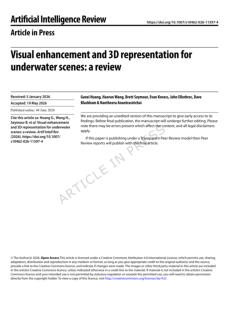
32 - Visual enhancement and 3D representation for underwater
scenes: a review
Authors: Guoxi Huang, Haoran Wang, Brett Seymour,
Evan Kovacs, John Ellerbroc, Dave Blackham &
Nantheera Anantrasirichai
Underwater visual enhancement (UVE) and 3D
reconstruction face major challenges from complex
aquatic imaging conditions. This paper provides a
comprehensive review, introducing fundamental physical
models, surveying methods from non-learning
approaches to data-driven techniques like NeRF and 3D
Gaussian Splatting, evaluating state-of-the-art algorithms
quantitatively and qualitatively on benchmarks, and
highlighting future research directions.