










Underwater mapping 2023










Authors: Yang Yu, and Chenfeng Qin
Underwater image enhancement faces challenges of light
scattering, absorption, and distortion. Instead of using a
specific underwater imaging model to mitigate the
degradation of underwater images, the authors propose
an end-to-end underwater-image-enhancement
framework that combines fractional integral-based Retinex
and an encoder–decoder network. The proposed variant
of Retinex aims to alleviate haze and color distortion in the
input image while preserving edges to a large extent by
utilizing a modified fractional integral filter.


Authors:
Zefeng Zhao, Zhuang Zhou, Yunting Lai, Tenghui Wang,
Shujie Zou, Haohao Cai, and Haijun Xie
Clear underwater images are necessary for many
underwater applications, while absorption, scattering, and
different water conditions will lead to blurring and
different color deviations. This paper proposed a fusion-
based image enhancement method for various water
areas to overcome the limitations of the available color
correction and deblurring algorithms. The authors
proposed two novel image processing methods, namely,
an adaptive channel deblurring method and a color
correction method, by limiting the histogram mapping
interval.



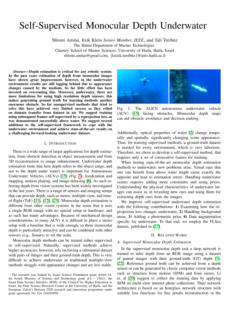
Authors: Shlomi Amitai, Itzik Klein, and Tali Treibitz
Depth estimation is critical for any robotic system. In the
past years, the depth estimation from monocular images
has shown significant improvement; however, in the
underwater environment, results are still lagging due to
appearance changes caused by the medium. The authors
suggest training using subsequent frames self-supervised
by a reprojection loss, as demonstrated above water. The
authors suggest several additions to the self-supervised
framework to cope with the underwater environment
and achieve state-of-the-art results on a challenging
forward-looking underwater dataset.


Authors: Mochou Yang, Yi Wu, and Guoying Feng
In an underwater environment, conventional imaging is
limited by low sensitivity, resulting in fuzzy images, while
ghost imaging can solve this problem. This study proposes
underwater laser ghost imaging based on Walsh speckle
patterns. According to the simulated and experimental
results, noise resistance and a low sampling rate of ghost
imaging based on Walsh speckle patterns are proved. As
the underwater environment's turbidity increases, the
image quality of ghost imaging based on Walsh speckle
patterns decreases.

Authors: Zheyong Li, Jinghua Li, Pei Zhang, Lihui
Zheng, Yilong Shen, Qi Li, Xin Li, and Tong Li
The detection of underwater targets through
hyperspectral imagery is a relatively novel topic as the
assumption of target background independence is no
longer valid, making it difficult to detect underwater
targets using land target information directly. Meanwhile,
deep-learning-based methods have faced challenges
regarding the availability of training datasets, especially in
underwater conditions. To solve these problems, a
transfer-based framework is proposed in this paper, which
exploits synthetic data to train deep-learning models and
transfers them to real-world applications.

Authors:
Yang Guan, Xiaoyan Liu, Zhibin Yu, Yubo Wang, Xingyu
Zheng, Shaoda Zhang, and Bing Zheng
Underwater image enhancement is a fundamental
requirement in the field of underwater vision. Along with
the development of deep learning, underwater image
enhancement has made remarkable progress. However,
most deep learning-based enhancement methods are
computationally expensive, restricting their application in
real-time large-size underwater image processing. The
authors propose a model based on a generative
adversarial framework for large-size underwater image
enhancement to solve these problems.

Authors: Yelena Randall, and Tali Treibitz Yan
The authors collected forward-looking stereo-vision and
visual-inertial image sets with two underwater imaging
platforms, a stereo camera rig, and an ROV in the
Mediterranean and Red Sea. To their knowledge, there is
only one other public dataset in the underwater
environment with this camera-sensor orientation. These
datasets are critical for developing several underwater
applications, including autonomous obstacle avoidance,
visual odometry, 3D tracking, Simultaneous Localization
and Mapping (SLAM), and depth estimation through
deep learning.

Authors:
Yuanheng Li, Shengxiong Yang, Yuehua Gong, Jingya
Cao, Guang Hu, Yutian Deng, Dongmei Tian, and
Junming Zhou
Unpaired Image-to-Image Translation using Cycle-
Consistent Adversarial Networks, also known as
CycleGAN, has been broadly studied regarding
underwater image enhancement, but it is difficult to apply
the model because it can be difficult to train if the dataset
used is not appropriate. In this article, the authors devise a
new method of building a dataset and choosing the best
images based on the widely used Underwater Image
Quality Measure (UIQM) scheme to create the dataset.


Authors:
Shijie Xu, Rendong Feng, Pan Xu, Zhengliang Hu, Haocai
Huang, and Guangming Li
Underwater environment observation with underwater
acoustic tomography has been considerably developed in
recent years. Moving sound transmission can obtain the
observation of entire spatial area with sound station
moving. Various internal structures, unique surface and
submarine boundaries and changing environment
constitutes a complex acoustic propagation channel. This
paper focus on the inversion method and signal
resampling for sound moving transmission. Also, the
current field in three-dimensional (3D) scale is also studied.


Authors:
Marios Xanthidis, Bharat Joshi, Monika Roznere, Weihan
Wang, Nathaniel Burgdorfer, Alberto Quattrini Li,
Philippos Mordohai, Srihari Nelakuditi, and Ioannis Rekleitis
The authors of this paper discuss how to effectively map
an underwater structure with a team of robots
considering the specific challenges posed by the
underwater environment.

Authors:
Shiying Feng, Xiaofeng Li, Lu Ren, Shuiqing Xu
Autonomous navigation of unmanned aerial vehicles
(UAVs) is widely used in building rescue systems. As the
complexity of the task increases, traditional methods based
on environment models are hard to apply. this paper
proposes a reinforcement learning (RL) algorithm to solve
the UAV navigation problem.


Authors: Daniel Short, Tingjun Lei, Chaomin Luo, Daniel
W. Carruth, Zhuming Bi
This study aims to address a gap in existing research by
integrating a biologically inspired Bat Algorithm (BA) for
path planning. It outlines the motivation behind the study,
the methodology involving the use of convolutional
neural networks (CNNs) for feature extraction, and the
implementation of the BA for global path planning. It also
highlights the structure of the paper and the validation of
the proposed approach through simulations and
comparisons.

Authors: Wei Song, Yaling Liu, Dongmei Huang, Bing
Zhang,Zhihao Shen, & Huifang Xu
This paper aims to systematically review underwater
image restoration technology, bridging the gap between
shallow-sea and deep-sea image restoration fields through
experimental analysis. The authors first categorize shallow-
sea image restoration methods into three types: physical
model-based methods, prior-based methods, and deep
learning-based methods that integrate physical models.
The core concepts and characteristics of representative
methods are analyzed. The research status and primary
challenges in deep-sea image restoration are then
summarized.

Authors:
Xiaoyang Bai, Zuodong Liang, Zhongmin Zhu, Alexander
Schwing, David Forsyth, & Viktor Gruev
Monitoring water properties using autonomous
underwater sampling robots remains a significant
challenge due to a lack of underwater geolocalization
capabilities. The authors present a new method for
underwater geolocalization using deep neural networks
trained on approximately 10 million polarization-sensitive
images acquired globally, along with camera position
sensor data.

Authors:
Tuochao Chen, Justin Chan, & Shyamnath Gollakota
The emergence of waterproof mobile and wearable
devices designed for underwater activities opens up
opportunities for underwater networking and localization
capabilities on these devices. The authors present the first
underwater acoustic positioning system for smart devices.
Unlike conventional systems that use floating buoys as
anchors at known locations, they design a system where a
dive leader can compute the relative positions of all other
divers, without any external infrastructure.

Authors: Xuanyao Bai, Kailun Wen, Donghong Peng,
Shuangqiang Liu,and Le Luo
The objective of this study is to explore the measurement
principles and detection methods of atomic
magnetometers, and it also examines the technological
means and research progress of atomic magnetometers in
various industrial fields, including magnetic imaging,
material examination, underwater magnetic target
detection, and magnetic communication. Additionally, this
study discusses the potential applications and future
development trends of atomic magnetometers.


Click on the
octopus to return to
the top of the page

Authors: Xuebo Zhang , Haixin Sun, & Arata Kaneko
This paper highlights the significance of marine
environment and hydroacoustic data collection for
military, economic, and ecological purposes. It discusses
the challenges environmental interference poses to
underwater communication and target detection and
emphasizes the need for advanced technical solutions to
improve detection and identification capabilities. The
paper also underscores the importance of sound wave
technology and signal processing in ocean exploration.

Authors: Leonidas Alagialoglou, Ioannis Manakos, Sofia
Papadopoulou, Rizos-Theodoros Chadoulis, &
Afroditi Kita
This study explains the effectiveness of different artificial
intelligence (AI) techniques for mapping underwater
aquatic vegetation (UVeg) using remote sensing data. It
evaluates the performance of classical AI tools and a
modern AI tool (Segment Anything Model, SAM) in the
context of few-shot learning with limited annotation. The
results highlight the superior performance of the SAM
model for airborne imagery but also note its challenges
for spaceborne imagery, providing researchers and
practitioners with insights into the strengths and
limitations of different AI models for UVeg mapping.


Authors: Shaowei Zhang, & Zhiqun Daniel Deng
This document overviews the advancements and
research in deep-sea exploration and observation
technology. It highlights the development of sophisticated
sensors and equipment for studying deep-sea
environments, such as seabed samplers and MEMS
sensors. The text also discusses specific technologies and
methods, such as atmospheric evaporation waveguide
communication and dual-axis rotary modulation inertial
navigation systems, that enhance ocean exploration
capabilities. Additionally, it mentions a study on
evaporation duct properties in the East China Sea,
emphasizing the importance of understanding this
phenomenon for electromagnetic wave propagation.

Authors: Hualong Du, Huijie Fan, Qifeng Zhang, and
Shuo Li
This text describes a method for accurately measuring the
volume of thick oil slicks in real-time, which is crucial for oil
spill response strategies and evaluating disposal efficiency.
It explains the use of ultrasonic inspection and image
processing techniques, facilitated by a remotely operated
vehicle and an airborne drone, to measure the thickness
and area of oil slicks. It also highlights the successful
verification of this method through laboratory
experiments, suggesting its potential application in real-
world oil spill scenarios.

Authors: Ziyang Wang, Liquan Zhao, Tie Zhong, Yanfei
Jia, & Ying Cui
This paper describes a proposed solution for improving
the quality of underwater images using a generative
adversarial network (GAN) with multi-scale and attention
mechanisms. It explains the problem of degraded
underwater images and introduces various modules and
techniques integrated into the GAN to enhance image
quality. It also mentions the evaluation of the proposed
method using specific datasets and highlights the superior
performance of the enhanced images compared to other
methods.

Authors:
Yiyang Chen, Pengqiang Ge, Guina Wang, Guirong
Weng, Hongtian Chen
This document is an analysis of the active contour model
(ACM) approach in image segmentation within the field
of computer vision. It reviews different types of ACMs,
discuss their theoretical foundations, and evaluate their
performance through experiments. Additionally, it seeks to
compare ACMs with deep learning-based algorithms and
identify future research directions in this area.

Authors:
Daniel Ierodiaconou, Dianne McLean, Matthew Jon Birt,
Todd Bond, Sam Wines, Ollie Glade-Wright, Joe Morris,
Doug Higgs, and Sasha K. Whitmarsh
This study examines the ecological value of offshore oil
and gas infrastructure in marine environments, particularly
as these structures approach the end of their operational
life. It informs decommissioning decisions by analyzing the
diversity and distribution of fish, invertebrate, and benthic
communities using remotely operated vehicle (ROV)
imagery, and also provides an overview of the methods
used, the results obtained, and highlights the ecological
significance of certain species observed in the study.

Authors: Jiancheng Yin, Xiangyu You, Yu Yao
This text informs the reader about the challenges and
methods involved in detecting subsea oil pipelines,
specifically focusing on the use of sonar and acoustic
scattering characteristics. It also aims to describe a study
that establishes an acoustic scattering model using the
finite element method to analyze various factors affecting
the detection of buried pipelines.

Authors:
Zefeng Zhao, Zhuang Zhou, Yunting Lai, Tenghui Wang,
Shujie Zou, Haohao Cai, and Haijun Xie
This text presents findings on the effectiveness of different
technologies, specifically the multibeam echo sounder
(MBES) WASSP S3 and the remotely operated underwater
vehicle (ROV) Chasing M2, in detecting and mapping
marine litter on the sea floor. It evaluates the capabilities
and limitations of these technologies in identifying marine
debris, particularly in the St. Ante Channel area in Croatia,
and provides guidelines for their integrated use in marine
litter detection.

Authors:
Shuangshuang Fan, Xinyu Zhang, Guangxian Zeng, and
Xiao Cheng
This study aims to improve the efficiency and accuracy of
mapping the underside of sea ice by proposing adaptive
sampling and map reconstruction methods. It highlights
the challenges of mapping ice topography with limited
resources and introduces a graphics-based adaptive
mapping method and a sparse approximation method for
reconstructing ice draft maps. The intent is to contribute to
the scientific understanding of sea-ice interactions and
provide a cost-effective solution for under-ice observation
missions.

Authors: Ahila Priyadharshini R, Ramajeyam K
This study introduces a new methodology for enhancing
the visual quality of underwater images. It outlines the
challenges faced in underwater imaging, such as speckle
noise, backscatter noise, and blur, and explains how the
proposed approach, which includes techniques like color
correction, contrast enhancement, homomorphic filtering,
and fusion, addresses these issues. It also highlights the
effectiveness of the methodology through qualitative and
quantitative assessments, claiming it surpasses existing
state-of-the-art techniques. The ultimate goal is to improve
the quality of underwater images for fields like marine
biology, oceanography, and underwater archaeology.
09 - Underwater ice adaptive mapping and reconstruction using
autonomous underwater vehicles.
Authors: Shuangshuang Fan, Xinyu Zhang, Guangxian
Zeng, and Xiao Cheng
The undersides of floating ice shelves and sea ice in
Antarctica and the Arctic are hard to access.
Understanding the interactions between ice shelves, sea
ice, and the ocean is important. Mapping the underside of
sea ice is necessary to understand its growth and decay.
This paper presents a low-cost underwater ice mapping
method for small Autonomous Underwater Vehicles
(AUVs) using adaptive sampling and reconstruction
methods. The proposed methods are validated with field
data.
06 - Weibull Tone Mapping (WTM) for the Enhancement of
Underwater Imagery
Authors: Chloe Amanda Game, Michael Barry
Thompson, and Graham David Finlayson
This paper presents a simpler and faster interactive tone-
mapping approach for end-users, built upon Weibull
Tone Mapping theory. It allows users to shape brightness
distributions using two parameter sliders. Experiments
show that this method can make desired adjustments in
over 80% of images, while 91% of control-point TMOs can
be visually well-approximated. The work emphasizes the
importance of image purpose in underwater image
enhancement.

18 - Underwater terrain positioning method based on Markov
random field for unmanned underwater vehicles
Authors: Pengyun Chen, Ying Liu, Xiaolong Chen, Teng
Ma, and Lei Zhang
This paper presents a Markov random field model for
underwater terrain-matching positioning, based on real-
time terrain data from a multi-beam echo sounder. The
method improves terrain adaptability and accuracy, and its
playback simulation tests show its usability in underwater
engineering applications for positioning correction.
28 - Enhancement and Optimization of Underwater Images and
Videos Mapping
Authors: Chengda Li, Xiang Dong, Yu Wang, and Shuo
Wang
This paper presents a high-speed enhancement and
restoration method for underwater images and videos
based on the dark channel prior (DCP). It includes an
improved background light estimation method, rough
estimation of the R channel's transmission map, a TM
optimizer, and an improved color correction algorithm.
The method is tested using various image-quality
assessment indexes and real-time underwater video
measurements on a flipper-propelled underwater vehicle-
manipulator system.
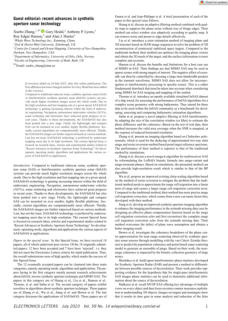
30 - Recent advances in synthetic aperture sonar technology
Authors: Xuebo Zhang, Gary Heald, Anthony P. Lyons,
Roy Edgar Hansen, and Alan J. Hunter
Synthetic aperture sonar (SAS) and interferometric
synthetic aperture sonar (InSAS) provide higher resolution
images than traditional sidescan sonar, attracting interest
in underwater engineering. Advances in navigation,
autonomous vehicles, and sonar technology have led to
lighter, more efficient SAS/InSAS systems. This Special Issue
includes research and studies on recent developments
and applications in SAS/InSAS technology.

Authors: Feihu Zhang, Diandian Xu and Chensheng
Cheng
Multi-vehicle collaborative mapping is more efficient in
unfamiliar underwater environments than single-vehicle
methods. The challenge of Simultaneous Localization
and Mapping (SLAM) with multiple underwater vehicles
is map registration. An algorithm using the Gaussian
Mixture Robust Branch and Bound (GMRBnB) algorithm
and interior point filtering technique is proposed, which
improves outlier tolerance and map registration
accuracy, surpassing Iterative Closest Point and Normal
Distributions Transform methods.
42 - An Underwater Distributed SLAM Approach Based on
Improved GMRBnB Framework
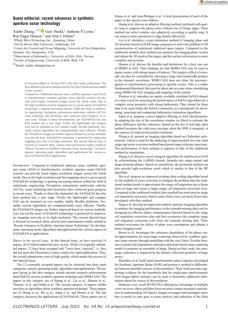
07 - Investigating the rate of turbidity impact on underwater spectral
reflectance detection
Authors: Hong Song, Syed Raza Mehdi, Zixin Li, Mengjie
Wang, Chaopeng Wu, Vladimir Yu Venediktov,
and Hui Huang
This document explores the inherent optical properties of
targeted objects, emphasizing the need to understand
how turbidity influences spectral data collection. Utilizing
a stare-type underwater spectral imaging system with a
liquid crystal tunable filter, the research examines the
correlation between increasing turbidity levels and
scattering intensity. The findings demonstrate a notable
increase in scattering effects at specific wavelengths and
highlight the effect of turbidity on spectral detection
accuracy, offering insights for improving underwater
object detection techniques.
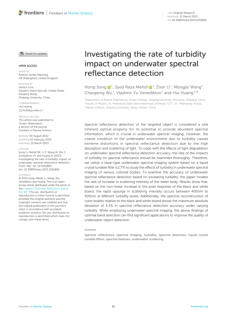
04 - Using UAVs and Photogrammetry in Bathymetric Surveys in
Shallow Waters
- Published by MDPI - Applied Sciences
Authors: Alexandre Almeida Del Savio, Ana Luna Torres,
Monica Alejandra Vergara Olivera, Sara Rocio
Llimpe Rojas, , Gianella Tania Urday Ibarra, and
Alcindo Neckel
This article discusses the use of unmanned aerial vehicles
(UAVs) and photogrammetry for conducting bathymetric
surveys with enhanced safety, cost-effectiveness, and
accuracy. The study evaluates error levels during UAV
flights over controlled water bodies at varying depths,
analyzing how turbidity and luminosity influences the
accuracy of these measurements. Key findings indicate
that higher luminosity correlates with lower errors up to a
depth of 0.97 m, while the effect of turbidity on error rates
varies based on depth, suggesting practical applications
for UAV-based photogrammetry in shallow waters.
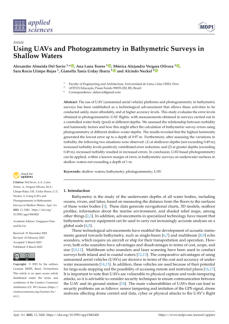
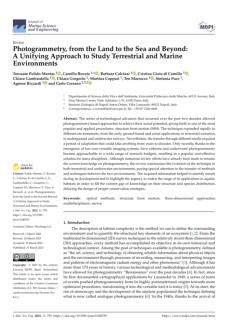
05 - Photogrammetry, from the Land to the Sea and Beyond:
A Unifying Approach to Study Terrestrial and Marine
Environments
- Published by MDPI - Journal of Marine Science and Engineering
Authors: Torcuato Pulido Mantas, Camilla Roveta, Barbara
Calcinai, Cristina Gioia di Camillo, Chiara
Gambardella, Chiara Gregorin, Martina Coppari,
Teo Marrocco, Stefania Puce, Agnese Riccardi,
and Carlo Cerrano
This article chronicles the evolution of photogrammetry,
particularly focusing on the structure from motion (SfM)
technique that has gained popularity due to
technological advances over two decades. It highlights
the transition of this methodology from terrestrial settings
to underground and underwater surveys, noting that
recent affordable imaging systems have democratized
access to these techniques across various research fields
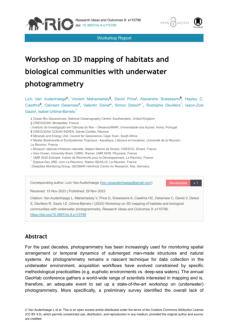
43 - Workshop on 3D mapping of habitats and biological
communities with underwater photogrammetry
- Published by Research Ideas and Outcomes (RIO)
Authors: Loïc Van Audenhaege, Vincent Mahamadaly,
David Price, Alexandre Sneessens, Hayley C.
Cawthra, Clément Delamare, Valentin Danet,
Simon Delsol, Rodolphe Devillers, Iason-Zois
Gazis, Isabel Urbina-Barreto
This paper discusses the growing use of photogrammetry
for monitoring underwater structures and its
development as a data collection method in aquatic
environments. It highlights a workshop organized at the
annual GeoHab conference aimed at addressing the
audience’s lack of knowledge in photogrammetry. The
workshop included theoretical concepts, sampling
designs, practical case studies, and hands-on training in
data acquisition and processing.

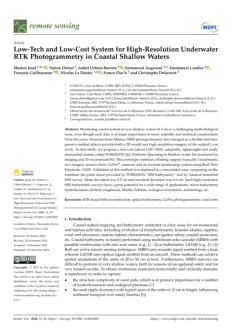
45 - Low-Tech and Low-Cost System for High-Resolution
Underwater RTK Photogrammetry in Coastal Shallow Waters
- Published by MDPI - Remote sensing
Authors: Marion Jaud, Simon Delsol, Isabel Urbina-Barreto
, Emmanuel Augereau, Emmanuel Cordier,
François Guilhaumon, Nicolas Le Dantec, France
Floc’h, and Christophe Delacourt
This study presents a novel, low-cost system named
POSEIDON, which utilizes Structure-from-Motion (SfM)
photogrammetry to create high-resolution 3D models of
the seabed. With a cost of approximately USD 1500, this
adaptable prototype includes floating support, imagery
sensors, and a precise positioning system. Validation of
POSEIDON’s methodology reveals a mean deviation of
5.2 cm compared to traditional terrestrial surveys,
highlighting its potential applications in various scientific
and technical fields.

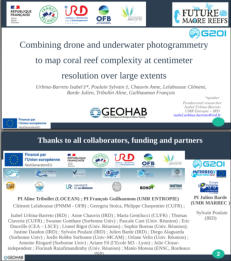
17 - Combining drone and underwater photogrammetry to map
coral reef complexity at centimeter resolution over large extents
Authors: Urbina-Barreto Isabel, Poulain Sylvain, Chauvin
Anne, Lelabousse Clément, Barde Julien, Tribollet
Aline, Guilhaumon François
This study presents a novel methodological framework
that integrates aerial drone (UAV) photogrammetry with
underwater photogrammetry to create high-resolution,
seamless 3D models of coral reef ecosystems. By
combining above-water and underwater imagery, the
authors reconstruct reef structures at centimeter-level
resolution across large areas. Therefore, it enables precise
quantification of 3D habitat complexity metrics across
entire reefscapes.

Authors: Bin Hu, Yiqiang Zhao, Guoqing Zhou, Jiaji He,
Changlong Liu,, Qiang Liu, Mao Ye, and Yao Li
Underwater laser detection is hindered by light
attenuation from scattering and absorption in water. This
study designs an underwater Lidar system using a paraxial
multi-channel detection strategy to improve dynamic
range in subsea environments. A multi-channel
underwater Lidar simulation (MULS) method based on
radiative transfer Lidar equations was developed and
validated through experiments under varied water
conditions. The prototype achieved range accuracy better
than 0.1085 m, with strong correlations between
simulated and measured waveforms, confirming the
simulation method's reliability.
29 - Simulation and Design of an Underwater LiDAR System Using
Non-Coaxial Optics and Multiple Detection Channels
Authors: Yongqiang Chen, Shouchuan Guo, Yan He,
Yuan Luo, Weibiao Chen, Shanjiang Hu, Yifan
Huang, Chunhe Hou, and Sheng Su
Underwater laser detection is hindered by light
attenuation from scattering and absorption in water. This
study introduces an underwater Lidar system using a
paraxial multi-channel detection strategy to improve
dynamic range in subsea environments. A multi-channel
underwater Lidar simulation (MULS) method, based on
radiative transfer Lidar equations, was developed and
validated through experiments under varied water
conditions. The prototype achieved range accuracy better
than 0.1085 m per channel, with strong agreement
between simulated and measured waveforms, confirming
the simulation's reliability.

Author: Guangbo Xu
Underwater LiDAR performance is hindered by laser
attenuation and backscattering from suspended particles.
To overcome these limitations, this paper presents a high-
speed signal processing system for underwater LiDAR
utilizing complete waveform sampling. The system
features a photodiode preamplifier and a 2 GHz sampling
frequency main control board, enabling a ranging
accuracy of 0.075 m and backscatter filtering. This work
offers a valuable reference for underwater LiDAR signal
processing system design.

Authors: Pau Vial, Narcís Palomeras, Joan Solà, Marc
Carreras
This paper presents a two-dimensional Simultaneous
Localization and Mapping (SLAM) system for Autonomous
Underwater Vehicles (AUVs). Designed to overcome the
challenges of the underwater environment, the system
utilizes inertial sensors and a mechanical profiling sonar.
Key innovations include a dead reckoning system based
on Lie Theory to manage pose uncertainty and a rigid
scan matching technique adapted for acoustic data,
which also estimates matching uncertainty. Bayesian-
Gaussian mixtures are employed in scan matching, with
registration solved via optimization in Lie groups.


Authors: Xudong Liu, Liping Zhang, Xiaoyu Zhai, Liye Li,
Qingji Zhou, Xue Chen, and Xiaobo Li
Polarization lidar (P-lidar) advances traditional lidar by
incorporating polarization properties (degree, angle,
ellipticity) alongside backscattering intensity and spectrum.
This expands detected physical information, enhancing
analysis for atmospheric, oceanic, and terrestrial remote
sensing. This review introduces P-lidar principles and
systems, surveys its applications across these domains, and
proposes future research directions to stimulate further
development.
Authors: Anna Marshall, Ryan R. Morrison, Brady Jones,
Shayla Triantafillou, Ellen Wohl
Wood accumulations significantly affect geomorphic,
hydraulic, and ecological processes in river corridors, yet
accurately characterizing them remains challenging. This
study assesses the effectiveness of handheld lidar
scanners, specifically the fourth-generation iPad Pro, in
collecting 3D wood accumulation data for measuring
volume, porosity, complexity, and roughness. Findings
indicate that handheld lidar offers a cost-effective
alternative to traditional field methods by providing user-
friendly data collection and visualization, enabling
accurate temporal volume comparisons, aiding porosity
measurements, and supporting hydraulic and
morphodynamic modeling.