











United Nations instruments and
diving and ROV operations
(Continuation)
C - United Nations instruments and underwater operations
Two main organs of the five currently in operation are involved in
commercial underwater and maritime interventions:
•
The Secretariat, via the Division for Ocean Affairs and the Law of
the Sea (DOALOS), which is the primary organ responsible for the
“Convention on the Law of the Sea (UNCLOS)”, which serves as the
foundational legal framework for maritime and underwater
activities.
•
The Economic and Social Council (ECOSOC), which plays a key role in
coordinating with specialized agencies and independent international
organizations that partner with the UN on maritime and underwater
interventions, such as commercial diving and ROV operations.
The other main organs (General Assembly, Security Council, and Court
of Justice) have limited or indirect roles in this specific context.
The Convention on the Law of the Sea (UNCLOS) and its
impact on commercial underwater activities:
This crucial document outlines the jurisdictional framework within
which all maritime regulations, including those specific to diving, must
operate, and serves as a reference in case of territorial disputes
regarding the exploitation of the oceans. Its principles were first
addressed during the United Nations Conferences on the Law of the
Sea (UNCLOS I and UNCLOS II), held in Geneva in 1958 and 1960.
These were later expanded upon in the General Assembly's Resolution
2749 (XXV) of December 1970. The convention was then negotiated
during the Third United Nations Conference on the Law of the Sea
(1973–1982) and entered into force on 16 November 1994
As mentioned above, the Division for Ocean Affairs and the Law of the
Sea (DOALOS) is responsible for managing it on behalf of the
Secretariat.
Companies should systematically refer to this convention when
organizing underwater operations, as it identifies the areas that fall
under a coastal state's jurisdiction (and thus whether its standards
apply), depending on their distance from its baseline. These areas
currently fall into five main parts:
•
The Territorial Sea is a zone that extends to 12 nautical miles: The
state has full sovereignty in it. However, foreign ships get a right of
"innocent passage" (innocent passage means that the ship can sail
at normal/full speed as long as its passage is not prejudicial to the
peace, good order, or security).
•
The Contiguous Zone is an extension of the Territorial Sea that
extends up to 24 nm, where the state can enforce customs, fiscal,
immigration, and sanitary laws.
•
The Exclusive Economic Zone (EEZ) is a zone where the state has
exclusive rights to exploit natural resources (fish, oil, gas) but doesn't
have full sovereignty, so other states retain navigation and overflight
rights. It extends up to 200 nm.
•
The Continental Shelf can be considered an extension of the
Exclusive Economic Zone (EEZ), giving the coastal state rights over
seabed resources beyond 200 nm where the physical shelf does. It
is, however, limited to 350 nautical miles (or 100 nm from the
2,500m isobath)
•
High seas are part of the oceans and seas beyond national
jurisdiction, open to all states, governed by flag-state law and
UNCLOS's general principles rather than any one country's rules.
Note that the International Seabed Authority (ISA) has been created
to govern mineral resources on the seabed beyond national
jurisdiction.
While these areas can be seen as the basis on which the the legal
framework of coatal states is built, this 202 pages convention also
details specific cases such as the contiguous zones between archipelic
states, the case of artificial islands, in addition to the rules related to
commercial navigation within the different areas (including free
passage in international straits), the conservation and management of
the environment, and and many others.
Disputes between states are solved by the International Tribunal for the
Law of the Sea (ITLOS) in Hamburg.
As with conventions, this document is a binding treaty for its signatory
countries, which currently number around 170, including the European
Union. However, the United States has neither signed nor ratified the
1982 Convention (due to historical objections to its original deep seabed
mining provisions). Despite this, it is widely regarded as reflecting
customary international law. This means that many of its core rules,
such as the 12 nautical mile territorial sea and the concept of the
Exclusive Economic Zone (EEZ), are considered binding even on non-
signatory states like the U.S., based on customary practice rather than
treaty consent. However, it is worth noting that not every provision of
this convention carries this customary status, so assumptions cannot
be made on a clause-by-clause basis.
The International Maritime Organization (IMO):
Because underwater operation at sea cannot happen without support
vessels and relevant diving systems, the documents issued by IMO
apply automatically.
Note that the organization is governed by the Assembly (approving the
work programme and budget), and the Council, which is the executive
organ of the assembly, responsible for supervising the work of the
Organization. The various Conventions, Codes, Resolutions, and
Guidelines are published by the the following committees:
•
The Facilitation Committee (FAL) deals with matters related to the
facilitation of international maritime traffic, including the arrival,
stay and departure of ships, persons and cargo from ports. The
Committee also addresses electronic business, including the single
window concept, and aims to ensure that the right balance is struck
between regulation and the facilitation of international maritime
trade.
•
The Legal Committee (LEG) deals with any legal matters within
IMO’s scope. This includes liability and compensation issues related
to the operation of ships, including damage, pollution, passenger
claims, and wreck removal. The Committee also addresses seafarer
matters, including the fair treatment of seafarers, and issues
concerning unlawful activities at sea which affect the safety of
navigation.
•
The Marine Environment Protection Committee (MEPC) addresses
environmental issues under IMO’s remit. This includes the control
and prevention of ship-source pollution covered by the MARPOL
treaty, including oil, chemicals carried in bulk, sewage, garbage and
emissions from ships, including air pollutants and greenhouse gas
emissions. Other matters covered include ballast water
management, anti-fouling systems, ship recycling, pollution
preparedness and response, and identification of special areas and
particularly sensitive sea areas.
•
The Maritime Safety Committee (MSC) deals with all matters related
to maritime safety and maritime security which fall within the scope
of IMO, covering both passenger ships and all kinds of cargo ships.
This includes updating the SOLAS Convention and related codes,
such as those covering dangerous goods, life-saving appliances and
fire safety systems. The MSC also deals with human element
issues, including amendments to the STCW Convention on training
and certification of seafarers. The MSC has a wide range of issues
on its current agenda, including goal-based standards, autonomous
vessels, piracy and armed robbery against ships, cyber security, e-
navigation and the modernization of the Global Maritime Distress
and Safety System (GMDSS).
•
The Technical Cooperation Committee (TC) oversees IMO’s capacity-
building programme and the implementation of technical
cooperation projects for which the Organization acts as the
executing or cooperating agency, ensuring that IMO supports the
United Nations Sustainable Development Goals and the 2030 Agenda
for Sustainable Development.
The organization is known to emit numerous documents, among which
the followings are related to the organization of underwater operations:
•
SOLAS (International Convention for the Safety of Life at Sea, 1974,
as amended), binding once ratified; governs the seaworthiness,
life-saving appliances, and safety management of the support
vessel itself.
•
STCW (International Convention on Standards of Training,
Certification and Watchkeeping for Seafarers), also binding; sets
minimum training and certification standards for the vessel's crew.
However, this convention is not applicable for diving and ROV crews
who are certified through separate, non-IMO schemes.
•
The International Code of Safety for Diving Operations, 2023
(Resolution MSC.548(107)), commonly refered as “The Diving Code
2023”, which entered into force on 1 January 2024. It follows an
approach covering fixed, portable, surface-oriented and mixed-gas
diving systems, introduces a two-part certification scheme. As with
Codes, its application is not binding. However, administrations are
"encouraged" to apply it.
Note that this code was adopted as the replacement of “the Code of
Safety for Diving Systems”, adopted in 1983, substantially revised
as Resolution A.831 in 1995, and paired with the 1991 hyperbaric-
evacuation guidelines (Resolution A.692), designed to set minimum
design, construction and survey standards for diving systems
fitted to ships and floating structures. Similarly as the diving code,
flag administrations and classification societies were encouraged to
adopt it.
One nuance with the “Diving Code 2023” is that it applies to ships of
not less than 500 gross tonnage that have a diving system installed
on or after January 1, 2024. It is however mentioned that
administrations may apply its provisions to lesser tonnage vessels
"as far as reasonable and practicable". Therefore, for smaller
vessels, such as workboats, inland vessels, or smaller offshore
support vessels under 500 GT, that typically utilize non-saturation
diving systems, continuing to reference the 1995 Code (Resolution
A.831) remains a perfectly valid, practical, and IMO-endorsed
approach.
Note that the “Diving Code 2023” is described in an previous article
in this Section.
•
The recently adopted (May 2026) International Code of Safety for
Maritime Autonomous Surface Ships (MASS Code), effective from 1
July 2026, addresses safety, remote operations, cybersecurity,
navigation, and other critical aspects for autonomous and remotely
operated surface ships (not underwater vehicles). This new Code is
currently in an experimental phase to gather operational data before
potential mandatory adoption under SOLAS.
In addition, the organization has acknowledged that its framework
could serve as a model for future regulations, including unmanned
underwater vehicles (UUVs). This suggests that regulations may be
developed for Remotely Operated Vehicles (ROVs) and Autonomus
Underwater Vehicles (AUVs) in the near future. For the moment, no
Document has been issued by IMO regarding commercial design
and working procedures of ROVs and AUVs.
•
The Guidelines for the Design, Construction and Operation of
Passenger Submersible Craft (IMO MSC/Circ.981) cover the design,
construction, and operation of passenger submersible craft and
other manned underwater vehicles. While this category of vehicles
is not commonly used today by the companies involved in
construction and inspection works, they continue to be employed for
scientific activities and similar.
Case of Classification Societies:
Classification Societies are independent, non-governmental
organizations that establish and verify technical standards for the
design, construction, and operational safety of ships, offshore
structures, and diving systems.
While independent of the IMO, they are linked to the organization
through the mandatory Recognized Organization (RO) Code, which
governs their delegated authority from flag states. It is worth noting
that since January 2015, when a flag state authorizes a Classification
Society as a Recognized Organization to conduct statutory surveys or
issue certificates on its behalf, that authorization must comply with Part
1 general requirements, (resources, independence, competence, quality
management) and Part 2 (RO oversight by the flag state) of the RO
Code, as legally required under SOLAS, MARPOL, and the 1988 Load
Lines Protocol.
The links to IMO are reinforced for those that are members of the
International Association of Classification Societies (IACS), as this
organization holds consultative status at IMO and contributes to rule-
making. Note that IACS is an industry association with its own
admission criteria around technical capability, quality management
systems, and fleet/asset coverage. Therefore, membership in this
association is voluntary, and IMO doesn't require it anywhere in the
Recognized Organization (RO) Code.
The core activities of the Classification societies include:
•
Surveying and inspecting vessels/offshore units for compliance
with class rules and, where delegated, IMO statutory requirements.
•
Developing class rules and technical guidelines for construction,
maintenance, and operation.
•
Issuing statutory certificates on behalf of flag states when
authorized as a Recognized Organization.
The International Labour Organization (ILO):
The ILO has no convention specifically dedicated to occupational diving
and underwater vehicles personnel. However, they are covered through
instruments aimed at broader categories.
•
The “Maritime Labour Convention, 2006 (MLC)”, binding on ratifying
states, sets minimum working and living conditions for seafarers
and applies to crew aboard dive-support vessels in the same way it
applies to any merchant ship's crew (working hours, repatriation,
medical care aboard, accommodation).
•
The “Occupational Safety and Health (Dock Work) Convention, 1979
(No. 152)”, covers all and any part of the work of loading or
unloading any ship as well as any work incidental thereto. As
suggested, this Convention applies when mobilizing and demobilizing
ships, which is common practice in our industry.
Also note that the ILO's body of Conventions, Recommendations, and
Codes of Practice on Occupational Safety and Health guides the
management of hazards in various work environments, including
manual and technical work. To simplify access and comprehension of
these documents, the organization has published the "ILO guide to
International Labour Standards on Occupational Safety and Health", a
document that reproduces the text of the nine key occupational safety
and health instruments listed below, which can also be downloaded
separately:
•
Occupational Safety and Health Convention, 1981 (No. 155)
•
Protocol of 2002 to the Occupational Safety and Health Convention,
1981
•
Occupational Safety and Health Recommendation, 1981 (No. 164)
•
Promotional Framework for Occupational Safety and Health
Convention, 2006 (No. 187)
•
Promotional Framework for Occupational Safety and Health
Recommendation, 2006 (No. 197)
•
Occupational Health Services Convention, 1985 (No. 161)
•
Occupational Health Services Recommendation, 1985 (No. 171)
•
Protection of Workers’ Health Recommendation, 1953 (No. 97)
•
List of Occupational Diseases Recommendation, 2002 (No. 194)
The United Nations Educational, Scientific and Cultural
Organization (UNESCO):
UNESCO touches diving and ROV work through two very different
mechanisms:
•
The "2001 Convention on the Protection of the Underwater Cultural
Heritage" is a binding treaty in force since 2009 and currently
ratified by roughly 80 states that defines underwater cultural
heritage as any trace of human existence submerged for at least
100 years, prohibits its commercial exploitation, and establishes in
situ preservation as the preferred first option before any recovery.
For commercial or scientific diving and ROV operators, this
Convention determines what a diving or an ROV team is legally
permitted to touch, recover, or even approach on a wreck site, and it
interacts with national heritage law wherever a state has ratified it.
•
The United Nations Decade of Ocean Science for Sustainable
Development (2021–2030), commonly referred to as the "Ocean
Decade", to which this website is a participant, was proclaimed by
the UN General Assembly in 2017 and coordinated by UNESCO's
Intergovernmental Oceanographic Commission (IOC), As mentioned
in our article describing this initiative in more detail, this is not a
regulatory instrument at all but a coordinating framework that
channels funding, data standards, and research priorities toward
ocean science, explicitly framed around UNCLOS and Sustainable
Development Goal 14.
The World Health Organzation (WHO):
The World Health Organization (WHO) governs cross-border public
health reporting through the International Health Regulations (IHR),
which, as previously mentioned, are the legally binding instrument of
international law for 196 countries. This framework requires countries
to develop core capacities to detect, assess, notify, and report events
that may constitute a public health emergency. Consequently, vessel
masters are required to report any diseases of this nature that occur
onboard their vessels. Guidelines for disease monitoring and the
evacuation of casualties should also be considered.
Among the key documents related to cross-border public health
reporting and communicable disease events under the IHR, we can
refer to the following:
•
International Health Regulations (2005), Third Edition (including
amendments)
•
WHO Guidance for the Use of Annex 2 of the International Health
Regulations (2005)
•
Case Definitions for the Four Diseases Requiring Notification to WHO
in All Circumstances under the IHR (2005)
•
WHO Recommended Surveillance Standards (Communicable Disease
Surveillance and Response Systems)
•
IHR Monitoring and Evaluation Framework
•
Report of the Review Committee on the Functioning of the
International Health Regulations (2005) during the COVID-19
Response
•
Regional Implementation Reports (e.g., EMRO, AFRO, EURO)
The Council for International Organizations of Medical Sciences
(CIOMS):
As mentioned in the previous chapter CIOMS guidelines are mostly
appliacble to diving medicine and research involving the use of humans.
Therefore the contacts of the CIOMS with the diving industry is
normally through medical abd scientific staffes.
However, it is worth noting that when diving companies do modification
of procedures such as decompression procedure on their own and
without the support of a relevant scientific support conform to the
description of the CIOMS (and by extention de declaration of Helsinki)
tey fall aoutside the recommendations of the CIOMS, which may be
used agaisnt them in court in case of an incident.
2 - Main Specialized Agencies involved
1 - Main Organs involved
3 - Main Independent International Organizations involved
The International Organization for Standardization (ISO):
The impact of ISO on occupational underwater activities extends far
beyond guidelines related only to these activities, as the Organization is
involved in the quasi totality of industrial segments. Therefore, every
item used for the construction of vessels or diving systems, and every
piece of equipment used during diving and ROV operations,
automatically falls within numerous ISO norms. As of the latest official
data, the Organization has already published 26,116 documents at the
end of December 2025, many of which have been adopted by states
and are therefore now standards. It is mentioned that the total number
of ISO published documents grows by roughly 1,400 to 1,500 new or
updated publications per year. Consequently, listing all the documents
related to underwater commercial activities or maritime activities would
require an entire book.
It is worth noting that as of the latest available data (end of 2025), the
breakdown of the committees at work for the organization is estimated
as follows:
•
Approximately 250 Technical Committees (TCs), each focusing on a
broad industry or technology area, such as ships, welding, or
environmental management
•
Approximately 700 Subcommittees (SCs) that operate under TCs
and focus on specific aspects of the broader field.
•
Approximately 2000 Working Groups (WGs), that are formed under
TCs or SCs to develop specific standards.
Among these numerous committees all linked directly or indirectly to
diving and ROV operations, we can highlight the "Ships and Marine
Technology Committee ISO/TC 8", which operates through the following
specialized sub-committees (SC) and Working groups (WG) as an
example of committee organization:
•
ISO/TC 8/SC 1
Maritime safety
•
ISO/TC 8/SC 2
Marine environment protection
•
ISO/TC 8/SC 3
Piping and machinery
•
ISO/TC 8/SC 4
Outfitting and deck machinery
•
ISO/TC 8/SC 6
Navigation and ship operations
•
ISO/TC 8/SC 7
Inland navigation vessels
•
ISO/TC 8/SC 8
Ship design
•
ISO/TC 8/SC 11
Intermodal and Short Sea Shipping
•
ISO/TC 8/SC 12
Ships and marine technology - Large yachts
•
ISO/TC 8/SC 13
Marine technology
•
ISO/TC 8/SC 25
Maritime greenhouse gas (GHG) emissions
•
ISO/TC 8/SC 26
Smart shipping
•
ISO/TC 8/SC 27
Ports and terminals
•
ISO/TC 8/WG 3
Special offshore structures and support
vessels
•
ISO/TC 8/WG 4
Maritime security
•
ISO/TC 8/WG 6
Ship recycling
•
ISO/TC 8/WG 11 Dredging
•
ISO/TC 8/WG 12 Aquatic nuisance species
•
ISO/TC 8/WG 14 Maritime education and training
•
ISO/TC 8/WG 15 Ocean Negative Carbon Emissions and Carbon
Neutrality
The same structure applies to all ISO committees. Note that the gaps in
the numbering of Subcommittees (SCs) and Working Groups (WGs) are
typically due to disbanded or inactive Subcommittees and Working
Groups.
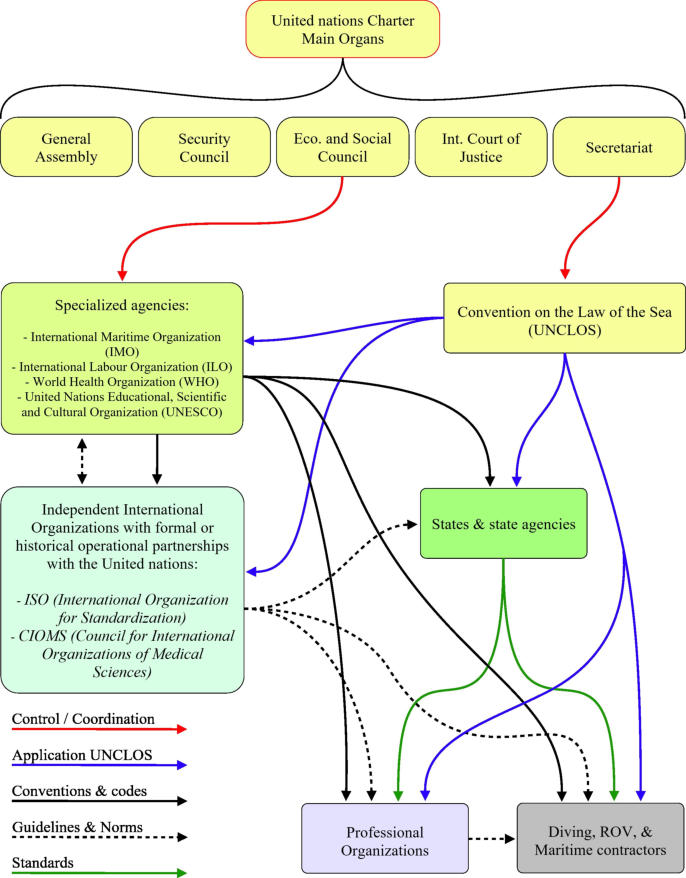
The chart below schematizes the relationships among the bodies
described in this chapter, and the fact that the United Nations
instruments become effective when states sign and ratify conventions,
codes, resolutions, and guidelines, bringing them into force. Once
adopted by states and brought into force, these documents become
"Standards" whose application by contractors is binding; non-
compliance can lead to legal consequences.
These conventions, codes, resolutions, and guidelines can also be
voluntarily adopted by companies even if states do not adopt them.
Some United Nations documents may be directly applicable to
contractors without state implementation; for example, UNCLOS applies
beyond areas under individual states' jurisdiction.
By contrast, documents issued by professional organizations are
guidelines only, so their application is not mandatory unless their
implementation is specified in a contract between two commercial
entities. For simplification, the same type of arrow is used for
Guidelines and Norms. The term "Norms" in this article refers to ISO
documents, which are intended to become standards but are not
technically standards under the definition above until states incorporate
them into legal instruments.
For simplicity, the direct link between ISO and the Economic and Social
Council, as shown in the previous chart, is not illustrated here.



Although the principle of overall consensus that guided the League of
Nations is not present in the United Nations Charter, the organization's
processes often aim to secure the maximum number of states
ratifying any submitted document. As a result, these documents are
typically formulated based on minimum acceptable levels rather than
more stringent criteria. The goal is to create agreements that are more
likely to gain approval from member states, rather than producing a
document that no state would ratify, which would prevent it from
coming into effect.
Another reason for these minimum acceptable levels is that drafters of
conventions or codes consider global perspectives and the capabilities
of existing states to implement the documents they create..
This principle of the "minimum acceptable level" is therefore one reason
for the voluntary adoption of the various United Nations Instrument
publications by numerous countries and companies.
It is important to note that this approach often, though not always, leads
professional organizations and other independent bodies to publish
guidelines of higher technical and safety levels than those found in
United Nations publications. This sometimes results in criticism from
people who consider the levels proposed by United Nations bodies
insufficient. However, as suggested above, the mission of the United
Nations is primarily to protect as many people as possible, taking into
account the technical means available for this purpose, which would fail
if the technical levels proposed are not reachable by some populations.
As a complement, we can see that the organization gradually increases
the technical requirements of its publications and takes into
consideration proposals from professional organizations when they are
considered suitable for the entire community and therefore does not
impose commercial approaches. As an example, we can refer to the
"International Code of Safety for Diving Operations, 2023," which
replaces the "Code of Safety for Diving Systems 1995." Therefore, we
can conclude that the policy implemented is suitable for the
organization's goals.
An exception to this policy comes from certain independent international
organizations that have formal or historical operational partnerships
with the United Nations, such as the International Organization for
Standardization (ISO), which is known to sometimes issue stringent
norms. However, these norms are not binding unless adopted by states.
Consequently, they do not directly affect the general United Nations
policy.
In addition to the above, the predominance of United Nations instrument
publications is, of course, based on the Charter itself, along with the
authority of published conventions over the domestic laws of signatory
countries. Additionally, some conventions, such as the Convention on the
Law of the Sea (UNCLOS), tend to impose obligations even on countries
that are not signatories.




Click on the
octopus to return to
the top of the page
1 - Technical level and predominance over other publications
D - To conclude: Technical level, accessibility and financial
aspects of United Nations documents on occupational
underwater activities
2 - Ease of document retrieval
Access to Charter Organs' publications is straightforward, as they are
clearly highlighted on the home page of the organization's website:
https://www.un.org/en/
Access to the documents issued by Specialized Agencies is also
relatively easy, as each has its own website. For the four detailed in this
article:
•
International Maritime Organization (IMO): https://www.imo.org/en/
•
International Labour Organization (ILO): https://www.ilo.org/
•
World Health Organization: https://www.who.int/
•
United Nations Educational, Scientific and Cultural Organization
(UNESCO): https://www.unesco.org/en
This applies to all other Specialized Agencies as well.
In addition, note that IMO and ILO conventions, codes, resolutions, and
guidelines are published in the subsection United Nations publications &
national laws in Section "Document" of this website. Extensions will be
gradually made to documents from other Specialized Agencies. Also,
note that the PDF document "Internet links to IMO resolutions and
maritime facts," which provides direct links to access the latest
resolutions from the various IMO committees, is available in this
subsection.
Access to documents from the Independent International Organizations
mentioned is also easy:
•
Council for International Organizations of Medical Sciences (CIOMS):
https://cioms.ch/
•
International Organization for Standardization (ISO):
https://www.iso.org/home.html
3 - Financial aspects
IMO conventions and their associated codes, guidelines, and resolutions
are publicly available for free.
The full text of the conventions, including their articles and annexes, is
usually accessible through the IMO's Implementation of Instruments
Support Section or other official IMO pages.
The exceptions are the officially consolidated, user-friendly, and
professionally formatted publications, such as SOLAS, MARPOL, or
STCW, which are typically paid, though unconsolidated versions or older
editions may be found for free on third-party sites (with potential
version risks).
The texts of ILO conventions, recommendations, and standards are
publicly available for free on the ILO website. Since May 2023, all ILO
publications and knowledge products are available for use or reuse
without needing permission, as long as the ILO is cited as the source.
WHO publications (including guidelines, reports, and major documents)
are also free to access, download, and share for non-commercial
purposes (published under the CC BY-NC-SA 3.0 IGO license).
Similarly to ILO and WHO, all new UNESCO publications (including books,
reports, articles, and research) can be downloaded, shared, and
adapted for non-commercial purposes, with proper attribution. However,
there may be exceptions for some co-published materials produced
with third parties and not sold by UNESCO itself.
Regarding publications by Independent International Organizations,
documents from the Council for International Organizations of Medical
Sciences (CIOMS) are published on the same basis as those from the
United Nations' specialized agencies.
On the other hand, documents from the International Organization for
Standardization (ISO) are all paid. While this practice can be critiqued
for creating a financial barrier that favors wealthy companies over
smaller entities, an issue seemingly overlooked by national standards
bodies of this federation, it conforms to those in force in many
countries for norms from third party industry standards–developing
bodies, such as, but not limiting to: NORSOK in Norway, ASTM in the
United States, BSI in the United Kingdom, AFNOR in France, DIN in
Germany.
Nevertheless, it must be noted that when adopted as laws by countries,
these norms become standards and can become available free of
charge. Also, it may happen that for safety or information reasons,
states may freely release some of these documents.
To conclude on this financial aspect, the policy of the United Nations
regarding the documents published by its Instruments fully aligns with
the principles it has been created for, ensuring that core documents
align with its Charter’s principles of openness, while paid access is
limited to independent organizations or value-added consolidated
editions.