











United Nations instruments and
diving and ROV operations
The United Nations is an intergovernmental organization founded to
maintain international peace and security, develop friendly relations
among nations, achieve international cooperation on economic, social,
cultural, and humanitarian problems, and promote respect for human
rights. This status results in the organization having no army and no
power to impose legislation. Instead, it should be viewed as a
permanent forum and treaty-making body through which sovereign
states voluntarily commit to rules and then hold each other to them with
varying degrees of enforceability.
The organization, which currently groups 193 states, has its political
headquarters on an international territory in New York City. However,
several branches are based in other capitals such as Geneva, Vienna,
Nairobi, London, Paris, and others.
It is worth noting that long before the United Nations, international
treaties were already a central feature of diplomacy between kingdoms,
we can for example refer to the treaty that followed the battle of
Kadesh faught between the Egyptian Empire, led by Pharaoh Ramesses
II, and the Hittite Empire, led by King Muwatalli II approximatelly in
1274 or 1275 BCE, that is currently considered the older documented
treaty between two kingdoms. Closer to our era, we can consider the
European ones such as the Peace of Westphalia in 1648 that ended 30
years of religious wars, again after the defeat of Napoleon in 1815, and
again after the Crimean War (1853-1854) between the Russian Empire
and a European-Turkish coalition led by the British and French (Paris
treaty 1856). In those periods, however, there was no permanent
international body to facilitate treaty-making; treaties were negotiated
directly by states and reflected their own diplomatic initiatives and
power relations.
After the First World War, international cooperation entered a new
phase with the creation of the “League of Nations” under the Treaty of
Versailles in 1920, the first major attempt to establish a permanent
body for peace rather than relying only on treaties negotiated case by
case. While successful in settling some border disputes, this league
failed at its core mission to prevent the 2nd war for a combination of
reasons such as the fact that it depended on leading states, the refusal
of some powerful states such as the United States to join it, the fact
that decisions of the council required unanimity, and the the absence of
enforcement mechanisms resulting in the fact that it did not have the
authority or cohesion to compel its members to act consistently.
Therefore, while officially dissolved in 1946, the organization effectively
ended its activities in 1939.
A - The United Nations: Goals and Origins


This failure led the Allied leaders fighting the Axis powers to consider a
new structure to fix the weaknesses of the League of Nations. This
resulted in the 1942 "Declaration by the United Nations", in which Allied
governments pledged to continue fighting the Axis powers together,
which was the 1st time the term "United Nations” was employed. The
1944 Dumbarton Oaks Conference then drafted the basic structure,
and the United Nations Charter was signed by the 51 founding member
states in San Francisco on 26 June 1945 and entered into force on 24
October 1945. This charter, which is still in force, marked a significant
evolution in international cooperation. It was founded on a universal
basis, notably regarding the sovereign equality of all member states,
while also ensuring the participation of the major powers. It featured a
clearer institutional structure and a Security Council able to take binding
decisions in matters of peace and security. Its mandate also extended
beyond the prevention of war to include human rights, economic and
social development, and international cooperation more generally.
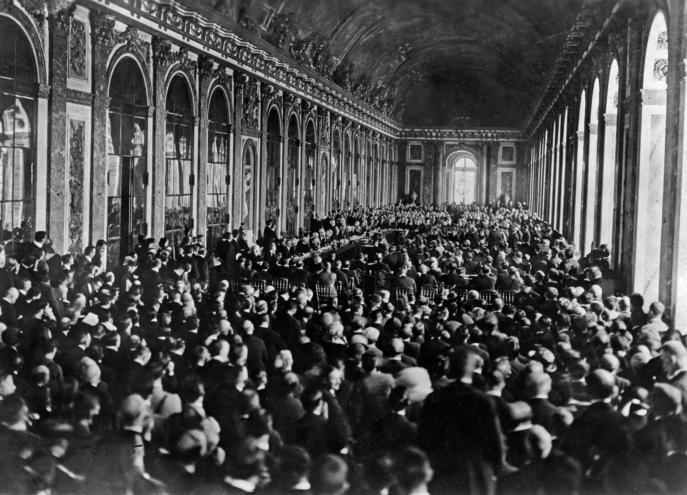
View of the Paris Peace Conference that led to the Treaty of
Versailles and the creation of the League of Nations in 1920
Definitions:
Under this framework, Instruments denote the normative and legal
architecture of the UN, such as treaties, declarations, and charters that
establish international law and standards.
Mechanisms denote the procedural and operational architecture;
namely, the committees, monitoring bodies, peacekeeping operations,
and review processes that implement, enforce, and bring those legal
standards to life.
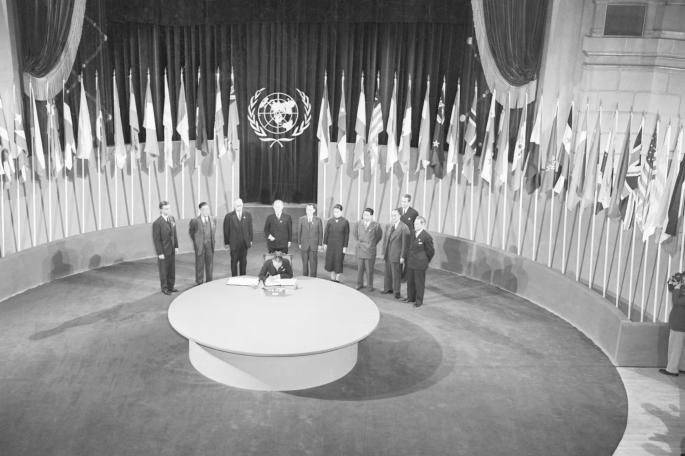
View of the signature of the United Nations Chart by the founding countries.
The photo shows the Chinese delegation led by Mr Wei Tao-ming.
B - Instruments and Mechanisms of the United Nations
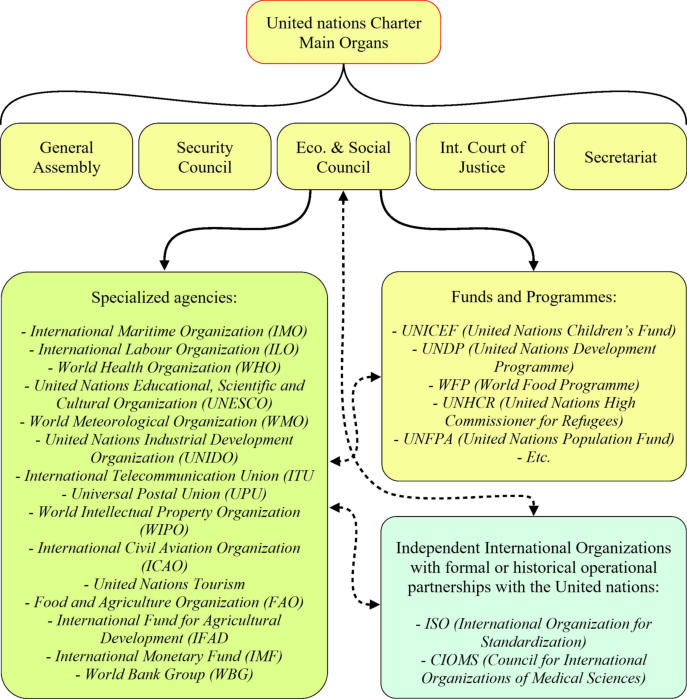
To ensure efficient operation, the United Nations Charter originally
established six main organs. However, one of these, the Trusteeship
Council, suspended its operations in 1994 after the independence of its
last trust territory. Consequently, the current active institutional
framework relies on the dynamic interplay of the five remaining core
bodies described below:
The General Assembly, also called "the Assembly":
While not a legislature, the General Assembly functions as the central
platform for multilateral dialogue, where each member state has an
equal voice. It debates and makes recommendations on almost any
matter within the Charter's scope, approves the UN budget, elects non-
permanent Security Council members, elects the Secretary-General on
the Security Council's recommendation, and emits resolutions and
declarations.
•
The General Assembly's "Resolutions" are formal decisions or
recommendations on specific issues, addressing particular actions,
policies, or responses to international situations. While they are not
legally binding, they carry significant political and moral weight as
expressions of the collective will or opinion of the international
community.
•
The General Assembly's "Declarations" are visionary, broader
statements of principles, values, or goals that articulate fundamental
norms or aspirations, such as human rights standards or
development goals, thereby setting out ideals that the international
community agrees to strive toward. Like resolutions, they are not
legally binding, but can have a strong influence on international law
and diplomacy over time.
The Security Council:
It is the instrument whose primary responsibility is international peace
and security. Under Chapter VII of the Charter, the United Nations
Security Council's resolutions can be legally binding on all member
states, making it the one part of the United Nations system that
resembles enforceable law. However, in practice, enforcement depends
on state cooperation. This Council is composed of 15 members (5
permanent: China, France, Russia, the United Kingdom, and the United
States, each holding veto power, and 10 elected by the General
Assembly for two-year terms.
The Economic and Social Council (ECOSOC):
This council coordinates the economic, social, and related work of the
United Nations and its specialized agencies, and it is the body through
which those agencies formally report to the United Nations system. It
issues formal resolutions and decisions that set policy positions or
follow up on mandates, as well as ministerial declarations and outcome
documents from high-level segments. It also publishes a wide range of
substantive and administrative documents, including Secretary‑General
reports, thematic and country reports from specialized agencies and
functional commissions, analytical background papers, official meeting
records and verbatim transcripts, agendas and summary records, as
well as press releases, meeting summaries, and conference or session
outcome documents.
The International Court of Justice (ICJ):
This instrument is the United Nations' judicial organ, which settles legal
disputes between states and gives advisory opinions to the United
Nations' organs and agencies. Its judgments are final and binding only
on the parties to a case, while its advisory opinions are authoritative but
not legally binding.
The Court, seated in The Hague (Netherlands), is composed of 15
judges, elected by both the General Assembly and the Security Council
to nine-year terms, with no two judges hailing from the same state.
While the composition is intended to reflect major legal systems and
geographic regions, judges serve in an individual and independent
capacity rather than as state representatives. However, it is worth
noting that the Court's contentious jurisdiction depends on the consent
of the states, which is currently lacking in many of them, resulting in
the Court's reach not being universal.
The Secretariat:
It is the United Nations' administrative organ led by the Secretary-
General, which supports the General Assembly, Security Council,
Economic and Social Council, and International Court of Justice by
providing substantive, procedural, and administrative assistance.
It implements mandates such as peace operations and sanctions,
drafts reports, organizes meetings, and handles diplomatic
communications, though it does not independently make binding policy.
It also produces various documents, including Secretary-General
reports, analytical papers, and meeting records. In addition, it manages
treaty registration through the United Nations Treaty Series.
1 - The Charter Organs
These are 15 autonomous, independently founded organizations, each
focused on managing specific activities. They have their own charters,
memberships, and budgets, which are linked to the United Nations
through formal relationship agreements negotiated with the Economic
and Social Council (ECOSOC). They are part of the United Nations
system but are not subordinate departments of the Secretariat. Those
most frequently cited for underwater works are:
The International Maritime Organization (IMO):
This organization, headquartered in London, was created in 1948
convention and entered into force in 1958. It is mandated to develop
and maintain a regulatory framework for shipping safety,
environmental performance, and legal matters. It works through an
Assembly of member states, a Council, and technical committees that
issue the following four types of documents:
•
“Conventions” are legally binding treaties adopted by the Assembly.
They establish international standards for maritime safety, security,
environmental protection, and labour conditions. They come into force
in the countries that have adopted them once those countries ratify
them. Therefore, their implementation is mandatory in such
countries, and non-compliance can lead to legal consequences.
•
“Codes” are detailed technical or operational rules or practices that
supplement conventions. They provide uniform implementation of
conventions or address specific issues such as, ship design, cargo
handling, or safety procedures. They are mandatory if referenced in
a convention, and recommended if adopted as non-mandatory.
•
“Resolutions” are formal decisions or recommendations adopted by
the Assembly or Council. They can amend conventions, adopt new
codes, or provide guidance on emerging issues. Their implementation
is mandatory if they amend a convention, and they are non-binding
if they are recommendations.
•
"Guidelines" are non-binding recommendations published to assist
member states, shipowners, or operators, providing relevant
practices or technical advice for implementing conventions and
codes. They may become mandatory if referenced in national laws
(in this case, they become a national standard).
The International Labour Organization (ILO):
This organization, which originated from the League of Nations, is
headquartered in Geneva and is governed by a tripartite structure
comprising government, employer, and worker delegates, all of whom
vote at its International Conference. It produces two distinct
instruments:
•
“Conventions”, which are treaties that become binding on a state once
ratified,
•
“Recommendations”, which are non-binding guidance and are often
issued alongside a Convention to provide more detailed, aspirational
context.
The World Health Organization (WHO):
This organization, founded in 1948, is also headquartered in Geneva. Its
function is to direct and coordinate international health work. Its main
binding instrument is the International Health Regulations (IHR), and it
issues technical guidelines on most health matters that are persuasive
but not compulsory unless a state chooses to adopt them domestically.
The United Nations Educational, Scientific and Cultural
Organization (UNESCO):
This organization, founded in 1945, is headquartered in Paris. It works
through a General Conference of member states and an Executive
Board to produce binding Conventions (subject to ratification), non-
binding Recommendations and Declarations, and runs standing
scientific programmes such as the Intergovernmental Oceanographic
Commission (IOC).
While these four organizations are the most commonly cited for diving
and ROV operations, the other eleven organizations that follow the same
management principles should also be kept in mind, as their operations
complement those mentioned above. These are:
The World Meteorological Organization (WMO):
This body has been created to facilitate international cooperation in
establishing networks for meteorological, hydrological, and geophysical
observations, as well as the exchange of weather data. It is also
headquartered in Geneva, Switzerland.
The United Nations Industrial Development Organization
(UNIDO):
This organization, headquartered in Vienna, Austria, was created to
promote and accelerate inclusive and sustainable industrial
development (ISID) in developing countries.
The International Telecommunication Union (ITU):
It is a specialized agency for information and communication
technologies, working to connect the world and allocate global radio
spectrum and satellite orbits. It is headquartered in Geneva,
Switzerland.
The Universal Postal Union (UPU):
This body coordinates postal policies among member nations and
ensures a truly universal network of up-to-date postal products and
services. It is headquartered in Bern, Switzerland.
The World Intellectual Property Organization (WIPO):
WIPO promotes the protection of intellectual property (such as patents,
copyrights, and trademarks) throughout the world. It is headquartered
in Geneva, Switzerland.
The International Civil Aviation Organization (ICAO):
This organization is headquartered in Montreal, Canada, and its core
mission is to codify the principles and techniques of international air
navigation and to foster the safe and orderly growth of international air
transport.
The United Nations Tourism (formerly the World Tourism
Organization, UNWTO):
The reason for this organization, based in Madrid, Spain, is to promote
responsible, sustainable, and universally accessible tourism as a driver
of economic growth and cultural understanding.
The Food and Agriculture Organization (FAO):
The body's function is to lead international efforts to defeat hunger,
improve nutrition, and increase agricultural productivity. It is
headquartered in Rome, Italy.
The International Fund for Agricultural Development (IFAD):
It is an international financial institution, headquartered in Rome, Italy,
dedicated to eradicating rural poverty and hunger in developing
countries.
The International Monetary Fund (IMF):
It was created to foster global monetary cooperation, secure financial
stability, facilitate international trade, and promote high employment and
sustainable economic growth. It is headquartered in Washington, D.C.,
USA.
The World Bank Group (WBG):
The function of this organization, based in Washington, D.C., USA, is to
provide vital financial and technical assistance to developing countries
worldwide to reduce poverty and support sustainable development.
2 - The Specialized Agencies
3 - Funds and Programmes
In addition to the 15 specialized agencies described above, the broader
"United Nations System" also includes various funds and programmes.
These are operational entities created by the General Assembly or
ECOSOC to address specific global challenges.
They are not Specialized Agencies but are part of the United Nations
System and report to the General Assembly or ECOSOC for oversight,
coordination, and alignment with the organization’s’ priorities.
They also collaborate with Specialized Agencies when their mandates
overlap or complement each other. Well known examples of such
entities are:
UNICEF (United Nations Children’s Fund): Focuses on child welfare,
education, and emergency relief.
UNDP (United Nations Development Programme): Works on sustainable
development, poverty reduction, and governance.
WFP (World Food Programme): Addresses hunger and food security,
often in collaboration with FAO (a Specialized Agency).
UNHCR (United Nations High Commissioner for Refugees): Protects and
assists refugees.
UNFPA (United Nations Population Fund): Focuses on reproductive health
and population issues.
4 - Independent International Organizations with formal or
historical operational partnerships with the United nations.
These organizations are not "United Nations agencies," nor are they
"United Nations-related organizations" in the strict diplomatic sense.
Instead, they are multi-stakeholder pillars of the global governance
ecosystem that the United Nations deliberately relies on precisely
because they are independent, and this separation from the United
Nations bureaucracy allows them to bridge the gap between
intergovernmental policy and on-the-ground technical, scientific, or
private-sector realities. Two of these organizations are regularly
mentioned for diving and ROV procedures:
ISO (International Organization for Standardization):
This well-known private, non-governmental international organization is
technically a federation of national standards bodies (though national
bodies often, but not always, depend on states), reputed for the
numerous standards it publishes. It is based in Geneva and is
governed by a General Assembly–style structure of member
delegations. Its “norms” (documents not yet adopted as standards) are
applied voluntarily worldwide, as with many United Nations instruments,
and its Geneva seat places it in the same institutional neighborhood as
the United Nations specialized agencies with which it frequently
collaborates on joint standards. It also holds consultative status with the
Economic and Social Council (ECOSOC), which, alongside its links with
several United Nations specialized agencies, demonstrates the close ties
connecting it to the United Nations.
CIOMS (Council for International Organizations of Medical
Sciences):
This international non-governmental organization was founded in 1949
jointly by WHO and UNESCO to coordinate the international medical
sciences community. It is not a United Nations body, but it was created
by two United Nations specialized agencies, remains in official relations
with WHO, and issues influential, though non-binding, ethical guidelines
(notably on human-subjects research) that are widely adopted into
national law and industry codes of practice, including in occupational
and hyperbaric medicine research.
Continued on the next page.




Click on the
octopus to return to
the top of the page