


















Scientific papers 2019 - Part A


Click on the octopus
to return to the top
of the page

Click here




Authors: Jean-Pierre Imbert, Costantino Balestra, Fatima
Zohra Kiboub, Oyvind Loennechen, & Ingrid Eftedal
Commercial saturation diving involves divers living and
working in an enclosed atmosphere with an elevated
partial pressure of oxygen (ppO2) for weeks. The divers
must acclimatize to these conditions during compression
for up to 28 days until decompression is completed.
During decompression, the ppO2 and ambient pressure
are gradually decreased; then, the divers must acclimatize
again to breathing normal air in atmospheric pressure
when they arrive at the surface. The authors investigated
51 saturation divers’ subjective evaluation of the
saturation and post-decompression phase via
questionnaires and individual interviews. The questions
were about decompression headaches and fatigue and
time before recovering to a pre-saturation state.

Authors: Jean-Pierre Imbert, Salih Murat Egi, Peter
Germonpre, & Costantino Balestra.
The risk of decompression sickness (DCS) after scuba
diving is linked to vascular gas emboli (VGE) present after
surfacing. VGE can be measured using ultrasound
Doppler and echocardiography. However, variations
occur between different divers and the same diver across
dives, potentially influenced by pre-dive conditioning. The
paper proposes a new idea that individual metabolic
processes influence the presence of static metabolic
bubbles, which may lead to circulating VGE after diving.

Authors:
Alain Boussuges, Guillaume Chaumet, Nicolas Vallée,
Jean Jacques Risso & Jean Michel Pontier
Previous studies have suggested that the circulatory
system was involved in the production of circulatory
bubbles after diving. This study was designed to research
the cardio-vascular function characteristics related to the
production of high bubble grades after diving.

Authors: Ali Erdal Gunes, Samil Aktas.
Complete blood count (CBC) is a routine diagnostic
procedure for patients and a part of routine health
inspection for healthy individuals. The effect of hyperbaric
oxygen (HBO2) therapy on CBC is not known.
The objective of this study was to determine the effects of
HBO2 on blood parameters in CBC with long-term HBO2
therapy.

Authors: Danilo Cialoni, Andrea Brizzolari, Michele Samaja,
Massimo Pieri, and Alessandro Marroni.
Nitric oxide plays an important role in the physiology and
pathophysiology of diving, and the related endothelial
dysfunction and oxidative stress roles have been
extensively investigated.
The scope of this study is to investigate the Nitrate and
Nitrite concentration and the total plasma antioxidant
capacity before, during and after a single SCUBA dive in
healthy scuba diving volunteers, as well as to look for
evidence of a possible relationship with venous gas
bubble formation.

Authors: Stanisław Skrzynski
In the article the author presents the specificity of
decompression of deep-sea dives in relation to methods
used in underwater works, with particular emphasis on
commercial diving in our country. In the 50 - 90 m depth
zone in the Polish offshore area, decompression was used
in underwater works (works below the depth of 50 m)
based on tables designed for bell diving. The technical,
organizational and formal conditions of these underwater
works corresponded to the national diving potential.

Authors:
Thijs T. Wingelaar, Pieter-Jan A. M. van Ooij, Paul
Brinkman, and Rob A. van Hulst
Exposure to hyperbaric hyperoxic conditions can lead to
pulmonary oxygen toxicity. Although a decrease in vital
capacity has long been the gold standard, newer
diagnostic modalities may be more accurate. In pulmonary
medicine, much research has focussed on volatile organic
compounds (VOCs) associated with inflammation in
exhaled breath. In previous small studies after hyperbaric
hyperoxic exposure several methyl alkanes were identified.
This study aims to identify which VOCs mark the
development of pulmonary oxygen toxicity.

Authors:
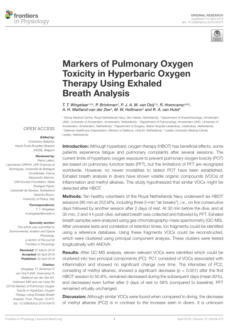
T. T. Wingelaar, P. Brinkman , P. J. A. M. van Ooij, R.
Hoencamp, A. H. Maitland-van der Zee, M. W. Hollmann,
and R. A. van Hulst
IAlthough hyperbaric oxygen therapy (HBOT) has
beneficial effects, some patients experience fatigue and
pulmonary complaints after several sessions. The current
limits of hyperbaric oxygen exposure to prevent
pulmonary oxygen toxicity (POT) are based on pulmonary
function tests (PFT), but the limitations of PFT are
recognized worldwide. However, no newer modalities to
detect POT have been established.
This study hypothesized that Volatil Organic Compounds
VOCs might be detected after HBOT.

Authors:
Amir Hadanny, Tal Zubari, Liat Tamir-Adler, Yair Bechor,
Gregory Fishlev, Erez Lang, Nir Polak, Jacob Bergan, Mony
Friedman, and Shai Efrati
This study is also purely medical and is published to
provide information about the role of Circadian rhythms,
which are 24-hour cycles that are part of the body's
internal clock, running in the background to carry out
essential functions which control many biological
processes in the body in both health and disease.

Authors:
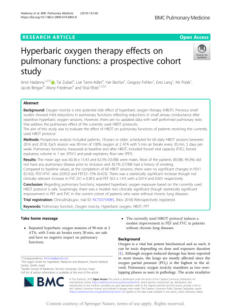
Amir Hadanny, Tal Zubari, Liat Tamir-Adler, Yair Bechor,
Gregory Fishlev, Erez Lang, Nir Polak, Jacob Bergan,
Mony Friedman, and Shai Efrati
The aim of this study was to evaluate the effect of
hyperbaric oxygen therapy (HBOT) on pulmonary
functions of patients receiving the currently used HBOT
protocol.

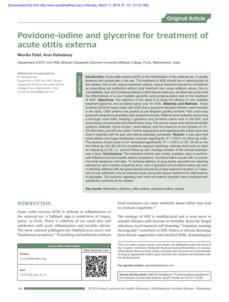
Authors: Monika Patel, Arun Dehadaray
Acute otitis externa (AOE) is the inflammation of the
external ear. It usually presents with severe pain in the ear.
The treatment of AOE should aim in relieving pain at the
earliest. Out of the various treatment options, topical
treatment should be considered as prescribing oral
antibiotics without local treatment can cause antibiotic
abuse. Due to unavailability, cost, and compliance issues of
other topical measures,
The authors observed and proved the effectiveness of a
new modality glycerine and povidone-iodine wick in the
treatment of AOE.

Authors: Shrestha K, Shah R, Sapkota S
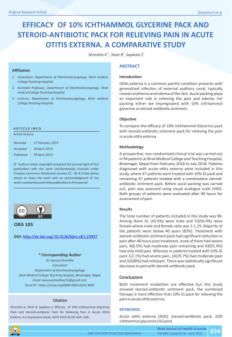
Otitis externa is a common painful condition presents with
generalized infection of external auditory canal, typically
reveals erythema and edema of the skin. Aural packing
plays an important role in relieving the pain and edema.
For packing either we impregnated with 10% Ichthammol
glycerine or steroid-antibiotic ointment.
Authors:
Brandon W. Lewis, Sonika Patial , and Yogesh Saini
The primary purpose of pulmonary ventilation is to supply
oxygen for sustained aerobic respiration in multicellular
organisms. However, abiotic insults and airborne
pathogens present in the environment are occasionally
introduced into the airspaces during inhalation, which
could be detrimental to the structural integrity and
functioning of the respiratory system.Defective mucociliary
clearance (MCC) is often associated with airway
mucoobstruction, increased occurrence of respiratory
infections, and progressive decrease in lung function in
mucoobstructive lung diseases.

Authors: Ashish Tawar, P. Gokulakrishnan
This review article is of interest to the doctors who face
the dilemma of treating the rare syndrome of DCI that
could present in the clinical spectrum ranging from
itching and minor pain to severe neurological symptoms
or other systemic pathology. The first aid lies in the
administration of 100% oxygen, and definitive treatment is
therapeutic recompression. With appropriate and
adequate treatment, recovery is complete, but some
severe cases may have lifelong residual deficits, even after
extended and multiple recompressions.

Authors:
Erik Hoencamp, Thijs TCF van Dongen , Pieter-Jan AM van
Ooij , Thijs T Wingelaar, Mees L Vervelde, Dave AA Koch,
Rob A van Hulst, Rigo Hoencamp
This paper was a systematic review of human and animal
studies of medications in the hyperbaric environment.
Studies were subdivided into those describing a
medication/hyperbaric environment interaction and those
concerned with prevention of diving disorders. Studies
without a relation to diving with compressed air, and
those concerning oxygen toxicity, hyperbaric oxygen
therapy or the treatment of decompression sickness were
excluded.

Author: David J Doolette
This is a brief document from Doctor Doolette that
provides an update on the current knowledge regarding
gas micronuclei, which are minuscule gas-filled voids
suspended in liquids that are considered the starting point
for bubble formation.

Authors: Tobias Cibis, Alistair McEwan, Arne Sieber,
Bjoern Eskofier, Karl Friedl, & Michael Bennett
This review discusses diving physiology and related
conditions, identifying key physiological parameters for
monitoring.
The authors explored technological solutions, particularly
wearable monitoring technologies, and assessed their
suitability for underwater use. They also reviewed current
safety devices, such as dive computers, focusing on their
decompression models and algorithms. This review
highlights the importance of biomedical monitoring in
diving and encourages further research and development
to improve safety.

Authors: Justin M. Hintze, Lina Geyer, Conall W. Fitzgerald,
Cristina Simoes Franklin, Fergal Glynn, Laura
Viani, Peter Walshe
The paper provides recommendations based on a study of
complications associated with SCUBA diving in patients
with cochlear implants. This study describes a retrospective
case series and literature review, highlighting specific cases
and the difficulties SCUBA divers face with cochlear
implants. The authors aim to raise awareness about
potential risks and suggest caution and adherence to
safety limits for such patients.

Authors: Geoffrey E. Ciarlone, Christopher M. Hinojo,
Nicole M. Stavitzski, Jay B. Dean
This document comprehensively reviews the central
nervous system oxygen toxicity (CNS-OT) associated with
hyperbaric oxygen (HBO2) therapy and underwater
activities. It explains the limitations and risks of HBO2
exposure due to CNS-OT, the symptoms and progression
of CNS-OT, the variability in the latent period of safe
oxygen breathing, summarizes current understanding of
the pathophysiology of CNS-OT, highlights conditions that
accelerate seizure onset, and the current strategies and
research for mitigating CNS-OT to enable safer and longer
HBO2 exposures.

Author:
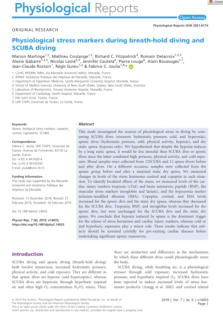
Marion Marlinge, Mathieu Coulange, Richard C. Fitzpatrick,
Romain Delacroix, Alexie Gabarre, Nicolas Lain, Jennifer
Cautela, Pierre Louge, Alain Boussuges, Jean-Claude
Rostain, Regis Guieu, & Fabrice C. Joulia
This scientific study investigated the sources of
physiological stress in different types of diving to compare
the stress responses induced by SCUBA diving, apneic
diving, and dry, static apnea by measuring changes in
stress hormones and cardiac injury markers. It highlights
the conclusion that hypoxia is the primary trigger for stress
responses in apneic activities and suggests the importance
of screening individuals for pre-existing cardiac conditions
before engaging in significant apneic maneuvers.

Authors:
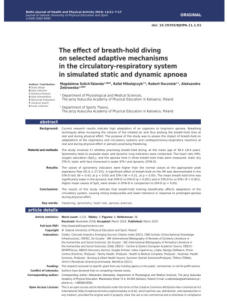
Magdalena Solich-Talanda, Rafał Mikołajczyk, Robert
Roczniok, Aleksandra Zebrowska
This study investigates the effects of breath-hold training
on the respiratory and circulatory systems in individuals
who practice freediving to assess how breath-hold
techniques impact physiological adaptations and reactions
both at rest and during physical exertion. It presents the
research's methodology, results, and conclusions,
highlighting the benefits of breath-hold training on the
circulatory system and its effects on heart rate and oxygen
saturation.

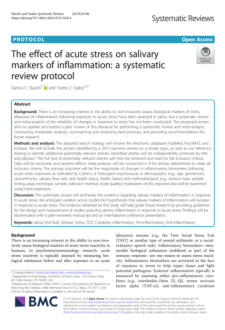
Authors: Danica C. Slavish, & Yvette Z. Szabo
This paper outlines a research proposal for conducting a
systematic review and meta-analysis on the reliability of
changes in salivary inflammatory biomarkers in response
to acute stress. It details the study's background, methods,
and anticipated outcomes, aiming to update and extend
previous literature, identify best practices, and provide
recommendations for future research in this area.

Authors:
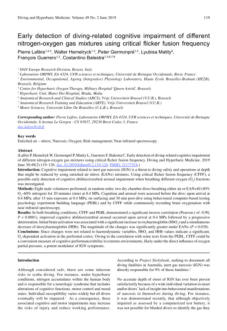
Pierre Lafère, Walter Hemelryck, Peter Germonpré, Lyubisa
Matity, François Guerrero, Costantino Balestra
This study investigated the effects of different oxygen
fractions on cognitive impairment related to inert gas
narcosis (IGN) during diving to determine whether using
enriched air nitrox (EANx) mixtures can reduce cognitive
impairment and improve diving safety. It describes the
research's methodology, results, and conclusions,
highlighting the potential of critical flicker fusion frequency
(CFFF) as a measure of cognitive performance in extreme
environments.

Authors: Ran Arieli
This document presents scientific findings on the
protective effects of helium preconditioning against
decompression illness (DCI) in rats. It summarizes the
results of a study by Zhang et al., which demonstrated
that helium prebreathing increased the survival rate and
reduced the incidence of DCI in experimental rats. It also
explores potential mechanisms for this protective effect,
focusing on the role of nanobubbles and helium's physical
properties compared to other gases like nitrogen and
oxygen.
35 - Immunopathology of Airway Surface Liquid Dehydration Disease
- Published by the Journal of Immunology Research - Wiley

Authors: David P. Looney, Edwin T. Long, Adam W. Potter,
Xiaojiang Xu, Karl E. Friedl, Reed W. Hoyt,
Christopher R. Chalmers, Mark J. Buller, and John
P. Florian
This study investigates how core temperature of U.S. Navy
divers responds to fatiguing exercise in various warm
water temperatures. It highlights that as water
temperature increases from 34.4°C to 38.6°C, the duration
of performance and peak core temperatures decrease,
while the rate of core temperature rise significantly
increases. The findings underscore the risks of
hyperthermia in warmer water conditions, suggesting the
need for new predictive models to enhance safety during
warm water diving operations.

Authors: Leonidas Palaiodimos, & Damianos G. Kokkinidis
The foramen ovale is a crucial fetal blood shunt allowing
oxygenated blood to bypass the lungs, which become
unnecessary and close at birth. However, in about 25% of
adults, it remains open, termed patent foramen ovale
(PFO). While most individuals with PFO are asymptomatic,
it has associations with various health conditions, notably
ischemic stroke due to paradoxical embolism. Recent
randomized clinical trials have shifted views on the
necessity of PFO closure in stroke patients, revealing
significant implications for treatment strategies.

Author: Chris Sames, Desmond F Gorman, Simon J
Mitchell, Lifeng Zhou
This study examined long-term hearing changes in 227
professional divers over 10–25 years. Initial hearing was
poorer than population norms, but subsequent
deterioration aligned with age-related declines rather than
diving exposure or smoking. Since hearing changes
mirrored natural aging, routine annual audiological testing
for divers lacks justification.

Authors: Antonio AM Giunta, Luca Liberati, Cristina
Pellegrino, Giampietro Ricci, Santino Rizzo
Eustachian tube balloon dilation was assessed in 20
freedivers with refractory equalization problems
unresponsive to prior medical, insufflation, or nasal surgery
treatments. A 20x3 mm balloon was inflated to 12 ATM
three times for 120 seconds each via a 70-degree catheter.
Fifteen patients improved (10 with complete resolution, 5
with minor residual delay); 5 showed no benefit.
Complications included one case of parotid emphysema
and one of mild high-frequency hearing loss. The
procedure demonstrated good efficacy.

Authors: Pooria Safai, Babak Farzaneh, Reza Fekrazad
This study evaluated microleakage in root canal fillings
using three obturation techniques—tapered single-cone,
lateral condensation, and vertical condensation—under
simulated diving pressures. Among 135 single-rooted
teeth, vertical condensation with AH26 sealer exhibited
the least microleakage at all pressures (101.3 kPa, 203 kPa,
304 kPa), though pressure increases did not significantly
worsen leakage. While vertical and lateral condensation
performed similarly, both outperformed the single-cone
method. Vertical condensation is recommended for
patients facing frequent pressure changes due to its
superior sealing ability.

Authors: Juan Carlos Ascencio-Lane, David Smart, John
Lippmann
This study reviewed 17 recreational diving deaths in
Tasmania (1995-2014; 12 scuba, 5 hookah) using chain of
events analysis. Key predisposing factors included
equipment condition, pre-existing health issues, and diver
experience/training. Findings highlight regional variations,
risks of unregulated hookah diving, and the value of
structured analysis for targeted prevention strategies and
public health messages.

Author: Peter T Wilmshurst
This paper discusses immersion pulmonary oedema (IPE),
which arises from factors that increase the hydrostatic
pressure gradient between the pulmonary capillaries and
the alveoli. Key factors include immersion effects (e.g.,
raised central blood volume and cardiac filling pressures),
negative-pressure breathing (influenced by lung centroid
position and diving equipment), cold-induced
vasoconstriction, exertion, and emotional stress. Individual
responses vary, and hypertension is the most common
predisposing cardiovascular condition, though other
medical factors may also contribute.

Authors: Abraham L Querido, & Robert A van Hulst
Attention deficit hyperactivity disorder (ADHD) is a
psychiatric condition that affects attention, concentration,
impulse control and awareness. Not only these symptoms,
but also the medications used to treat ADHD
(psychostimulants) pose a risk to both the diver and his or
her buddy. This article presents guidelines for recreational
diving in combination with ADHD and psychostimulants.
These guidelines are based solely on ‘expert’ opinion and
were adopted at a meeting of the Dutch Association for
Diving Medicine in 2017.

Authors: Mårten Silvanius, Simon J Mitchell, Neal W
Pollock, Oskar Frånberg, Mikael Gennser, Jerry
Lindén, Peter Mesley, Nicholas Gant
This study examined the accuracy of temperature sticks in
predicting CO2 absorption in diving rebreathers using
soda lime. The Inspiration and rEvo rebreathers were
tested at both surface pressure and 3–6 metres sea water
depth, simulating moderate and low exercise scenarios.
Results showed that while temperature sticks provided
timely warnings at shallow depth, they were less accurate
during moderate exercise at surface pressure, failing to
warn in most high-exercise scenarios.

Authors: Andrew Trevett, Carolyn Sheehan, Antony
Wilkinson, Inez Moss
Lion’s mane jellyfish stings are usually characterised by
local inflammation, especially weals. Systemic symptoms
are not widely described although there is a well known
fictional description of a fatal reaction to envenoming. The
authors describe five divers presenting with suspected
decompression sickness, where the probable diagnosis
was jellyfish envenoming.

Authors: Romain Siaffa, Marc Luciani, Bruno Grandjean,
Mathieu Coulange
Portal venous gas is a rare finding in diving injuries, with
few documented cases. This report describes a severe
decompression sickness (DCS) case where a 49-year-old
man experienced cutaneous, neurological, and
pulmonary symptoms after deep diving. A CT scan
revealed significant hepatic and portal venous gas without
abdominal pain. Symptoms resolved with hyperbaric
oxygen therapy. While portal venous gas in DCS lacks
clear pathological significance, isolated cases appear
harmless. Medical imaging aids differential diagnosis,
particularly in symptomatic divers.

Authors: George Anderson, Douglas Ebersole, Derek
Covington, Petar J Denoble
This study compared two methods to reduce
decompression sickness (DCS) risk in divers with patent
foramen ovale (PFO): conservative diving and PFO closure.
In a prospective analysis, divers either continued diving
without closure (n=23) or underwent closure (n=42). Both
groups reduced diving intensity and DCS incidence post-
intervention, but only the closure group showed a
significant decrease, particularly in divers with large PFOs.
Seven mild and one serious adverse event were reported
after closure. The authors conclude that PFO closure
should be considered individually, benefiting healthy
divers with high DCS burden, large PFOs, or plans for
advanced diving.

Authors: George And
This pilot study investigated changes in serum tau protein
in 10 navy divers who performed repeated dives to 52–90
msw over four days. Tau levels rose significantly from a
median of 0.200 pg·mL-¹ before diving to 0.450 pg·mL-¹
after (P=0.016), while glial fibrillary acidic and
neurofilament light proteins were unchanged. No
correlation existed with venous gas emboli detected by
Doppler. Results indicate repeated diving may cause
neuronal stress.

Authors: David Monnot, Thierry Michot, Emmanuel
Dugrenot, François Guerrero, Pierre Lafère
This study aimed to assess dive-related injuries (DI) among
French scuba divers, as prior research lacks comprehensive
data on non-DCI injuries and injury management efficacy.
Conducted via an online, retrospective survey of 799
divers, results showed that 35% had never experienced a
DI, with ear barotrauma as the most common injury.
Symptom rates declined with age and among male divers.
Dive leaders managed 58% of injuries, while 32% of
injured divers sought no help. Of 114 DCI cases, 74%
resolved completely, but 19% reported mild and 7% severe
residual symptoms; 10% of untreated divers still reported
residual symptoms.

Authors: Chris Sames, Desmond F Gorman, Simon J
Mitchell, Lifeng Zhou
Approximately 77% of New Zealand professional divers
leave the industry within five years, and this study
investigated whether undetected health issues were a
major cause. Of 601 early leavers ('quitters'), only 2.9%
cited health as their primary reason for quitting; 97.1% left
due to job-related dissatisfaction (e.g., pay, employment
stability). Health data comparisons between quitters and
long-term divers ('stayers') revealed no significant medical
differences except that quitters smoked four times more
often. The findings indicate that early attrition is driven by
industry factors, not undiagnosed health problems, and
that New Zealand’s current health surveillance system
effectively identifies health issues relevant to diving fitness.

Authors: Jacek Kot, Piotr Siondalski, Ewa Lenkiewicz
Hyperbaric oxygen therapy (HBOT) exposes medical
devices to increased pressure and oxygen. In Europe, such
devices must be CE-approved. However, no left ventricular
assist device (LVAD) is currently CE approved for HBOT.
Case: A 65-year-old male with a non-CE marked LVAD
required HBOT for a severe soft tissue infection. A risk
analysis led to the decision to isolate the LVAD's external
part in a pressure-resistant, vented housing during HBOT.
Thirty standard HBOT sessions were safely conducted
using this method, leading to clinical improvement and a
longer wait for heart transplantation. In conclusion,
isolation housing that vents to the hyperbaric chamber's
dumping system enables the safe use of medical devices
without prior HBOT compatibility testing.

Authors: Céline MJ Goffinet, Graham Simpson
Primary lung bullae can cause pulmonary barotrauma,
leading to cerebral arterial gas embolism (CAGE) in divers,
though they often go undiagnosed due to minimal
symptoms or radiographic findings. A case of a 27-year-old
healthy male is presented, who developed CAGE after
introductory diving and was found to have an
undiagnosed large primary lung bulla. This underscores
the risks of primary lung bullae in recreational diving-
related pulmonary barotrauma.