













Fusion applications - A resource guide
Fusion software enables the seamless merging, alignment, and analysis
of heterogeneous datasets to create a single, accurate digital
representation of a physical environment or asset. In underwater
geospatial, engineering, or inspection contexts, it refers to specialized
tools that integrate, align, and correlate diverse datasets, such as
photogrammetry, underwater LASER, and CAD applications, into a
unified, coherent model.
By combining these datasets, fusion software produces more accurate
and interpretable representations of submerged structures and their
environments. This approach facilitates cross-disciplinary collaboration
and supports informed decision-making by providing a comprehensive
view of the project or site. In addition, such applications provide precise
information essential for the safe and efficient organization of both
diver and underwater vehicle dives.
Purpose and Benefits of Fusion Software:
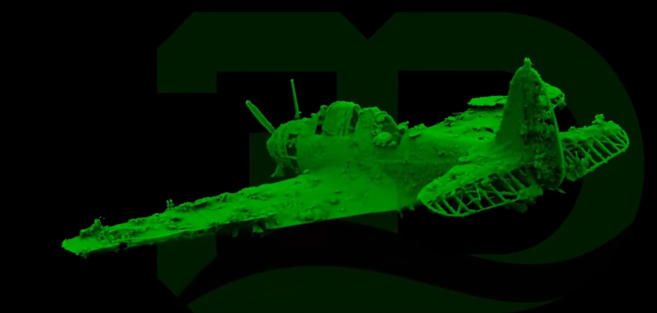
Underwater LASER view of a "Douglas Devastator" torpedo bomber wreck by 3D at Depth company
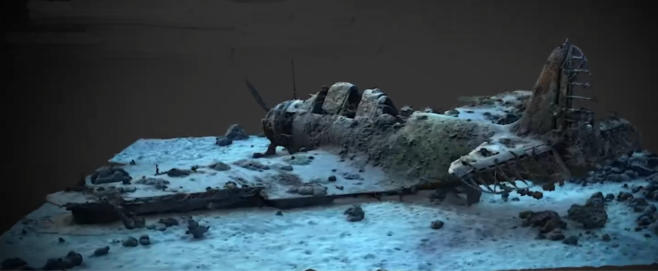
View of the wreck above after fusing the LASER view with photogrammetry (also by 3D at Depth company)
Several scenarios are to be considered by diving and ROV contractors:
1 - Inspection of a structure with existing Computer-Aided Design
(CAD) drawings:
With such a scenario, photogrammetry and laser scanning, whose
purpose, advantages, and inconveniences are discussed in the two
previous posts of this section, are used to capture a realistic overall
view of the structure's as-found condition. Fusion software then
merges the photogrammetry data with the laser scan data. This
results in a more precise representation than using such
procedures alone, since photogrammetry provides strong
visual/textural detail and color information while laser scanning
contributes superior dimensional accuracy and scale. The merged
dataset is then correlated with existing computer-aided design
(CAD) drawings, producing a complete three-dimensional
representation. Operators can zoom in for precise measurements
and visual inspections, directly comparing the as-built condition to
the original design.
2 - Inspection of a structure with no existing drawings (reverse
engineering):
This applies to wrecks or structures whose drawings have been
lost. Here, photogrammetry and laser scanning are used for
reverse engineering, with their data correlated to generate new 3D
CAD drawings. The two datasets can be fused to build the CAD
model, or each can independently generate a model. Fusing both is
generally more precise because, as mentioned above, it combines
the dimensional accuracy of laser scanning with the visual, textural
detail and color information of photogrammetry. This synergy
mitigates the weaknesses of each method while amplifying their
strengths.
3 - Bathymetric mapping:
Bathymetric data from light detection and ranging (LiDAR) and
multibeam echosounder (MBES) SONAR can be fused to produce a
precise, seamless picture of the seabed and shoreline, with LiDAR
handling shallow, clear water where light penetration is sufficient,
and multibeam echosounder covering deeper or turbid areas where
LiDAR loses effectiveness. The fused dataset can be correlated with
existing maps or used to generate new maps in computer-aided
design (CAD) or Geographic Information System (GIS) software.
Overview of Fusion Software Applications in the Market
Based on the above, we investigated applications that could be used for
each scenario mentioned and serve as a starting point for selecting the
"ideal software" for the company's operations and its financial and
operational resources. In addition, we sought information on the
ergonomics of the applications mentioned, considering this an essential
factor for the comfort and effectiveness of the data fusion specialists
operating them. Regarding this last point, it must be considered that an
application with better ergonomics than others can ultimately prove to
be more efficient, even if its technical performance is not the best. This
is why, similar to other specialised applications used on computers,
operators often request to use applications they are comfortable with.
Note that applications that can do everything in one click are rare;
therefore, it is often necessary to fuse laser and photogrammetry data
first before operating them with CAD software.
For convenience, each application is classified according to its purpose
(so the technical possibilities it offers) and grouped according to the
scenarios mentioned above. However, scenarios #1 & #2 have been
kept in the same table because they involve investigating underwater
structures or wreckage, and we can consider that reverse-engineering
software can also be used for normal inspection.
Applications that can be used for Scenario #3 are separated because
bathymetry is usually specific.
To make the reading as simple as possible, the following terminologies
are used.
•
"Fusing"; which means combining the source datasets as defined
above
•
"Overlaying"; which means placing the fused data on top of the CAD
drawing or an existing map for comparison and visual reference.
•
"Used for reverse engineering" for the applications that can be used
for this purpose.
Regarding minimum hardware requirements, the specifications for
Central Processing Units (CPUs) and Graphics Processing Units (GPUs)
can be difficult to interpret for those unfamiliar with computer design.
For clarity, examples are provided, tied to the performance levels
referenced by the editors. While other models exist beyond those listed,
these examples are grouped into the following hardware-performance
tiers:
•
Entry-Level: Standard office or engineering machines. Suitable for
small datasets, visualization, and basic photogrammetry.
•
Mid-Level: Powerful engineering workstations. Capable of handling
medium datasets, CAD integration, and moderate reverse
engineering.
•
High-Level: Advanced engineering workstations. Required for large
point clouds, complex CAD, and enterprise GIS (Geographic
Information System).
•
Workstation (Very High Performance): Professional-grade systems
for simulation, enterprise CAD, and proprietary sonar/laser systems.
Random Access Memory (RAM) and disk space required to run each
software application are also listed. However, note that effective use
typically demands more than the minimums mentioned.
Ergonomics are classified as below:
•
Level 1: Intuitive / Straightforward (can be used without specific
training by people accustomed to computers)
•
Level 2: Moderate / Intermediate (May require support for some
functions)
•
Level 3: Complex / Advanced (requires specialized training)
•
Level 4: Expert / Highly Complex (requires specialized training and
operator certification).
Please note that we have no commercial ties with the software editors
mentioned (this website is fully independent and non-profit) and do not
claim that the list provided covers all offerings in this industry, which is
impossible given that new products are regularly released and we may
have missed several publishers. Therefore, the information in this
article is provided for informational purposes only, to spark interest in
the technology described.
A - Applications for the inspection and
reverse engineering of structures
3D at Depth
- Purpose: Fusing Laser points with photogrammetry + overlay with
CAD
- Editor: Kraken Robotics
- Headquarters editor: 1900 S Sunset St, Suite 1-D, Longmont, Colorado,
80501, USA
- Website: https://www.krakenrobotics.com/
- Minimum hardware requirements:
•
Operating system: Windows 11
•
CPU: Intel i7 11th gen
•
GPU: NVIDIA GTX 1650–1660 (Uses NVIDIA only)
•
RAM: 16 GB
•
Performance tier: Entry-level / Mid-Level:
•
Disk space tier: 200 GB free on SSD
- Ergonomics: Level 2 (Moderate)
- Pricing: Consult the editor
- Technical support: Email support
- Training: On-site and remote training
3DF Scarlet + 3DF Zephyr
- Purpose: Fusing Laser points with photogrammetry
- Editor: 3Dflow SRL
- Headquarters editor: Strada Le Grazie 15, 37134 Verona, Italy
- Website: https://www.3dflow.net
- Minimum hardware requirements:
•
Operating system: Windows 10/11
•
CPU: Intel i7 / AMD Ryzen 7 or equivalent
•
GPU: NVIDIA RTX 3060 / AMD RX 6700
•
RAM: 32 GB
•
Performance tier: Mid to High
•
Disk space tier:
- Ergonomics: Level 2 (Moderate)
- Pricing: Consult the editor
- Technical support: Email support
- Training: The "3Dflow Academy" offers official online courses and
certifications.
Autodesk ReCap + Civil 3D
- Purpose: Cloud points fusing with CAD
- Editor: Autodesk, Inc
- Headquarters editor: The Landmark @ One Market, Suite 400, San
Francisco, CA 94105, USA
- Website: https://www.autodesk.com
- Minimum hardware requirements:
•
Operating system: Windows
•
CPU: Intel i7/Xeon / AMD Ryzen 9
•
GPU: NVIDIA RTX 3070–3080 / AMD RX 6800
•
RAM: 32 GB
•
Performance tier: High
•
Disk space tier: High (≥2 TB)
- Ergonomics: Level 3 (Complex)
- Pricing: ~$305/mo or ~$2,425/yr (Subscription)
- Technical support: 24/7 web, chat, and phone support
- Training: Autodesk University, official learning paths, and in-product
interactive tutorials.
Agisoft Metashape
- Purpose: Fusing Laser points with photogrammetry
- Editor: Agisoft LLC
- Headquarters editor: 11 Degtyarniy per., St. Petersburg 191144, Russia
- Website: https://www.agisoft.com
- Minimum hardware requirements:
•
Operating system: Windows 10/11, Mac OS 12, and Linux
•
CPU: Intel i5 10th gen / AMD Ryzen 5
•
GPU: NVIDIA GTX 1650–1660 / AMD RX 5500
•
RAM: 16–32 GB
•
Performance tier: Entry–Mid
•
Disk space tier: Entry (≥500 GB)
- Ergonomics: Level 1 (Straightforward)
- Pricing: Subscription per user - $85/month, $680/year, or $2,040 for
3 years,
- Technical support: Email support
- Training: Official online training courses and certifications are
available directly from Agisoft.
Autodesk Fusion 360
- Purpose: Cloud points fusing with CAD (used for reverse engineering)
- Editor: Autodesk, Inc
- Headquarters editor: The Landmark @ One Market, Suite 400, San
Francisco, CA 94105, USA
- Website: https://www.autodesk.com
- Minimum hardware requirements:
•
Operating system: Windows & Mac
•
CPU: Intel i7 11th gen / AMD Ryzen 7
•
GPU: NVIDIA RTX 3060 / AMD RX 6700
•
RAM: 16 GB
•
Performance tier: Mid
•
Disk space tier: Mid (≥1 TB)
- Ergonomics: Level 2 (Moderate)
- Pricing: ~$70/mo or ~$545/yr (Subscription)
- Technical support: 24/7 web, chat, and phone support
- Training: Autodesk University, official learning paths, and in-product
interactive tutorials.
Catia 3DExperience
- Purpose: Overlay fused Laser and optical data with CAD
- Editor: Dassault Systèmes SE
- Headquarters editor: 10, rue Marcel Dassault, 78140 Vélizy-
Villacoublay, France
- Website: https://www.3ds.com
- Minimum hardware requirements:
•
Operating system: Windows
•
CPU: Intel Xeon / AMD Threadripper Pro
•
GPU: NVIDIA RTX A6000 / AMD Radeon Pro W7900
•
RAM: 64–128 GB
•
Performance tier: Workstation
•
Disk space tier: Workstation (≥2–4 TB + NAS/cloud)
- Ergonomics: Level 4 (Expert)
- Pricing: Subscription (Consult the editor)
- Technical support: Global customer support portal
- Training: 3DEXPERIENCE Edu platform and official Dassault training
centers worldwide.
Bentley ContextCapture + MicroStation
- Purpose: Overlay fused Laser and optical data with CAD
- Editor: Bentley Systems, Inc.
- Headquarters editor: Exton, Pennsylvania, USA
- Website: https://www.bentley.com
- Minimum hardware requirements:
•
Operating system: Windows
•
CPU: Intel i9 / Xeon / AMD Ryzen 9
•
GPU: NVIDIA RTX 3080–4080 / AMD RX 7900
•
RAM: 32–64 GB
•
Performance tier: High
•
Disk space tier: High (≥2 TB)
- Ergonomics: Level 3 (Complex)
- Pricing: Subscription (Consult the editor)
- Technical support: Support portal, phone, and email.
- Training: Bentley Learn Server, official instructor-led training, and
certification programs.
Bentley iTwin
- Purpose: Fusing Laser points with photogrammetry + Cloud points
fusing with CAD
- Editor: Bentley Systems, Inc.
- Headquarters editor: Exton, Pennsylvania, USA
- Website: https://www.bentley.com
- Minimum hardware requirements:
•
Operating system: Windows
•
CPU: Intel i9 / Xeon / AMD Threadripper
•
GPU: NVIDIA RTX A4000–A6000 / AMD Radeon Pro W6800
•
RAM: 32–64 GB
•
Performance tier: Workstation
•
Disk space tier: Workstation (≥2–4 TB + NAS/cloud)
- Ergonomics: Level 3 (Complex)
- Pricing: Subscription (Consult theeditor)
- Technical support: Support portal, phone, and email.
- Training: Bentley Learn Server, official instructor-led training, and
certification programs.
CloudCompare
- Purpose: Fusing Laser points with photogrammetry + Fused data
overlay with CAD
- Editor: open-source project,
- Headquarters editor: No headquarters (Open source community)
- Website: https://www.cloudcompare.org
- Minimum hardware requirements:
•
Operating system: Windows /Mac /Linux
•
CPU: Intel i5 / AMD Ryzen 5
•
GPU: NVIDIA GTX 1650 / AMD RX 5500
•
RAM: 8–16 GB
•
Performance tier: Entry
•
Disk space tier: Entry (≥500 GB)
- Ergonomics: Level 1 (Straightforward)
- Pricing: Free (Open Source)
- Technical support: No commercial support, but highly active forums
- Training: No formal paid training. Relies on community-written guides
and documentation.
Coda Octopus
- Purpose: Fusing Laser points with photogrammetry + overlay with
CAD
- Editor: Coda Octopus Group, Inc.
- Headquarters editor: 3300 S Hiawassee Road #104-105, Orlando, FL
32835, USA
- Website: https://www.codaoctopusgroup.com
- Minimum hardware requirements:
•
Operating system: Microsoft Windows 10 and 11
•
CPU: Intel Core i7/i9 or AMD Ryzen 7/9
•
GPU: NVIDIA GeForce RTX 4060
•
RAM: 16–32 GB
•
Performance tier: Mid
•
Disk space tier: 1 TB
- Ergonomics: Level 3 (Complex)
- Pricing: Consult the editor
- Technical support: 24/7 technical assistance
- Training: The "Coda Octopus Virtual Training Room (VTR)" and
dedicated product training services
DimEye VLS System
- Purpose: Fusing Laser points with photogrammetry + Cloud points
fusing with CAD (used for reverse engineering)
- Editor: DimEye Corp
- Headquarters editor: 41945 Boardwalk c, Suite C, Palm Desert, CA
92211, United States
- Website: https://www.dimeyecorp.com/
- Minimum hardware requirements: Not published
- Ergonomics: Level 3 (Complex)
- Pricing: Consult the editor
- Technical support: Direct engineering support from DimEye Corp.
- Training: On-site or remote training for system deployment and 3D
processing.
EIVA NaviSuite
- Purpose: Fusing Laser points with photogrammetry
- Editor: EIVA a/s (Company acquired by Sonardyne International)
- Headquarters editor: Niels Bohrs Vej 17, Stilling, 8660 Skanderborg,
Denmark
- Website: https://www.eiva.com
- Minimum hardware requirements:
•
Operating system: Windows 10 or 11 Pro, 64-bit
•
CPU: Intel i5 10th gen / AMD Ryzen 5
•
GPU: NVIDIA GTX 1650–1660 / AMD RX 5500
•
RAM: 16 GB minimum.
•
Performance tier: Entry-to-mid
•
Disk space tier: Modern SSD or SATA no space mentioned
- Ergonomics: Level 3 (Complex)
- Pricing: Consult the editor
- Technical support: Dedicated support portal and direct contact with
EIVA engineers
- Training: "EIVA Academy" offers official online and on-site training
courses.
Geomagic Control X
- Purpose: Cloud points fusing with CAD
- Editor: Hexagon AB
- Headquarters editor: Lilla Bantorget 15, SE-111 23 Stockholm, Sweden
- Website: https://www.hexagon.com
- Minimum hardware requirements:
•
Operating system: Windows
•
CPU: Intel i9 / Xeon / AMD Ryzen 9
•
GPU: NVIDIA RTX 3080–4080 / AMD RX 7900
•
RAM: 32–64 GB
•
Performance tier: High
•
Disk space tier: High (≥2 TB)
- Ergonomics: Level 3 (Complex)
- Pricing: ~$20k–$30k (Lifetime + Maintenance)
- Technical support: Global technical support and maintenance
- Training: Official Oqton/Geomagic training courses and certification
programs
Leica Cyclone
- Purpose: Fusing Laser with photogrammetry + Overlay with CAD
- Editor: Leica Geosystems AG (Hexagon group)
- Headquarters editor: Heinrich-Wild-Strasse, 9435 Heerbrugg,
Switzerland
- Website: https://www.leica-geosystems.com
- Minimum hardware requirements:
•
Operating system: Windows
•
CPU: Intel i7 / AMD Ryzen 7
•
GPU: NVIDIA RTX 3070 / AMD RX 6800
•
RAM: 32 GB
•
Performance tier: Mid–High
•
Disk space tier: High (≥2 TB)
- Ergonomics: Level 2 (Moderate)
- Pricing: ~$3k–$5k (Lifetime + Maintenance)
- Technical support: Gobal support network.
- Training: Hexagon Geosystems Academy offers official certification
and instructor-led training.
Geomagic Design X
- Purpose: Cloud points fusing with CAD (used for reverse engineering)
- Editor: Hexagon AB
- Headquarters editor: Lilla Bantorget 15, SE-111 23 Stockholm, Sweden
- Website: https://www.hexagon.com
- Minimum hardware requirements:
•
Operating system: Windows
•
CPU: Intel i9 / Xeon / AMD Ryzen 9
•
GPU: NVIDIA RTX 3080–4080 / AMD RX 7900
•
RAM: 32–64 GB
•
Performance tier: High
•
Disk space tier: High (≥2 TB)
- Ergonomics: Level 3 (Complex)
- Pricing: ~$20k–$30k (Lifetime + Maintenance)
- Technical support: Global technical support and maintenance
- Training: Official Oqton/Geomagic training courses and certification
programs.
Oceaneering Vision
- Purpose: Fusing Laser points with photogrammetry + overlay with
CAD
- Editor: Oceaneering International, Inc.
- Headquarters editor: 5875 N Sam Houston Pkwy W, Suite 400,
Houston, TX 77086, USA
- Website: https://www.oceaneering.com
- Minimum hardware requirements: Not published
- Ergonomics: Level 3 (Complex)
- Pricing: Consult the editor
- Technical support: Provided as part of Oceaneering’s comprehensive
subsea service and deployment contracts.
- Training: Operational training is provided to client teams during
system deployment topside.
- Note: The available sources mention that this software is offered for
customer use and collaboration, including streamlining
inspection processes, but they do not spell out a public licensing
policy for third-party contractors specifically.
Pix4Dmatic
- Purpose: Fusing Laser points with photogrammetry
- Editor: Pix4D
- Headquarters editor: Route de Renens 24, 1008 Prilly, Switzerland
- Website: https://www.pix4d.com/
- Minimum hardware requirements:
•
Operating system: Windows / Mac
•
CPU: Intel i7 / AMD Ryzen 7
•
GPU: NVIDIA RTX 3060–3070 / AMD RX 6700
•
RAM: 16–32 GB
•
Performance tier: Mid
•
Disk space tier: Mid (≥1 TB)
- Ergonomics: Level 1 (Straightforward)
- Pricing: ~$350/mo or ~$2,990/yr (Subscription)
- Technical support: Priority email and ticket support for users
- Training: Pix4D Training Academy offers official, structured courses.
PolyWorks
- Purpose: Fusing Laser points with photogrammetry + overlay or
fusing data with CAD (used for reverse engineering)
- Editor: InnovMetric Software Inc.
- Headquarters editor: 2014 Cyrille-Duquet, Suite 310, Québec, QC G1N
4N6, Canada
- Website: https://www.innovmetric.com
- Minimum hardware requirements:
•
Operating system: Windows
•
CPU: Intel i9 / Xeon / AMD Ryzen 9
•
GPU: NVIDIA RTX 3080 / AMD RX 7900
•
RAM: 32–64 GB
•
Performance tier: High
•
Disk space tier: High (≥2 TB)
- Ergonomics: Level 2 (Moderate)
- Pricing: ~$6k–$10k (Lifetime + Maintenance)
- Technical support: Provides global technical support.
- Training: "InnovMetric University" offers official training and
certification
Rhino 3D + Mesh Repair plugins
- Purpose: Cloud points fusing with CAD (used for reverse engineering)
- Editor: Robert McNeel & Associates
- Headquarters editor: 146 N Canal St, Suite 320, Seattle, WA 98103,
USA
- Website: https://www.rhino3d.com
- Minimum hardware requirements:
•
Operating system: Windows / Mac
•
CPU: Intel i5/i7 / AMD Ryzen 5/7
•
GPU: NVIDIA GTX 1660 / AMD RX 5600
•
RAM: 16 GB
•
Performance tier: Entry–Mid
•
Disk space tier: Mid (≥1 TB)
- Ergonomics: Level 1–2 (Straightforward/Moderate)
- Pricing: ~$1000 (Lifetime)
- Technical support: Direct email support; plugin developers provide
their own dedicated support.
- Training: Official Rhino training and numerous authorized third-party
training centers globally.
ROV3D
- Purpose: Fusing Laser points with photogrammetry
- Editor: Whitecap Scientific Corporation
- Headquarters editor: 323 Freshwater Rd, Suite 200, St. John’s, NL
A1B 1C3, Canada
- Website: https://www.rov3d.com
- Minimum hardware requirements:
•
Operating system: Windows 10 - 64-bit.
•
CPU: Intel i5 or equivalent
•
GPU: NVIDIA GTX 1650–1660 / AMD RX 5500
•
RAM: 16 GB
•
Performance tier: Entry–Mid
•
Disk space tier: Entry (≥500 GB)
- Ergonomics: Level 1 – 2 (Straightforward - Moderate)
- Pricing: Consult the editor
- Technical support: In-field support and post-processing assistance
are provided to clients.
- Training: Training is provided for ROV pilots and operators on camera
calibration and real-time software use.
Siemens NX
- Purpose: Cloud points fusing with CAD (used for reverse engineering)
- Editor: Siemens AG
- Headquarters editor: Werner-von-Siemens-Straße 1, 80333 Munich,
Germany
- Website: https://www.siemens.com
- Minimum hardware requirements:
•
Operating system: Windows / Linux
•
CPU: Intel Xeon / AMD Threadripper Pro
•
GPU: NVIDIA RTX A5000–A6000 / AMD Radeon Pro W7900
•
RAM: 64–128 GB
•
Performance tier: Workstation
•
Disk space tier: Workstation (≥2–4 TB + NAS/cloud)
- Ergonomics: Level 4 (Expert)
- Pricing: Consult the editor
- Technical support: Global support network
- Training: Siemens Xcelerator Academy and official global training
partners.
SolidWorks + ScanWorks plugins
- Purpose: Cloud points fusing with CAD (used for reverse engineering)
- Editor: Dassault Systèmes SolidWorks Corp.
- Headquarters editor: 175 Wyman Street, Waltham, MA 02451, USA
- Website: https://www.solidworks.com
- Minimum hardware requirements:
•
Operating system: Windows
•
CPU: Intel i9 / Xeon / AMD Ryzen 9
•
GPU: NVIDIA RTX 3080–4080 / AMD RX 7900
•
RAM: 32–64 GB
•
Performance tier: High
•
Disk space tier: High (≥2 TB)
- Ergonomics: Level 4 (Complex)
- Pricing: ~$1,295–1,995/year (varies by tier/reseller)
- Technical support: support network and local VARs (Value Added
Resellers).
- Training: Official SolidWorks training programs and VAR-led
certification courses.
Teledyne PDS (Product Design Suite)
- Purpose: Fusing Laser points with photogrammetry + overlay with
CAD
- Editor: Teledyne CARIS
- Headquarters editor: 115 Waggoners Lane, Fredericton, NB E3B 2L4,
Canada
- Website: https://www.teledynecaris.com
- Minimum hardware requirements:
•
Operating system: Windows 10 or 11
•
CPU: Intel i5 10th gen / AMD Ryzen 5
•
GPU: NVIDIA GeForce GTX 1080
•
RAM: 16 GB
•
Performance tier: Entry–Mid
•
Disk space tier: Not mentioned
- Ergonomics: Level 3 (Complex)
- Pricing: Consult the editor
- Technical support: Provides dedicated software support.
- Training: Teledyne Marine offers official software training sessions
and resources.
Viewport3 Data Fusion
- Purpose: Fusing Laser points with photogrammetry + overlay with
CAD
- Editor: Viewport3 Ltd.
- Headquarters editor: Unit 2, West Pitmillan Business Centre, Foveran,
Aberdeenshire AB41 6AL, UK
- Website: https://www.viewport3.com
- Minimum hardware requirements: Not published
- Ergonomics: Level 2 (Moderate)
- Pricing: Consult the editor (project / service-based pricing)
- Technical support: Provided as part of their service contracts.
- Training: Workflow training and consultation are provided to clients
utilizing their photogrammetry services.
Esri ArcGIS Pro
- Purpose: LiDAR and SONAR data fusing + overlay with CAD or
existing maps
- Editor: Environmental Systems Research Institute, Inc. (Esri)
- Headquarters editor: 380 New York Street, Redlands, CA 92373, USA
- Website: https://www.esri.com
- Minimum hardware requirements:
•
Operating system: Windows
•
CPU: Intel i7 / AMD Ryzen 7
•
GPU: NVIDIA RTX 3060 / AMD RX 6700
•
RAM: 16–32 GB
•
Performance tier: Mid
•
Disk space tier: Mid (≥1 TB)
- Ergonomics: Level 1–2 (Straightforward-Moderate)
- Pricing: ~$100/mo or ~$700/yr (Subscription)
- Technical support: Technical Support portal (phone, chat, email).
- Training: Esri Training portal offers hundreds of self-paced courses,
instructor-led classes, and certifications.
Voyis
- Purpose: Fusing Laser points with photogrammetry
- Editor: Voyis Imaging Inc. (Kraken Robotics)
- Headquarters editor: 120 Randall Dr, Unit E, Waterloo, ON N2V 1C6,
Canada
- Website: https://www.voyis.com
- Minimum hardware requirements: Not published
- Ergonomics: Level 3 (Complex)
- Pricing: Consult the editor
- Technical support: The services offered include project consultation,
on-site support, remote support, and data
processing
- Training: Voyis Academy provides a training program for integrating,
operating, and processing data.
AutoCAD Map 3D
- Purpose: Cloud points fusing with CAD or existing maps
- Editor: Autodesk Inc.
- Headquarters editor: The Landmark @ One Market, Suite 400, San
Francisco, CA 94105, USA
- Website: https://www.autodesk.com
- Minimum hardware requirements:
•
Operating system: Windows 10 or Windows 11.
•
CPU: Intel i5 / AMD Ryzen 5
•
GPU: NVIDIA GTX 1650 / AMD RX 5500
•
RAM: 8–16 GB miimum - 32 GB recommended
•
Performance tier: Entry
•
Disk space tier: 20 GB. - Entry (≥500 GB)
- Ergonomics: Level 3 (Complex)
- Pricing: Subscription ~$2,900+/year
- Technical support: Autodesk support portal
- Training: Autodesk University and official learning paths.
B - Applications for bathymetry and mapping
EIVA NaviModel
- Purpose: LiDAR and SONAR data fusing + overlay with CAD or
existing maps
- Editor: EIVA a/s
- Headquarters editor: Niels Bohrs Vej 17, 8660 Skanderborg, Denmark
- Website: https://www.eiva.com
- Minimum hardware requirements:
•
Operating system: Windows
•
CPU: Intel i7 / AMD Ryzen 7
•
GPU: NVIDIA RTX 3060–3070 / AMD RX 6700
•
RAM: 16–32 GB
•
Performance tier: Mid
•
Disk space tier: Mid (≥1 TB)
- Ergonomics: Level 2 (Moderate)
- Pricing: Consult the editor
- Technical support: Dedicated support portal and direct engineer
contact.
- Training: EIVA Academy offers specific NaviModel visualization and
reporting training courses.
Global Mapper
- Purpose: LiDAR and SONAR data fusing + overlay with CAD or
existing maps
- Editor: Blue Marble Geographics
- Headquarters editor: 22 Carriage Lane, Hallowell, ME 04347, USA
- Website: https://www.bluemarblegeo.com
- Minimum hardware requirements:
•
Operating system: Windows
•
CPU: Intel i5 / AMD Ryzen 5
•
GPU: NVIDIA GTX 1650 / AMD RX 5500
•
RAM: 8–16 GB
•
Performance tier: Entry
•
Disk space tier: Entry (≥500 GB)
- Ergonomics: Level 1 (Straightforward)
- Pricing: ~$599 (Lifetime)
- Technical support: Email and phone support
- Training: Blue Marble offers official live online training and self-paced
video courses.
QPS Qimera
- Purpose: LiDAR and SONAR data fusing + overlay with CAD or
existing maps
- Editor: Quality Positioning Services BV (QPS)
- Headquarters editor: Handelsweg 6–2, 3707 NH Zeist, Netherlands
- Website: https://www.qps.nl
- Minimum hardware requirements:
•
Operating system: Windows
•
CPU: Intel i7 / AMD Ryzen 7
•
GPU: NVIDIA RTX 3060–3070 / AMD RX 6700
•
RAM: 16–32 GB
•
Performance tier: Mid
•
Disk space tier: Mid (≥1 TB)
- Ergonomics: Level 2 (Moderate)
- Pricing: Consult the editor
- Technical support: Global technical support.
- Training: QPS offers official training courses and live webinars
Globato
- Purpose: LiDAR and SONAR data fusing + overlay with CAD or
existing maps
- Editor: Globato Inc.
- Headquarters editor: 31259 Wiegman Rd, Hayward, CA 94544, USA
- Website: https://pypi.org/project/globato/
- Minimum hardware requirements:
Globato is a Python package rather than a desktop app, so the usual
"minimum hardware requirements" format doesn't really apply.
Consequently, it can run on any OS with a supported Python
version.
- Ergonomics: Level 2 (Moderate)
- Pricing: Free / open-source package on PyPI.
- Technical support: Data access and format support.
- Training: Globato is a dataset, not requiring operational training
Teledyne CARIS HIPS & SIPS
- Purpose: LiDAR and SONAR data fusing + overlay with CAD or
existing maps
- Editor: Teledyne CARIS Inc
- Headquarters editor: 115 Waggoners Lane, Fredericton, NB E3B 2L4,
Canada
- Website: https://www.teledynecaris.com
- Minimum hardware requirements:
•
Operating system: Windows
•
CPU: Intel i9 / Xeon / AMD Ryzen 9
•
GPU: NVIDIA RTX 3080–4080 / AMD RX 7900
•
RAM: 32–64 GB
•
Performance tier: High
•
Disk space tier: High (≥2 TB)
- Ergonomics: Level 3 (Complex)
- Pricing: Consult the editor
- Technical support: Teledyne Marine global support network.
- Training: Teledyne Marine offers official CARIS training courses


Click on the
octopus to return to
the top of the page